

The United Nations Office at Geneva
Multimedia Newsroom
Large numbers of civilian casualties and massive destruction to civilian infrastructure caused by attacks conducted by Russian armed forces – and on a much lower scale also by Ukrainian armed forces – are not in compliance with International Humanitarian Law. This is the result of a report presented today by the top human rights official, Michelle Bachelet, at the Human Rights Council in Geneva.
“The high numbers of civilian casualties and the extent of destruction caused to civilian infrastructure continue to raise significant concerns that attacks conducted by Russian armed forces are not complying with IHL (International Humanitarian Law)”, said UN High Commissioner for Human Rights, Michelle Bachelet. “While on a much lower scale, it also appears likely that Ukrainian armed forces did not fully comply with IHL in eastern parts of the country”.
The report examines the human rights situation in Ukraine in the context of the armed attack by the Russian Federation, covering the period between 24 February and 15 May 2022. The findings are based on information gathered by the UN Human Rights Monitoring Mission in Ukraine during 11 field visits, visits to 3 places of detention, and 517 interviews with victims and witnesses of human rights violations, as well as other sources of information.
“While we have yet to be provided with access to territory occupied by Russian armed forces, we document violations of international human rights law and international humanitarian law (IHL) committed by all parties, and we remain fully committed to monitoring the human rights situation across the entire territory of Ukraine”, said the UN High Commissioner for Human Rights.
As of 3 July, OHCHR has documented over 10,000 civilian deaths or injuries across Ukraine, with 335 children among the 4,889 documented as killed. However, the actual figures are likely considerably higher.
“Most of the documented civilian casualties were caused by the use of explosive weapons in populated areas”, said the top UN human rights chief. “Shelling from heavy artillery, such as multiple launch rocket systems, and missile and air strikes, including weapons that can carry cluster munitions, were used repeatedly”.
The mass displacement of the civilian population – including over 8 million within the country – has had disproportionate impact on women, children, older persons and persons with disabilities.
“Concerns persist about unlawful killings, including summary executions”, Ms Bachelet said. “Growing evidence gives my Office reasonable grounds to believe that serious violations of International Humanitarian Law in this regard have been committed by Russian armed forces”. She added that “as of 15 May 2022, over 1,200 civilian bodies have been recovered in Kyiv region alone”.
OHCHR is working to corroborate over 300 allegations of killings by Russian armed forces in situations that were not linked to active fighting.
Also cases of conflict-related sexual violence were reported. According to Ms Bachelet, “my team has verified 28 cases of conflict-related sexual violence, including cases of rape, gang rape, torture, forced public stripping, and threats of sexual violence”. She added further that “the majority of cases were committed in areas controlled by Russian armed forces, but there were also cases committed in Government controlled areas.”
According to the report, the arbitrary detention of civilians has also become widespread in territory controlled by Russian armed forces and affiliated armed groups. Despite restrictions on access, OHCHR has documented 270 cases of arbitrary detention and enforced disappearance with 8 of the victims found dead.
The High Commissioner also expressed concern by appalling reports that torture and ill-treatment by both parties continue, including of prisoners of war, with little progress in holding those responsible to account.
She remained concerned for people, among them Mariupol residents, who have not passed the so-called ‘filtration’ process by Russian armed forces in evacuations.
Regarding the situation of human rights in the temporarily occupied Autonomous Republic of Crimea and the city of Sevastopol, Ukraine, Ms. Bachelet recalled Russia to respect its obligations as an occupying Power under international human rights law and under International Humanitarian Law.
“In Crimea, new legislation is curtailing the already limited space to express dissenting opinions”, she said. “41 cases of prosecution of Crimean residents for ‘discrediting’ or ‘calling for obstruction’ of Russian armed forces are documented”.
OHCHR continues to call for independent, impartial and effective investigation of all allegations of torture or cruel, inhuman or degrading treatment, enforced disappearance, arbitrary arrest and detention in Crimea.
Speaking on zoom from Ukraine, Emine Dzhaparova, First Deputy Minister for Foreign Affairs in Ukraine said that “Russia’s occupation of Crimea in 2014 and today’s full-scale war against Ukraine are a part of one chain of events”. She added that “they are a total disregard for international law and human rights” and that “justice can be restored only through accountability for the perpetrators of these crimes and full restoration of the territorial integrity of my country”.
In a speech at the same Human Rights Council session the First Counsellor of the Permanent Mission of the Russian Federation to the UN in Geneva, Evgeny Ustinov, said that “we are compelled to note that the OHCHR (UN Office of the High Commissioner for Human Rights) has finally based itself to become an instrument serving the interest of one group of states”. Mr. Ustinov added that “the tone and contents of the report demonstrate that it is part of the disinformation campaign against Russia, spreading lies, manipulating public opinion including to justify keeping weapons on a terrorist Kyiv regime, weapons used against peaceful citizens in Donetsk and Luhansk People’s Republic”.
-ends-
STORY: Situation in Ukraine and Crimea – Human Rights Council
TRT: 3 mins 42s
SOURCE: UNTV CH
RESTRICTIONS: NONE
LANGUAGE: ENGLISH/RUSSIAN
ASPECT RATIO: 16:9
DATELINE: 5 July 2022, GENEVA, SWITZERLAND
SHOTLIST
- Medium shot, UN Geneva flag alley.
- Wide shot, Human Rights Room
- SOUNDBITE (ENGLISH): Michelle Bachelet, UN High Commissioner for Human Rights: “The high numbers of civilian casualties and the extent of destruction caused to civilian infrastructure continue to raise significant concerns that attacks conducted by Russian armed forces are not complying with IHL (International Humanitarian Law). While on a much lower scale, it also appears likely that Ukrainian armed forces did not fully comply with IHL in eastern parts of the country”.
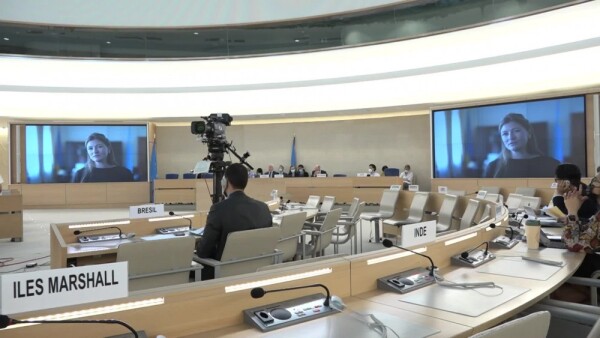
- Medium shot, delegates in Human Rights Room with speakers on screen
- SOUNDBITE (ENGLISH): Michelle Bachelet, UN High Commissioner for Human Rights: “While we have yet to be provided with access to territory occupied by Russian armed forces, we document violations of international human rights law and international humanitarian law (IHL) committed by all parties, and we remain fully committed to monitoring the human rights situation across the entire territory of Ukraine”.
- Medium shot, delegates in Human Rights Room with speakers on screen
- SOUNDBITE (ENGLISH): Michelle Bachelet, UN High Commissioner for Human Rights: “Most of the documented civilian casualties were caused by the use of explosive weapons in populated areas. Shelling from heavy artillery, such as multiple launch rocket systems, and missile and air strikes, including weapons that can carry cluster munitions, were used repeatedly”.
- Medium shot, delegates in Human Rights Room filmed from behind
- SOUNDBITE (ENGLISH): Michelle Bachelet, UN High Commissioner for Human Rights: “Concerns persist about unlawful killings, including summary executions. Growing evidence gives my Office reasonable grounds to believe that serious violations of International Humanitarian Law in this regard have been committed by Russian armed forces. As of 15 May 2022, over 1,200 civilian bodies have been recovered in Kyiv region alone”.
- Wide shot, delegates in Human Rights room
- SOUNDBITE (ENGLISH): Michelle Bachelet, UN High Commissioner for Human Rights: “My team has verified 28 cases of conflict-related sexual violence, including cases of rape, gang rape, torture, forced public stripping, and threats of sexual violence. The majority of cases were committed in areas controlled by Russian armed forces, but there were also cases committed in Government controlled areas.”
- Medium shot, delegates in Human Rights Room filmed from behind with camera man in front of the podium with speakers
- SOUNDBITE (ENGLISH): Michelle Bachelet, UN High Commissioner for Human Rights: “In Crimea, new legislation is curtailing the already limited space to express dissenting opinions. 41 cases of prosecution of Crimean residents for ‘discrediting’ or ‘calling for obstruction’ of Russian armed forces are documented.”
- Wide shot, Human Rights Room with delegates and ceiling
- SOUNDBITE (ENGLISH): Emine Dzhaparova, First Deputy Minister for Foreign Affairs, Ukraine (on zoom): “Russia’s occupation of Crimea in 2014 and today’s full-scale war against Ukraine are a part of one chain of events. They are a total disregard for international law and human rights. Justice can be restored only through accountability for the perpetrators of these crimes and full restoration of the territorial integrity of my country. We call upon the international community to work hard towards these goals”.
- Medium shot, delegates in Human Rights Room with Emine Dzhaparova on screens
- SOUNDBITE (RUSSIAN original + English translation) - Evgeny Ustinov, First Counsellor, Permanent Mission of the Russian Federation to the UN in Geneva: “We are compelled to note that the OHCHR (UN Office of the High Commissioner for Human Rights) has finally based itself to become an instrument serving the interest of one group of states. The tone and contents of the report demonstrate that it is part of the disinformation campaign against Russia, spreading lies, manipulating public opinion including to justify keeping weapons on a terrorist Kyiv regime, weapons used against peaceful citizens in Donetsk and Luhansk People’s Republic”.
- Medium shot, delegates in the Human Rights Room
- Two shot, delegates in the Human Rights Room
- Medium shot, delegates in the Human Rights Room
Similar Stories

1
1
1
Edited News | OCHA , UNICEF , WFP
Aid agencies warned on Friday of the fast-developing humanitarian emergency inside Taiz City in Yemen, which has been encircled by de facto Houthi forces fighting government troops along the country’s west coast.

2
17
1
2
Edited News , Press Conferences , Images | OCHA , WMO
Two UN agencies teamed up on Wednesday to issue an appeal for immediate assistance to help communities already being impacted by the strongest El Niño on record.

3
16
2
2
Edited News , B-roll , Conferences , Images | UNITED NATIONS , UNOG
Sixth Consultative Meeting on Enhancing Coordination of Peace Initiatives and Efforts for Sudan

1
1
1
Edited News | UNICEF , WHO , UNHCR
Yemen war continues to force families from homes amid hunger and disease
More than 250,000 people have now fled renewed fighting in Yemen, the UN said on Tuesday, citing particular concern for those sheltering in the southwestern city of Taiz and the wider governorate, where access is “essentially blocked”.

1
1
1
Edited News | UNICEF
A little over one year since a ceasefire agreement was announced between Hamas fighters and Israel, more than 340 children have been reported killed and hundreds more injured, the UN Children’s Fund, UNICEF, said on Friday.

1
1
1
Edited News | UNICEF , IFRC
Six weeks after Nepal’s deadly flooding disaster, communities are still struggling to rebuild their lives, but they will need sustained help as global warming increases the risk of another Himalayan catastrophe, the UN Children’s Fund (UNICEF) said on Friday.

1
1
1
Edited News | WHO
In suspected Russia plague death, testing and monitoring underway – WHO
The death of a lab worker in Russia’s Siberia region has sparked concerns about plague being the cause, the UN World Health Organization (WHO) said on Tuesday, adding that it was following the situation closely.

1
1
Edited News | OHCHR , UNOG
UN Human Rights Chief Volker Türk on Friday provided and oral update to the 63rd session of the Human rights Council on Ukraine.

1
1
1
Edited News | OHCHR , UNOG
UN Human Rights Chief Volker Türk on Friday provided and oral update to the 63rd session of the Human rights Council on the human rights situation in Haiti.

1
1
1
Edited News | WHO
Repeated delays in bringing lifesaving medicines, prosthetics and more from Israel into Gaza risk having devastating consequences on Palestinians who urgently need them in the wartorn enclave, the UN World Health Organization (WHO) said on Friday. “A truck full of non-priority supplies or the right supplies arriving too late, doesn't save lives. That's the question that actually matters," said Dr Reinhilde Van De Weerdt, WHO Representative in the OPT.

1
1
1
Edited News | WHO
DRC: Early access to care and oxygen decisive for Ebola patients’ survival – WHO
In the Democratic Republic of the Congo (DRC), health workers fighting the country’s largest-ever Ebola outbreak are struggling to overcome critical challenges to patient care, the UN World Health Organization (WHO) warned on Tuesday.

1
1
1
Edited News | OCHA , UN
Civilians in Iran are continuing to feel the consequences of months of conflict and military escalation, the UN’s top official in the country has said, as loss of life, damage to civilian infrastructure and mounting economic pressures leave many facing continued uncertainty.