

The United Nations Office at Geneva
Multimedia Newsroom
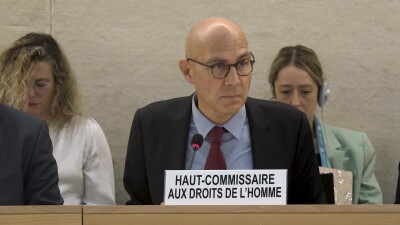
“Yet again, I must report on the deeply distressing situation in Haiti. Only last week, in the latest symptomatic horror, gang members entered a neighbourhood of Pont Sondé in the dead of night, setting fire to houses and gunning down residents as they fled. At least 70 people were killed, including three small babies,” Türk said, as he presented his Office’s latest report.
The report details the magnitude of the chaotic violence inflicted on the population between the end of February and the beginning of July this year. The High Commissioner noted that his Designated Expert on Haiti, William O'Neill, visited the country last month, with his observations confirming the continued gravity of the situation.
“I am convinced that the security crisis, the rule of law crisis, and the governance crisis that Haitians are enduring can be resolved,” Türk said.
“Crucial to that effort must be full implementation of the Security Council's arms embargo to prevent the supply of firearms and ammunition to non-State actors in Haiti, as well as its targeted asset freeze and travel ban. The embargo is mandatory, and it was adopted unanimously – most recently in October 2023. It is due to be renewed on 18 October. I strongly encourage passage of this important set of measures, and I urge all States – including all Security Council Member States – to enforce every aspect in full,” the High Commissioner stated.
Weapons and ammunition are not manufactured in Haiti but flow in from businesses elsewhere. States must do more to enforce in full the Security Council's embargo on weapons exporters operating in or from their territory. This is leading to thousands of killings, massive displacement, the complete destruction of the economy, and horrific suffering.
The UN Human rights Office has documented targeted killings and random shootings, including of children, by members of increasingly powerful criminal gangs; mass kidnappings; the forced recruitment, exploitation and trafficking of children; as well as the burning and looting of residences and businesses.
“Gender-based violence, including sexual violence, has reached new peaks of brutality and scale, with my Office documenting collective rapes among other horrors. The number of internally displaced people in the country has risen by 95 per cent since March, to 703,000 – almost 6 per cent of the population,” Türk said.
Attacks against hospitals; banks; police stations; schools; the main seaport and airport in the capital; and gangs' control of roads have further disrupted the provision of essential services, with lethal humanitarian impact. Over 4.9 million people are experiencing acute food insecurity; in other words, well over one-third of the population are suffering severe undernourishment, reflected in wasting and starvation. Three million Haitian children are in need of humanitarian aid.
“I welcome last week's renewal by the Security Council of the Multinational Security Support (MSS) mission. It is also absolutely crucial to ensure that the MSS mission, led by Kenya, is given adequate resources and support. All security operations – including those conducted jointly by the MSS mission and the Haitian police – need to comply fully with international law, including international human rights law, and they need to be accountable,” Türk said.
The UN Human Rights Office is supporting the development and implementation of the compliance mechanism requested by the Security Council. Together with the MSS mission, the Office is organising briefings for personnel with command responsibility regarding international standards on the use of force; preventing sexual exploitation and abuse; and a principled approach to issues involving children associated with gangs. The Office is also continuing to support the Haitian authorities, and to monitor and verify alleged human rights violations, including any allegations of sexual exploitation and abuse.
Switching to French, Türk also highlighted some of the key challenges Haiti faces.
« De manière plus générale, il est également essentiel de renforcer la gouvernance et les institutions de l'État, en particulier la justice, la police et le secteur pénitentiaire. En outre, il faut commencer à s'attaquer aux inégalités et à la pauvreté, omniprésentes dans le pays, » he said.
« Je salue l'inclusion, par le nouveau gouvernement de transition, d'engagements clés en matière de droits humains dans sa feuille de route. Ses plans d'action concrète pour lutter contre la corruption et d'autres violations des droits humains comprennent des unités judiciaires spécialisées pour aider à lutter contre les crimes de masse, tels que les violences sexuelles, ainsi que les crimes financiers. La persistance des pratiques de corruption, en particulier au sein des institutions publiques, est profondément déstabilisante et il est urgent de prendre des mesures à cet égard, » Türk said (also in French).
“Haiti is a small country of immense importance to our world. In terms of human rights, we can never forget its revolution against slavery and colonial oppression, surely one of the most inspiring chapters in human history,” Türk said.
The extraordinary creativity of Haitian culture, and the ingenuity and determination of so many Haitian individuals, have driven outsized contributions to the economies and societies of many States.
“It pains me to see the deportations, mistreatment, and hateful and racist smears that target Haitians in some countries of the region. Haitians have the same rights to live free from violence, fear and misery as every person of every other nationality,” the High Commissioner said.
“In a country of less than 28,000 square kilometres – less than 65% of the size of Switzerland – addressing the current crisis is not an outsized challenge, in either strategy or cost. On the contrary: each facet of Haiti's current crisis can be addressed and can be resolved,” Türk stated.
ENDS
For more information and media requests, please contact:
Ravina Shamdasani: +41 22 917 9169 / ravina.shamdasani@un.org
Thameen Al-Kheetan: +41 22 917 4232 / thameen.alkheetan@un.org
Tag and share - Twitter: @UNHumanRights and Facebook: unitednationshumanrights
STORY: UN Human Rights High Commissioner Volker Türk on Haiti
TRT: 04:45
SOURCE: OHCHR
RESTRICTIONS: NONE
LANGUAGE: English /French/NATS
ASPECT RATIO: 16:9
DATELINE: 8 October 2024 – GENEVA, SWITZERLAND
SHOTLIST
- Exterior shots : Palais des Nations
- Wide shot : Room 20 Palais des Nations
- SOUNDBITE (English) — Volker Türk, UN High Commissioner for Human Rights: “Yet again, I must report on the deeply distressing situation in Haiti. Only last week, in the latest symptomatic horror, gang members entered a neighbourhood of Pont Sondé in the dead of night, setting fire to houses and gunning down residents as they fled. At least 70 people were killed, including three small babies.”
- Cut aways: Room 20 Palais des Nations
- SOUNDBITE (English) — Volker Türk, UN High Commissioner for Human Rights: “I am convinced that the security crisis, the rule of law crisis, and the governance crisis that Haitians are enduring can be resolved.”
- Cut aways: Room 20 Palais des Nations
- SOUNDBITE (English) — Volker Türk, UN High Commissioner for Human Rights: “Crucial to that effort must be full implementation of the Security Council's arms embargo to prevent the supply of firearms and ammunition to non-State actors in Haiti, as well as its targeted asset freeze and travel ban. The embargo is mandatory, and it was adopted unanimously – most recently in October 2023. It is due to be renewed on 18 October. I strongly encourage passage of this important set of measures, and I urge all States – including all Security Council Member States – to enforce every aspect in full.”
- Cut aways: Room 20 Palais des Nations
- SOUNDBITE (English) — Volker Türk, UN High Commissioner for Human Rights: “Gender-based violence, including sexual violence, has reached new peaks of brutality and scale, with my Office documenting collective rapes among other horrors. The number of internally displaced people in the country has risen by 95 per cent since March, to 703,000 – almost 6 per cent of the population.”
- Cut aways: Room 20 Palais des Nations
- SOUNDBITE (English) — Volker Türk, UN High Commissioner for Human Rights: “I welcome last week's renewal by the Security Council of the Multinational Security Support (MSS) mission. It is also absolutely crucial to ensure that the MSS mission, led by Kenya, is given adequate resources and support. All security operations – including those conducted jointly by the MSS mission and the Haitian police – need to comply fully with international law, including international human rights law, and they need to be accountable.”
- Cut aways: Room 20 Palais des Nations
- SOUNDBITE (French) — Volker Türk, UN High Commissioner for Human Rights : “De manière plus générale, il est également essentiel de renforcer la gouvernance et les institutions de l'État, en particulier la justice, la police et le secteur pénitentiaire. En outre, il faut commencer à s'attaquer aux inégalités et à la pauvreté, omniprésentes dans le pays.”
- Cut aways: Room 20 Palais des Nations
- SOUNDBITE (French) — Volker Türk, UN High Commissioner for Human Rights : “Je salue l'inclusion, par le nouveau gouvernement de transition, d'engagements clés en matière de droits humains dans sa feuille de route. Ses plans d'action concrète pour lutter contre la corruption et d'autres violations des droits humains comprennent des unités judiciaires spécialisées pour aider à lutter contre les crimes de masse, tels que les violences sexuelles, ainsi que les crimes financiers. La persistance des pratiques de corruption, en particulier au sein des institutions publiques, est profondément déstabilisante et il est urgent de prendre des mesures à cet égard.”
- Cut aways: Room 20 Palais des Nations
- SOUNDBITE (English) — Volker Türk, UN High Commissioner for Human Rights: “Haiti is a small country of immense importance to our world. In terms of human rights, we can never forget its revolution against slavery and colonial oppression, surely one of the most inspiring chapters in human history.”
- Cut aways: Room 20 Palais des Nations
- SOUNDBITE (English) — Volker Türk, UN High Commissioner for Human Rights: “It pains me to see the deportations, mistreatment, and hateful and racist smears that target Haitians in some countries of the region. Haitians have the same rights to live free from violence, fear and misery as every person of every other nationality.”
- Cut aways: Room 20 Palais des Nations
- SOUNDBITE (English) — Volker Türk, UN High Commissioner for Human Rights: In a country of less than 28,000 square kilometres – less than 65% of the size of Switzerland – addressing the current crisis is not an outsized challenge, in either strategy or cost. On the contrary: each facet of Haiti's current crisis can be addressed and can be resolved.”
Similar Stories

1
1
1
Edited News | UNICEF
A little over one year since a ceasefire agreement was announced between Hamas fighters and Israel, more than 340 children have been reported killed and hundreds more injured, the UN Children’s Fund, UNICEF, said on Friday.

1
1
1
Edited News | UNICEF , IFRC
Six weeks after Nepal’s deadly flooding disaster, communities are still struggling to rebuild their lives, but they will need sustained help as global warming increases the risk of another Himalayan catastrophe, the UN Children’s Fund (UNICEF) said on Friday.

1
1
1
Edited News | WHO
In suspected Russia plague death, testing and monitoring underway – WHO
The death of a lab worker in Russia’s Siberia region has sparked concerns about plague being the cause, the UN World Health Organization (WHO) said on Tuesday, adding that it was following the situation closely.

1
1
Edited News | OHCHR , UNOG
UN Human Rights Chief Volker Türk on Friday provided and oral update to the 63rd session of the Human rights Council on Ukraine.

1
1
1
Edited News | OHCHR , UNOG
UN Human Rights Chief Volker Türk on Friday provided and oral update to the 63rd session of the Human rights Council on the human rights situation in Haiti.

1
1
1
Edited News | WHO
Repeated delays in bringing lifesaving medicines, prosthetics and more from Israel into Gaza risk having devastating consequences on Palestinians who urgently need them in the wartorn enclave, the UN World Health Organization (WHO) said on Friday. “A truck full of non-priority supplies or the right supplies arriving too late, doesn't save lives. That's the question that actually matters," said Dr Reinhilde Van De Weerdt, WHO Representative in the OPT.

1
1
1
Edited News | WHO
DRC: Early access to care and oxygen decisive for Ebola patients’ survival – WHO
In the Democratic Republic of the Congo (DRC), health workers fighting the country’s largest-ever Ebola outbreak are struggling to overcome critical challenges to patient care, the UN World Health Organization (WHO) warned on Tuesday.

1
1
1
Edited News | OCHA , UN
Civilians in Iran are continuing to feel the consequences of months of conflict and military escalation, the UN’s top official in the country has said, as loss of life, damage to civilian infrastructure and mounting economic pressures leave many facing continued uncertainty.
1
1
1
Edited News | WHO , UNICEF
Aid agencies in Yemen highlighted the growing hunger emergency sparked by renewed fighting between Houthi opposition forces and Government troops, after mobile health clinics reported that hundreds of children displaced by the violence are suffering from the most deadly form of malnutrition.
1
1
1
Edited News | UNHCR
Displacement on the rise in Yemen as fighting continues - UNHCR
As hostilities worsen in Yemen, more people have been fleeing their homes, further intensifying the humanitarian crisis within the region, the UN Refugee Agency (UNHCR) warned on Tuesday.
1
1
1
Edited News | IOM , OHCHR , UNFPA , UNOG , UNHCR , WHO
Yemen’s humanitarian crisis growing by the hour amid spike in displacement
Yemenis displaced by renewed fighting have described fleeing for their lives amid shelling and gunfire, aid agencies reported on Friday, while highlighting the dramatic increase in humanitarian needs in the country and in Djibouti, where thousands have sought shelter.
1
1
1
Edited News | OHCHR , UNOG
The UN Human Rights Office issued on Friday a report documenting a shocking pattern of sexual violence amid Russia’s full-scale armed attack on Ukraine.