

The United Nations Office at Geneva
Multimedia Newsroom
Middle East crisis: UN human rights office condemns spiralling violence
Amid reports of intensifying Israeli bombing in Lebanon and Gaza overnight and continuing Hezbollah rocket fire into Israel, the UN human rights office, OHCHR, called on Friday for an end to the “killing, destruction [and] bellicose posturing” by those in power.
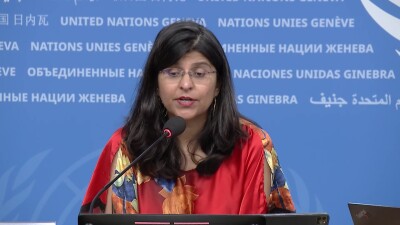
“The situation for civilians on the ground in Lebanon, Gaza, Israel and Syria is getting worse by the day,” said Ravina Shamdasani, OHCHR spokesperson.
Speaking in Geneva, she described how the densely populated capital of Beirut “is increasingly being hit by Israeli airstrikes”. Hundreds have been killed and more than one million people have now fled their homes throughout the country, she told journalists, while Hezbollah and other armed groups “continue to fire rockets into Israel, resulting in the first civilian fatalities in the north since the most recent escalation of hostilities between Israel and Lebanon last month”.
Healthcare centres and emergency workers have not been spared from the intensifying Israeli strikes, with 96 primary health care centres and clinics closed by 5 October, according to the Lebanese authorities. “We've had several reports also of airstrikes, targeting other medical centres and of paramedics as well as firefighters, being killed,” Ms. Shamdasani said.
Since 30 September, 49 healthworkers have been killed in nine confirmed attacks, according to the UN World Health Organization (WHO).
Responding to reports from UN peacekeepers UNIFIL that the Israel Defense Forces (IDF) fired on the Mission on Thursday, injuring two troops, Ms. Shamdasani insisted that States are obliged under international law “to ensure that they are not hit, that they are protected”.
UN peacekeepers are based in south Lebanon to support a return to stability under a 2006 Security Council mandate. Any deliberate attack on peacekeepers is a grave violation of international humanitarian law and of Security Council resolution 1701, UNIFIL said in a statement following the incident, amid widespread IDF destruction of towns and villages in south Lebanon, and ongoing missile attacks on northern Israel.
“On 9 and 10 October, Hezbollah said it had launched at least 360 missiles from southern Lebanon into Israel,” Ms. Shamdasani said. “Two people were killed in a rocket attack on the border town of Kiryat Shmona on 9 October, a day after five others were injured in a rocket attack on Haifa.”
Meanwhile in Gaza, UN humanitarians have continued to warn that the situation for civilians is getting worse, as the Israeli military renews its push into the north where some 400,000 people face evacuation orders.
“Over the last week, the Israeli military has intensified operations in north Gaza, further severing the area from the rest of the Gaza Strip and risking afresh the lives of civilians in the areas,” Ms. Shamdasani said. “Intense strikes, shelling, quadcopter shootings and ground incursions have occurred over the past days, hitting residential buildings and groups of people, causing numerous casualties and once again, mass displacement of Palestinians in the area.”
As UN aid agencies and partners prepare to roll out the second phase of the mass polio vaccination campaign next week, the WHO’s Representative for the Occupied Palestinian Territories, Dr Rik Peeperkorn, underscored the impact of a chronic lack of humanitarian access to the enclave and in particular, the north.
“Many of the hospitals in the north are running out of fuel. Most of the UN and humanitarian missions are not happening to the north. They’re running out of a a few specific medical supplies and we are one year in this crisis,” Dr Peeperkorn said, as he confirmed that three relief missions north of Wadi Gaza had not made it this week. “So, we request again…that these humanitarian missions to the north, wherever, to the south, they need to happen.”
Story: Gaza, Lebanon update – OHCHR, WHO
Speakers:
- Ravina Shamdasani, OHCHR
- Dr Rik Peeperkorn, WHO
TRT: 02’57”
SOURCE: UNTV CH
LANGUAGE: ENGLISH / NATS
ASPECT RATIO: 16:9
DATELINE: 11 October 2024 - GENEVA, SWITZERLAND
RESTRICTIONS: None
SHOTLIST
- Exterior medium shot: UN flag alley.
- Wide shot of the UN Geneva Press room.
- SOUNDBITE (English) Ravina Shamdasani, OHCHR: “The situation for civilians on the ground in Lebanon, Gaza, Israel and Syria is getting worse by the day. The densely populated capital of Beirut is increasingly being hit by Israeli airstrikes. Hundreds are dead and over a million people have fled their homes throughout the country. Hezbollah and other armed groups continue to fire rockets into Israel, resulting in the first civilian fatalities in the north since the most recent escalation of hostilities between Israel and Lebanon last month.”
- Medium-wide shot of Press room, podium and participants.
- SOUNDBITE (English) Ravina Shamdasani, OHCHR: “On 5 October, the Ministry of Public Health reported that 96 primary health care centres and clinics have been closed. We've had several reports also of airstrikes, targeting other medical centres, and of paramedics as well as firefighters, being killed.”
- Medium-wide, Press room, journalists, TV camera.
- SOUNDBITE (English) Ravina Shamdasani, OHCHR: “On the UNIFIL troops who are there, it is clear that States have an obligation to ensure that they are not hit, that they are protected and that the primary obligation with that, of course, lies on the State of Israel, to ensure this. The recent statements that were made were unfortunate, implying that, their safety cannot be guaranteed. But of course, it is the responsibility of the State to ensure that they are protected and they are able to carry out their work.”
- Medium, journalist.
- SOUNDBITE (English) Ravina Shamdasani, OHCHR: “Over the last week, the Israeli military has intensified operations in north Gaza, further severing the area from the rest of the Gaza Strip and risking afresh the lives of civilians in the areas. Intense strikes, shelling, quadcopter shootings and ground incursions have occurred over the past days, hitting residential buildings and groups of people, causing numerous casualties and once again, mass displacement of Palestinians in the area.”
- Wide, Press room.
- SOUNDBITE (English) Ravina Shamdasani, OHCHR: “On 9 and 10 October, Hezbollah said it had launched at least 360 missiles from southern Lebanon into Israel. Two people were killed in a rocket attack on the border town of Kiryat Shmona on 9 October, a day after five others were injured in a rocket attack on Haifa.”
- Medium, Press room.
- Medium, podium moderator with mobile devices.
- SOUNDBITE (English) Dr Rik Peeperkorn, WHO Representative for the Occupied Palestinian Territory (from Jerusalem): “Many of the hospitals in the north are running out of fuel. Most of the UN and humanitarian missions are not happening to the north. They’re running out a few specific medical supplies and we are one year in this crisis. And this a kind of - I don't get it - that we can still not have these humanitarian corridors to make sure that these missions can continue. So, we request again, start a new request, that these humanitarian missions to the north, wherever, to the south, they need to happen.”
- Medium-wide, journalists.
- Medium, TV journalist adjusting camera.
Similar Stories

1
1
1
Edited News | UNICEF
A little over one year since a ceasefire agreement was announced between Hamas fighters and Israel, more than 340 children have been reported killed and hundreds more injured, the UN Children’s Fund, UNICEF, said on Friday.

1
1
1
Edited News | UNICEF , IFRC
Six weeks after Nepal’s deadly flooding disaster, communities are still struggling to rebuild their lives, but they will need sustained help as global warming increases the risk of another Himalayan catastrophe, the UN Children’s Fund (UNICEF) said on Friday.

1
1
1
Edited News | WHO
In suspected Russia plague death, testing and monitoring underway – WHO
The death of a lab worker in Russia’s Siberia region has sparked concerns about plague being the cause, the UN World Health Organization (WHO) said on Tuesday, adding that it was following the situation closely.

1
1
Edited News | OHCHR , UNOG
UN Human Rights Chief Volker Türk on Friday provided and oral update to the 63rd session of the Human rights Council on Ukraine.

1
1
1
Edited News | OHCHR , UNOG
UN Human Rights Chief Volker Türk on Friday provided and oral update to the 63rd session of the Human rights Council on the human rights situation in Haiti.

1
1
1
Edited News | WHO
Repeated delays in bringing lifesaving medicines, prosthetics and more from Israel into Gaza risk having devastating consequences on Palestinians who urgently need them in the wartorn enclave, the UN World Health Organization (WHO) said on Friday. “A truck full of non-priority supplies or the right supplies arriving too late, doesn't save lives. That's the question that actually matters," said Dr Reinhilde Van De Weerdt, WHO Representative in the OPT.

1
1
1
Edited News | WHO
DRC: Early access to care and oxygen decisive for Ebola patients’ survival – WHO
In the Democratic Republic of the Congo (DRC), health workers fighting the country’s largest-ever Ebola outbreak are struggling to overcome critical challenges to patient care, the UN World Health Organization (WHO) warned on Tuesday.

1
1
1
Edited News | OCHA , UN
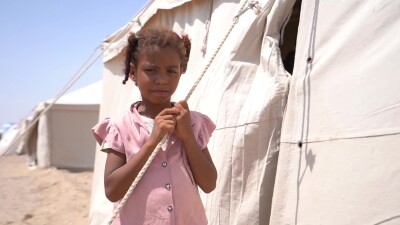
Civilians in Iran are continuing to feel the consequences of months of conflict and military escalation, the UN’s top official in the country has said, as loss of life, damage to civilian infrastructure and mounting economic pressures leave many facing continued uncertainty.
1
1
1
Edited News | WHO , UNICEF
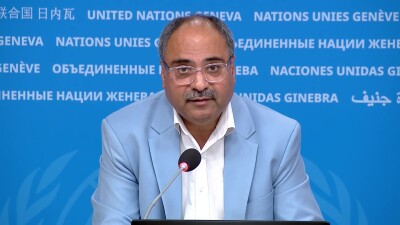
Aid agencies in Yemen highlighted the growing hunger emergency sparked by renewed fighting between Houthi opposition forces and Government troops, after mobile health clinics reported that hundreds of children displaced by the violence are suffering from the most deadly form of malnutrition.
1
1
1
Edited News | UNHCR
Displacement on the rise in Yemen as fighting continues - UNHCR
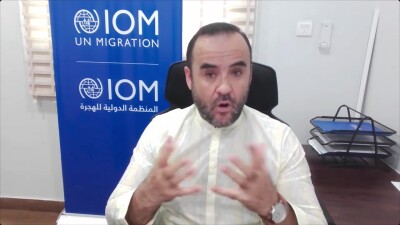
As hostilities worsen in Yemen, more people have been fleeing their homes, further intensifying the humanitarian crisis within the region, the UN Refugee Agency (UNHCR) warned on Tuesday.
1
1
1
Edited News | IOM , OHCHR , UNFPA , UNOG , UNHCR , WHO
Yemen’s humanitarian crisis growing by the hour amid spike in displacement
Yemenis displaced by renewed fighting have described fleeing for their lives amid shelling and gunfire, aid agencies reported on Friday, while highlighting the dramatic increase in humanitarian needs in the country and in Djibouti, where thousands have sought shelter.
1
1
1
Edited News | OHCHR , UNOG
The UN Human Rights Office issued on Friday a report documenting a shocking pattern of sexual violence amid Russia’s full-scale armed attack on Ukraine.