

The United Nations Office at Geneva
Multimedia Newsroom
Press Conferences , Edited News | HRC
HRC - Press Conference: Commission of Inquiry on the Occupied Palestinian Territory 13 March 2025
Rights probe alleges Israeli forces’ sexual violence against Palestinians used as a method of war
Senior human rights investigators reporting to the Human Rights Council alleged on Thursday that sexual and gender-based violence by Israeli security forces against Palestinian men, women and children have been increasingly used “as a method of war” following the 7 October 2023 attacks that sparked the Gaza war.
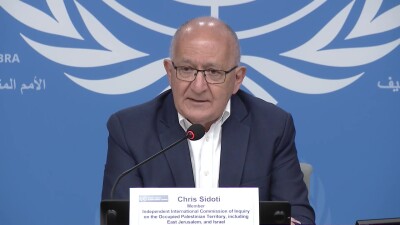
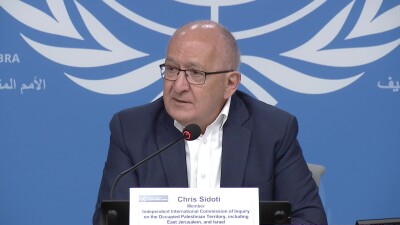
“Israel has increasingly employed sexual, reproductive and other forms of gender-based violence against Palestinians as part of a broader effort to undermine their right to self-determination,” maintained Chris Sidoti from the Commission of Inquiry on the Occupied Palestinian Territory (OPT).
Speaking in Geneva, the human rights lawyer said that “the frequency, prevalence and severity of sexual and gender-based crimes perpetrated across the OPT leads the Commission to conclude that sexual and gender-based violence is increasingly used as a method of war by Israel to destabilize, dominate, oppress and destroy the Palestinian people”.
Established by the Council in May 2021, the Commission has a mandate to investigate and report on alleged violations of international law in the OPT, including East Jerusalem - and in Israel. Previous reports have covered in detail the terror attacks on Israeli villages and towns on 7 and 8 October by Hamas-led Palestinian armed fighters that killed around 1,250 people and left more than 250 taken as hostages back to Gaza.
Publication of the Commission’s report followed two days of public hearings held in Geneva from 11 to 12 March, featuring victims and witnesses of sexual and reproductive violence and medical personnel who assisted them, as well as civil society representatives, academics, lawyers and medical experts.
Mr. Sidoti said that the Commission had made several requests to the Israeli authorities for information on specific, serious cases of sexual and gender-based violence against Palestinian prisoners taken from Gaza. But no information has been provided about prosecutions of members of the Israeli security forces or Israeli settlers for sexual and violence committed since October 2023, he told journalists.
In a statement accompanying the release of the Commission’s report, it asserted that “forced public stripping and nudity, sexual harassment including threats of rape, as well as sexual assault” were “standard operating procedure” of the Israeli Security Forces toward Palestinians.
“Other forms of sexual and gender-based violence, including rape and violence to the genitals, were committed either under explicit orders or with implicit encouragement by Israel’s top civilian and military leadership,” the report maintained.”
“We heard evidence - you would have heard it if you were looking at our hearings during the last two days - where men and boys were forced to strip wholly or almost wholly, that is down to underpants and then were kept in that condition, often having to sit on stones on the ground in the cold in winter for up to three days.”
The Commission also asserted that Israeli forces had systematically destroyed sexual and reproductive healthcare facilities across Gaza, including Gaza's largest fertility clinic, Al Basma centre, in December 2023.
Tank shelling destroyed about 4,000 embryos at the clinic that reportedly assisted 2,000-3,000 patients a month.
“There is a question about whether those who were firing the tank shell - because our conclusion is that it was destroyed by a tank shell - knew at that time that it was a fertility clinic,” Mr. Sidoti said. “But certainly their commanders knew and the commanders would have known that there were tanks operating within that vicinity and firing on buildings and fired on a healthcare facility that was clearly marked.”
The Commission’s report finds that the destruction amounts “to two categories of genocidal acts in the Rome Statute and the Genocide Convention, including deliberately inflicting conditions of life calculated to bring about the physical destruction of Palestinians and imposing measures intended to prevent births”.
Head of the Commission, Navi Pillay, said in a statement that the targeting of reproductive healthcare facilities including “direct attacks” on maternity wards and the IVF clinic, “combined with the use of starvation as a method of war, has impacted all aspects of reproduction…These violations have not only caused severe immediate physical and mental harm and suffering to women and girls, but irreversible long-term effects on the mental health and reproductive and fertility prospects of Palestinians as a group.”
Israel ‘categorically rejects’ allegations
In a press release published on Wednesday, the Israeli mission in Geneva said their Government “categorically rejects the unfounded allegations” made in the commission’s report.
Israel accused the COI of instrumentalising sexual violence “to advance its predetermined and biased political agenda, setting back the important work of international institutions to combat the perpetration of these abhorrent acts as a weapon of war.”
STORY: Commission of Inquiry on the Occupied Palestinian Territory
TRT: 03’37”
SOURCE: UNTV CH
RESTRICTIONS: NONE
LANGUAGE: ENGLISH / NATS
ASPECT RATIO: 16:9
DATELINE: 13 March 2025 GENEVA, SWITZERLAND
Speaker: Chris Sidoti, Member of the Commission
SHOTLIST
- Exterior medium shot: Palais des Nations, Flag Alley.
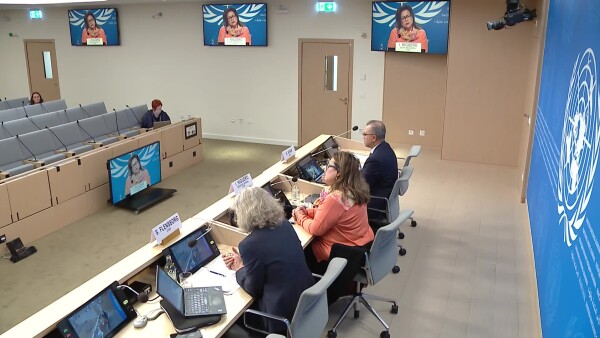
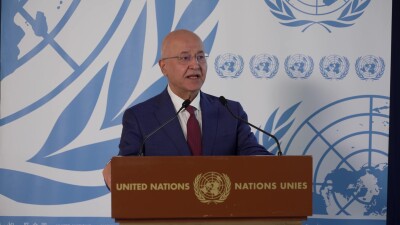
- Wide shot of the Press room, podium speakers, journalists at UN Geneva.
- SOUNDBITE (English) – Chris Sidoti, Commissioner: “Our report finds that Israel has increasingly employed sexual, reproductive and other forms of gender-based violence against Palestinians as part of a broader effort to undermine their right to self-determination. It also concludes that Israel has carried out genocidal acts through the systematic destruction of sexual and reproductive healthcare facilities.”
- Medium shot of podium speakers, TV screen showing Commissioner.
- SOUNDBITE (English) - Chris Sidoti, Commissioner: “The frequency, prevalence and severity of sexual and gender-based crimes perpetrated across the Occupied Palestinian Territory leads the Commission to conclude that sexual and gender-based violence is increasingly used as a method of war by Israel to destabilize, dominate, oppress and destroy the Palestinian people.”
- Wide, photographer, journalists.
- SOUNDBITE (English) - Chris Sidoti, Commissioner: “The Commission documented a pattern of sexual violence, including cases of rape and other forms of sexual violence, torture and other inhumane acts that amount to war crimes and crimes against humanity.”
- Medium, Press room, TV screens showing Commissioner.
- SOUNDBITE (English) - Chris Sidoti, Commissioner: “We have not made any finding of genocide; we have identified a number of acts that constitute the categories of genocidal act under the law, we have not yet examined the question of genocidal purpose.”
- Wide, Press room, photographer and journalists.
- SOUNDBITE (English) – Chris Sidoti, Commissioner: “Several requests for information and access were sent to the Government of Israel, including requests for information on specific cases of sexual and gender-based violence carried out by members of the Israeli security forces. The Commission has not received any information about prosecutions of members of the Israeli security forces or Israeli settlers for sexual and violence committed since October 2023.”
- Medium-wide, journalists, photographer.
- SOUNDBITE (English) – Chris Sidoti, Commissioner: “We heard evidence - you would have heard it if you were looking at our hearings during the last two days - where men and boys were forced to strip wholly or almost wholly, that is down to underpants and then were kept in that condition, often having to sit on stones on the ground in the cold in winter for up to three days.”
- Medium, photographer, TV screen showing Commissioner.
- SOUNDBITE (English) – Chris Sidoti, Commissioner: “There is a question about whether those who were firing the tank shell - because our conclusion is that it was destroyed by a tank shell - knew at that time that it was a fertility clinic, but certainly their commanders knew and the commanders would have known that there were tanks operating within that vicinity and firing on buildings and fired on a healthcare facility that was clearly marked.”
- Medium-wide, photographer, journalists, TV journalists.
- SOUNDBITE (English) – Chris Sidoti, Commissioner: “Victims of human rights violations are entitled to have their experience recorded and known, acknowledged and at the very least, we're doing that. But we don't have the capacity, we're not a court, we want the courts to act, we want states to act, we want the United Nations to act.”
- Medium-wide, TV journalists, control booths.
- Medium-wide, journalists.
Similar Stories
1
1
1
Press Conferences | CITES
Wildlife trade and conservation policy discussions at the 81st meeting of the CITES Standing Committee (SC81)

1
1
1
Edited News | UNICEF , WHO , UNHCR
Yemen war continues to force families from homes amid hunger and disease
More than 250,000 people have now fled renewed fighting in Yemen, the UN said on Tuesday, citing particular concern for those sheltering in the southwestern city of Taiz and the wider governorate, where access is “essentially blocked”.
1
1
1
Press Conferences | UNHCR , UNCTAD , WMO , OCHA , UNICEF , WHO
UNHCR Hungary’s 1956 Refugee Crisis: 70 Years On, UNCTAD World Investment Forum 2026, Doha, WMO Greenhouse Gas Bulletin and Climate Update for COP31, OCHA Afghanistan: Malnutrition, Girls’ Education and Recovery, UNICEF Yemen: Child Malnutrition and Unsafe Water in Taiz, WHO Inequalities in Noncommunicable Diseases and Risk Factors
1
1
1
Press Conferences | UNHCR
End of UNHCR's 77th Annual Executive Committee (ExCom) meeting week

1
1
1
Edited News | UNICEF
A little over one year since a ceasefire agreement was announced between Hamas fighters and Israel, more than 340 children have been reported killed and hundreds more injured, the UN Children’s Fund, UNICEF, said on Friday.
1
1
1
Press Conferences | UNICEF , IOM , UNHCR
UN Special Assistant to the Personal Envoy Office (SUDAN): Peace Initiatives and Efforts in Sudan; UNICEF: Dire situation of children in Gaza; IOM: Damaged Homes and Energy Attacks Risk Displacing Ukrainians for this winter; UNHCR: update on EXCOM week
1
1
1
Press Conferences | IOM , UNDRR
UN stresses importance of household preparedness for disaster risk reduction.

1
1
1
Edited News | UNICEF , IFRC
Six weeks after Nepal’s deadly flooding disaster, communities are still struggling to rebuild their lives, but they will need sustained help as global warming increases the risk of another Himalayan catastrophe, the UN Children’s Fund (UNICEF) said on Friday.
1
1
1
Statements , Press Conferences | OHCHR
1
1
1
Press Conferences | UNHCR , UNICEF , IFRC , OHCHR , UN WOMEN , IOM , OCHA , WHO
UNHCR – ExCom Meeting, UNICEF – Nepal Recovery, IFRC – Flash Floods, WHO – Mental Health, IOM – South Sudan Floods, OCHA – DRC Humanitarian aid, UNHCR – Sahel Displacement, UNICEF – Yemen Update, IOM – Gaza Shelter, UN Women – Gaza Women, OHCHR – Arrests and detentions of Syrians by Israeli force
2
1
2
Press Conferences | UNCTAD
Presentation of the Trade and Developement Report 2026
Embargoed until 9 October 2026 at 11 a.m. (Geneva Time)
UNCTAD: UNCTAD’s flagship report finds that governments increasingly use industrial, trade, financial and technology policies to pursue economic and national security objectives. Market access and the ability to move into higher-value activities now depend more heavily on technology, finance and geopolitics.
1
1
1
Press Conferences | UPU
Release of the State of the Postal Sector Report 2026