

The United Nations Office at Geneva
Multimedia Newsroom
Press Conferences , Edited News | UNECE
UNECE Press Conference - Critical Minerals: myths and realities
Middle East war: After oil and gas crunch, concerns grow over vital raw minerals
The shipping crisis in the Strait of Hormuz caused by war in the Middle East has exposed a new threat: a looming shortage of strategic minerals that drive economies all over the world - and a race by countries to obtain them.
Until war erupted on 28 February with the Israeli-US bombing of Iran and counterstrikes across Gulf States, a wide range of key minerals and related products was available, according to the UN Economic Commission for Europe (UNECE).
But as the conflict goes on, the pressure has increased to obtain these same raw materials, to ensure the continuing production of everything from semiconductors to solar panels.
The result has been higher prices on commodities markets and a potential pivot to new production sites where there’s less geopolitical uncertainty.
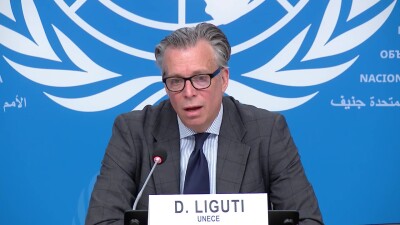
“The impact of the Gulf War, it is not only in the energy market, it's been impacting some sub-products coming from oil” such as sulphur, helium and naphtha - said Dario Liguti, Director of UNECE’s Sustainable Energy Division. All are byproducts of oil refining and used in a wide range of manufacturing applications, from fertilizers to insecticides, plastics and matches, along with cooling and semiconductor production. Naptha is another byproduct of oil refining and a key building block of the chemicals industry.
“The first reaction besides of course the increase in prices will be industries lowering their use and therefore lowering their production…whether it's solar panels, whether it's magnets, whether it's batteries, et cetera, going forward,” Mr. Liguti maintained.
Before the war, a full 30 per cent of the world's production of sulphur - which is used in metals processing - transited through the Strait of Hormuz. But that was when some 140 ships per day transited the crucial trade waterway. Today, shipping is at a virtual standstill, following attacks on vessels and an ongoing stand-off between Iran and the US over use of the strait.
If the conflict situation continues, shortages in key minerals “will become evident”, the UNECE official continued, forcing industry “to lower their production” of critical minerals used in renewable energy equipment and digital technology. “Therefore over time, that will have an increasing impact on prices first…and then secondly on the availability of that equipment.”
Today, industries that relied on supplies from the Strait of Hormuz “are using their existing stocks and they're using the reserves and they're ramping up production elsewhere”, Mr. Liguti said.
He highlighted a “drive from many Member States around the world to secure those minerals” which will result in countries increasingly building “strategic stocks…to avoid a similar disruption in future.
“So far, the situation is being felt in some regional markets, particularly in South Asia and Southeast Asia, where there is a lot of refining and processing going on of these initial commodities. But over time, the geographical scope will become larger.”
In addition to the massive human cost of the war, the UNECE official noted how the oil and natural gas crisis also threatens to undermine the global shift to green energy sources.
“You can see how a crisis which is fundamentally focused on the on the old traditional fossil fuels sector, how that that impacts as well the new energy, the new renewable energy, and the transition that we have been undertaking and we actually need to accelerate, as you know, as we are falling behind in the Paris 2030 targets”.
ends
STORY: Critical minerals crunch - UNECE
TRT: 2’59”
SOURCE: UNTV CH
RESTRICTIONS: NONE
LANGUAGE: ENGLISH, NATS
ASPECT RATIO: 16:9
DATELINE: 23 APRIL 2026, GENEVA, SWITZERLAND
SHOTLIST
Speaker:
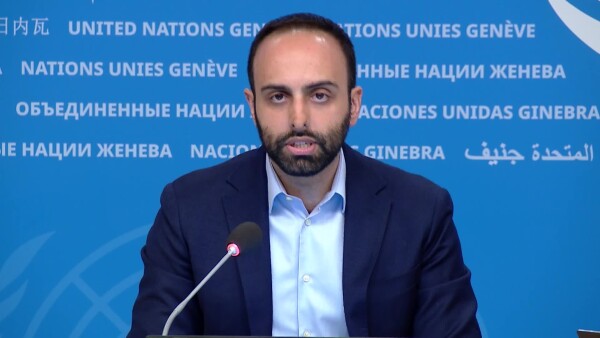
- Dario Liguti, Director, Sustainable Energy Division, UNECE
- Exterior wide shot, United Nations flag flying.
- Wide shot of panel at press briefing.
- SOUNDBITE: (ENGLISH): Dario Liguti, Director, Sustainable Energy Division, UNECE: “The impact of the Gulf War, it is not only is in the energy market, it's been impacting as well some sub-products coming from oil, and you mentioned sulphur correctly, but helium as well, and then naphtha, which are byproducts of the oil refining and are used in different processes.”
- Medium-wide, podium speakers, TV screen showing speaker.
- SOUNDBITE: (ENGLISH): Dario Liguti, Director, Sustainable Energy Division, UNECE: “If the situation – if the conflict situation - continues, the shortages will become evident and will force industries to lower their production of certain technologies, you know, and particularly critical minerals for renewable energy equipment, for example, digital technologies, for that purpose as well. And therefore over time, that will have an increasing impact on prices first of this equipment and then secondly on the availability of that equipment if the conflict continues.”
- Wide, podium speakers, journalists.
- SOUNDBITE: (ENGLISH): Dario Liguti, Director, Sustainable Energy Division, UNECE: “The first reaction besides of course the increase in prices will be industries lowering their use and therefore lowering their production of whether it's solar panels, whether it's magnets, whether it's batteries, et cetera, going forward.”
- Wide, Press room, participants.
- SOUNDBITE: (ENGLISH): Dario Liguti, Director, Sustainable Energy Division, UNECE: “What I can tell you is there is a drive from many Member States around the world to secure those minerals, and we will see increasingly Member States building strategic stocks of those minerals to avoid going into the future or facing into the future this sort of situation.”
- Wide shot of panel, photographer.
- SOUNDBITE: (ENGLISH): Dario Liguti, Director, Sustainable Energy Division, UNECE: “So far, the situation is being felt in some regional markets, particularly in South Asia and Southeast Asia, where there is a lot of refining and processing going on of these initial commodities. But over time, the geographical scope will become larger.”
- Wide, Press room, screens showing speaker.
- SOUNDBITE: (ENGLISH): Dario Liguti, Director, Sustainable Energy Division, UNECE: “So you can see how a crisis which is fundamentally focused on the old traditional fossil fuels sector, how that that impacts as well the new energy, the new renewable energy, and the transition that we have been undertaking and we actually need to accelerate, as you know, as we are falling behind in the Paris 2030 targets”.
- Medium, photographer
- Medium, journalist.
- Medium, journalist.
Similar Stories
1
1
1
Edited News | WHO
The risk of hantavirus spreading to the general population is “absolutely low”, the UN World Health Organization (WHO) stressed on Friday.
1
1
1
Press Conferences | UN WOMEN , WFP , WHO
UN Women - The situation of women and girls in Lebanon; WFP - Deteriorating humanitarian conditions in Somalia; WHO - Hantavirus interim update
1
1
1
Edited News | UNHCR , IFRC
Death and destruction have continued unabated in Lebanon while communities are still unable to return to their homes despite a ceasefire that began on 17 April, humanitarians said on Tuesday.
1
1
Edited News | WHO
Deadly hantavirus on board cruise ship may be transmitted among humans - WHO
Hantavirus victims on a ship in the Atlantic Ocean may have been infected prior to joining the cruise and human-to-human transmission on board cannot be ruled out – although it is rare - the World Health Organization (WHO) said on Tuesday.
1
1
1
Press Conferences | ILO , UNHCR , IFRC , WHO , OHCHR , UNECE
ILO - Report on Skills and Lifelong Learning; UNHCR, IFRC - Humanitarian Needs Rise in Lebanon; WHO Cruise Ship Hantavirus; OHCHR - Civilians Impacted Amid Clashes in Mali; UNECE - Call for Water Cooperation in Central Africa; IFRC - Call for Protection of Humanitarian Personnel on the Anniversary of the Founding of IFRC
1
7
1
1
Press Conferences | ITU , UNDRR
Doreen Bogdan-Martin, ITU Secretary-General and the Special Representative of the UN Secretary-General for Disaster Risk Reduction and head of the UN Office for Disaster Risk Reduction, Kamal Kishore, will brief the media on the launch a joint report titled "When Digital Systems Fail: The Hidden Risks of our Digital World."
1
1
1
Edited News | OHCHR
UN rights chief concerned by upheld convictions of Cambodian activists.
1
1
1
Edited News | UNHCR , OHCHR
Middle East crisis puts aid, food, fuel further out of reach for millions already struggling – UN agencies
As the Middle East crisis continues the humanitarian fallout is worsening, with aid route disruptions and food and fuel price hikes wrecking the lives and rights of the most vulnerable, UN agencies warned on Friday.
1
1
1
Press Conferences | UNHCR , OHCHR
Rolando Gómez, Chief of the Press and External Relations Section, United Nations Information Service (UNIS) at Geneva, chaired a hybrid press briefing, which was attended by spokespersons and representatives of the United Nations High Commissioner for Refugees and the Office of the High Commissioner for Human Rights.
1
1
2
Edited News | UNMAS
Demining experts from around the world have been sharing their collective shock at the widespread and growing threat from unexploded ordnance, the new head of the UN Mine Action Service (UNMAS) said on Wednesday.
1
1
1
Edited News | OHCHR , UNOG
The UN Human Rights Office in Syria conducted a 5-day visit to the northeast of the country where they received accounts of human rights violations and abuses.
1
1
1
Edited News | UNICEF
Sudan: ‘History repeating itself’ for Darfur’s children - UNICEF
Mass atrocities in Sudan’s Darfur 20 years ago reverberated as far as Hollywood, but today, a new generation of children faces attacks, hunger and displacement in an emergency largely ignored by the outside world, the UN Children’s Fund (UNICEF) warned on Tuesday.