

The United Nations Office at Geneva
Multimedia Newsroom
Press Conferences | OHCHR , UNICEF , WHO , UNOG , UNITED NATIONS , UNCTAD , ILO
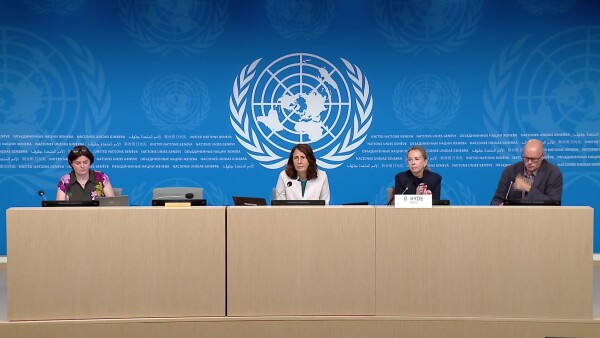
UNOG Bi-weekly press briefing 19 February 2021
Human Rights Council
Rolando Gomez, for the Human Rights Council (HRC), informed that the forty-sixth regular session of the Human Rights Council would open on 22 February. The month-long session would last until 23 March. On 22 February, the President of the Council would open the session, followed by the statements by the President of the General Assembly, the UN Secretary-General, and the UN High Commissioner for Human Rights, and the Swiss Federal Councillor for Foreign Relations. Some 53 dignitaries were scheduled to speak on the first day, including nine heads of state and government. There would be a total of 2.5 days of the high-level segment, with over 130 dignitaries scheduled to speak – the highest number ever. All dignitaries would be speaking by video messages. COVID-19 would be a dominant feature throughout the session, and no physical side events would be organized, due to the health restrictions.
More information on the 46th session is available here. All sessions would be webcast in six languages at webtv.un.org, and meeting summaries would be prepared in English and French.
Alessandra Vellucci, for the United Nations Information Service (UNIS), reminded that a virtual background briefing to preview the UN Secretary-General’s remarks would be held today at 3 p.m. Geneva time. Volker Turk, Assistant Secretary-General for Strategic Coordination, would provide more details on the remarks and would be available to answer questions.
Militia violence and displaced children in the Democratic Republic of the Congo
Edouard Beigbeder, Representative of the United Nations Children’s Fund (UNICEF) in the Democratic Republic of the Congo, said that in UNICEF’s new report, displaced children of the DRC were sharing their dramatic testimonies of fear, flight, and living in the limbo. The children knew what they wanted: normal life in peace, with rights and education. In 2010, there had been 1.7 million internally displaced persons; today, there were over 5.2 million IDPs, more than any country other than Syria. The number of children killed over the past year was higher than the official figures showed, and thousands of children had been recruited as militia fighters. North Kiwu, South Kiwu, and Tanganika were the most affected regions. Some 10 humanitarian workers had been killed and 42 had been kidnapped in 2020.
Mr. Begbeder stressed that the DRC remained among the poorest countries in the world. In eastern DRC, many families had been displaced due to the barbaric violence by armed groups. UNICEF was continuing its work with local partners to deliver aid to displaced families. Children needed protection; former child soldiers needed rehabilitation; they needed education in order to be able to build their future. UNICEF called on all parties to the conflict in eastern Congo to cease all attacks against schools, hospitals, recruitment of child soldiers and brutal behavior against civilians. The international community was called upon to support children of the DRC. There were worrying signs that the global solidarity with the DRC was waning, warned Mr. Beigbeder.
Responding to questions, Mr. Beigbeder said that getting full, real numbers of both killed children and recruited child soldiers remained a challenge. The rate of malnutrition in the country was over 40 percent, with 3-4 percent severely malnutritioned children. Eastern Congo was most affected by the violence, where dozens of various militias were creating pockets of malnutrition and preventing immunization.
Situation in Marib Governorate, Yemen
Elizabeth Throssell, for the Office of the High Commissioner for Human Rights (OHCHR), expressed concern for the fate of civilians in Marib Governorate in northern Yemen, including at least 800,000 internally displaced people, amid an escalation in hostilities as Houthi forces, were trying to seize control of the region from the Yemeni Government. With the fighting intensifying, IDP sites in the mountain district of Sirwah had been left without water and electricity, as well as health and education services. As a result, several thousand people, many in need of humanitarian assistance, had been fleeing Sirwah towards Marib City, 15 to 20 km away, which itself was coming under attack from the Houthi forces.
OHCHR urged all parties to the conflict to respect international humanitarian law principles on the conduct of hostilities, in particular the principles of distinction, which prohibited the targeting of civilians and civilian objects and infrastructure, as well as the principles of proportionality and precautions in attack and against the effects of attacks.
Full press briefing note is available here.
In a response to a question, Ms. Throssell said that since March 2015, the OHCHR had recorded 8,063 civilians killed and 12,946 injured.
Alessandra Vellucci, for the United Nations Information Service (UNIS), informed that the United Nations Special Envoy for Yemen, Martin Griffiths, had briefed the Security Council the previous day. Mr. Griffiths had said that the conflict in Yemen had taken a sharp escalatory turn with Ansar Allah (Houthi) most recent offensive in Marib governorate. The humanitarian situation was worsening.
Judicial independence in Haiti
Elizabeth Throssell, for the Office of the High Commissioner for Human Rights (OHCHR), stated that the OHCHR was very concerned by the latest attacks against judicial independence in Haiti, all the more so given the current political and institutional instability gripping the country. A judge of the Supreme Court, as well as at least 22 other people had been arrested on 7 February in circumstances that might amount to an unlawful or arbitrary arrest and detention. The judge had been released, but 17 others were still in pre-trial detention.
OHCHR called on the authorities to ensure respect for the established legal and institutional framework and to comply with their obligations under the Haitian Constitution and international human rights treaties. OHCHR also urged the Government and opposition to engage in a meaningful and inclusive dialogue to avoid further escalation of tensions and to resolve the current political and institutional deadlock in a manner that was both lasting and sustainable.
OHCHR press briefing note is here.
Princess Latifa
Responding to questions, Ms. Throssell, for the Office of the High Commissioner for Human Rights (OHCHR), said that the OHCHR had raised the case with the Permanent Mission of the United Arab Emirates in Geneva and was now waiting for their response. OHCHR had asked for a proof of life. Several public communications on this issue were on record, including from the UN Working Group on Enforced Disappearances.
Strategic preparedness and response plan for COVID-19
Margaret Harris, for the World Health Organization (WHO), informed that the Strategic Preparedness and Response Plan (SPRP) for 2021 would be posted today and built on last year’s SPRP, with six objectives: suppress transmission; reduce exposure; counter misinformation and disinformation; protect the vulnerable; reduce death and illness; and accelerate equitable access to new tools, including vaccines, diagnostics and therapeutics.
The financial need to meet those objectives was USD 1.96 billion, including USD 1.2 billion for the WHO component of the ACT-Accelerator. USD 643 million would go towards supporting people in need of humanitarian assistance in fragile, conflict and vulnerable settings.
Of the USD 1.7 billion requested for SPRP 2020, WHO had been able to raise USD 1.5 billion (88.2 percent), covering, inter alia, 19 million tests and 19.7 million respirator masks shipped to countries, 243 million PPE shipped, including masks, face shields, gloves, gowns and goggles, and 12,000 ICU beds provided by WHO through surge mechanisms.
COVID-19
Answering to questions, Margaret Harris, for the World Health Organization (WHO), said that mark wearing, particularly in certain conditions (crowded places, places with low ventilation, for example), should be a standard, including for those who had already had COVID-19. Its purpose was twofold: to prevent the wearer from spreading the virus to other people, and to protect the wearer from being infected. Different vaccine developers had tested vaccines using different regimes, explained Ms. Harris. One same rule was probably not applicable to all vaccines. The question whether those who had already had COVID-19 could be protected with only one vaccine dose was currently under consideration. The investigative mission to China was still working on its final report, said Ms. Harris.
Geneva announcements
Catherine Huissoud, for the United Nations Conference on Trade and Development (UNCTAD), informed about a press conference on the publication of the Technology and Innovation Report 2021 - Catching technological waves - Innovation with equity. The virtual conference would take place on 23 February at 3 p.m., and the speakers would be Isabelle Durant, Acting Secretary General of UNCTAD, and Shamika Sirimanne, Director, Division on Technology and Logistics, UNCTAD. The report was under embargo until 25 February at 7 a.m..
Rosalind Yarde, for the International Labour Organization (ILO), informed about the launch of the World Employment and Social Outlook 2021 (WESO) - The role of digital labour platforms in transforming the world of work. A virtual press conference would take place on 23 February at 9:15 a.m., and the embargo would be lifted at 2 p.m. the same day. Speakers would be Guy Ryder, ILO Director-General, and Uma Rani Amara, Senior Economist, RESEARCH Department. ILO experts were available for interviews in English, French, or Spanish.
Margaret Harris, for the World Health Organization (WHO), informed that on 22 February, WHO Director-General Dr. Tedros would hold a bilateral meeting with German Federal President Frank-Walter Steinmeier at 11:30 a.m. about international cooperation in the fight against pandemics. That would be followed by a joint virtual press briefing at 12:30 p.m.
Alessandra Vellucci, for the United Nations Information Service (UNIS), said that the High-level Segment of the Conference on Disarmament would take place during the week of 22- 26 February. To date, 48 dignitaries, from both member States and observers, had inscribed to the list of speakers. So far, a confirmed 33 Foreign Ministers and seven Deputy Foreign Ministers would address this Conference during the week. Members of the press could follow the proceedings through UNOG’s audio livestream service.
The Committee on the Elimination of Discrimination Against Women, which had opened this week its seventy-eighth session, would meet in public from 12:30 to 2:30 on 22, 23 and 24 February to review the report of Denmark.
The Committee on Economic, Social and Cultural Rights, which had opened this week its sixty-ninth session, would meet in public from 4 to 6 p.m. on 23, 24 and 25 February to review the report of Latvia.
Ms. Vellucci informed that today at 9 p.m. Geneva time, UN Secretary-General António Guterres would join U.S. Special Presidential Envoy for Climate John F. Kerry at an event marking the United States’ re-entry into the Paris Agreement on climate change.
Finally, Ms. Vellucci reminded that today the United Nations Office at Geneva was marking the International Mother Language Day with a screening of the award-winning documentary “Colours of the Alphabet” followed by a discussion with the film producer and director. The event could be followed live here, and the movie could also be watched at the dedicated UN Geneva webpage until 21 February.
Similar Stories
1
1
1
Press Conferences | CITES
Wildlife trade and conservation policy discussions at the 81st meeting of the CITES Standing Committee (SC81)
1
1
1
Press Conferences | UNHCR , UNCTAD , WMO , OCHA , UNICEF , WHO
UNHCR Hungary’s 1956 Refugee Crisis: 70 Years On, UNCTAD World Investment Forum 2026, Doha, WMO Greenhouse Gas Bulletin and Climate Update for COP31, OCHA Afghanistan: Malnutrition, Girls’ Education and Recovery, UNICEF Yemen: Child Malnutrition and Unsafe Water in Taiz, WHO Inequalities in Noncommunicable Diseases and Risk Factors
1
1
1
Press Conferences | UNHCR
End of UNHCR's 77th Annual Executive Committee (ExCom) meeting week
1
1
1
Press Conferences | UNICEF , IOM , UNHCR
UN Special Assistant to the Personal Envoy Office (SUDAN): Peace Initiatives and Efforts in Sudan; UNICEF: Dire situation of children in Gaza; IOM: Damaged Homes and Energy Attacks Risk Displacing Ukrainians for this winter; UNHCR: update on EXCOM week
1
1
1
Press Conferences | IOM , UNDRR
UN stresses importance of household preparedness for disaster risk reduction.
1
1
1
Statements , Press Conferences | OHCHR
1
1
1
Press Conferences | UNHCR , UNICEF , IFRC , OHCHR , UN WOMEN , IOM , OCHA , WHO
UNHCR – ExCom Meeting, UNICEF – Nepal Recovery, IFRC – Flash Floods, WHO – Mental Health, IOM – South Sudan Floods, OCHA – DRC Humanitarian aid, UNHCR – Sahel Displacement, UNICEF – Yemen Update, IOM – Gaza Shelter, UN Women – Gaza Women, OHCHR – Arrests and detentions of Syrians by Israeli force
2
1
2
Press Conferences | UNCTAD
Presentation of the Trade and Developement Report 2026
Embargoed until 9 October 2026 at 11 a.m. (Geneva Time)
UNCTAD: UNCTAD’s flagship report finds that governments increasingly use industrial, trade, financial and technology policies to pursue economic and national security objectives. Market access and the ability to move into higher-value activities now depend more heavily on technology, finance and geopolitics.
1
1
1
Press Conferences | UPU
Release of the State of the Postal Sector Report 2026
1
1
1
Press Conferences | IOM , ITU , UNECE , UNICEF , WHO , WMO
UNICEF: Ebola, DRC - children orphans or separating them from parents and caregivers; IOM: Humanitarian needs in Djibouti amid arrivals from Yemen and increased migrant movements; WHO: Darfur, scale of health needs far exceeds available resources; WMO co-sponsored Global Heat Forum, Bangkok, monthly Global Seasonal Climate Update; UNECE: UN Forum of Mayors; ITU Plenipotentiary Conference 2026; WHO: child and adolescent obesity guidelines and new global roadmap to tackle pregnancy hypertension, a leading cause of maternal mortality
1
1
1
Press Conferences | OCHA , UN WOMEN , UNHCR , WFP , WHO , WTO , UNEP
OCHA – $160M CERF allocation to 12 underfunded crises; UNHCR – 5.8M refugee children remain out of school amid funding cuts; UN Women – Middle East escalation and food security among women/girls; WHO – Gaza supplies and overall situation; WFP – Yemen food insecurity and impact on global hunger ; UNEP - First International Conference of the Global Framework on Chemicals in Geneva | 16-20 November 2026
1
1
1
Press Conferences | UNHCR , WHO
Yemen's health system nears collapse amid conflict, causing rising casualties and medicine shortages.