

The United Nations Office at Geneva
Multimedia Newsroom
STORYLINE
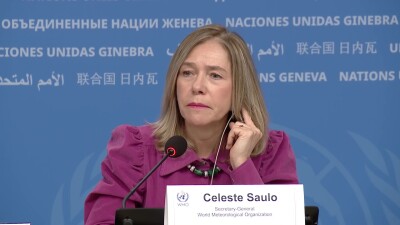
In her first public statement to journalists at the UN in Geneva, the new UN weather chief, Professor Celeste Saulo, emphasized today (16 January) that one of the priorities of her administration will be to strengthen early warning systems that can forecast when and where extreme weather events will be occurring. With natural disasters becoming more frequent due to human-caused climate change, the need for early warning systems has increased.
Adapting to the climate change is not a choice but an essential necessity, said the new Secretary-General of the World Meteorological Organization (WMO) in her introductory remarks at a press briefing. “It's about building resilient communities, especially in the most vulnerable regions, capable of resisting to, and recovering from, climate-related disasters.”
She added that “early warning systems will be the linchpin in disaster risk reduction, transforming threats into opportunities for sustainable development. Under my leadership, we will fortify early warning systems, enhance data accessibility, and make science and timely, life-saving information accessible to all.”
Making sure that “we are not mere observers, we are architects of a sustainable future,” Professor Saulo said that “over the next years, we have an opportunity, a duty, and a possibility, to shape the narrative on climate action. This is about empowering nations, fostering inclusivity, and creating sustainable pathways for a shared prosperity.”
At the end of her mandate, Professor Saulo would like to be measured on the execution of common tasks she has achieved for the WMO.
“We share a common understanding of what we need, the issues how we can implement, and the implementation is, for me, the crucial aspect of all what we do. If we fail at implementation, we will be failing I would say the world. And here is where my strength will be. It will be focused in implementing and implementing the decisions that our member countries decided.”
Replying to a journalist's question on her role being the first female Secretary-General of the World Meteorological Organization, Professor Saulo said that “it's not only about women, I would say it is about diversity and we have different ways of thinking, the problems, the issues and finding solutions. I don't say that it is necessarily better. But I think it's different and I, for example I highlighted for me, how important family is. For me, it's a building block, something that moves me forward because I'm thinking of the new generations all the time. I cannot do something without thinking of the impact for the future generations.”
Professor Saulo is from Argentina. She took office on 1 January 2024. She succeeds Professor Petteri Taalas of Finland who completed his two-term mandate.
-ends-
STORY: WMO Secretary-General Celeste Saulo
TRT: 2:50”
SOURCE: UNTV CH
RESTRICTIONS: NONE
LANGUAGE: ENGLISH / NATS
ASPECT RATIO: 16:9
DATELINE: 16 January 2024 GENEVA, SWITZERLAND
- Exterior medium shot: UN flag alley
- Wide shot: speakers at the press conference
- SOUNDBITE (English) – Celeste Saulo, Secretary-General of the World Meteorological Organization (WMO): “Over the next years, we have an opportunity, a duty, and a possibility, to shape the narrative on climate action. This is about empowering nations, fostering inclusivity, and creating sustainable pathways for a shared prosperity. We are not mere observers; we are architects of a sustainable future.”
- Wide shot: press room with journalists and speakers at the podium
- SOUNDBITE (English) – Celeste Saulo, Secretary-General of the World Meteorological Organization (WMO): “Adapting to the climate change is not a choice but an essential necessity. It's about building resilient communities, especially in the most vulnerable regions, capable of resisting to, and recovering from, climate-related disasters. Early warning systems will be the linchpin in disaster risk reduction, transforming threats into opportunities for sustainable development. Under my leadership, we will fortify early warning systems, enhance data accessibility, and make science and timely, life-saving information accessible to all.”
- Medium shot: UN photographer under screen with speaker
- SOUNDBITE (English) – Celeste Saulo, Secretary-General of the World Meteorological Organization (WMO): “We share a common understanding of what we need, the issues how we can implement and the implementation is, for me, the crucial aspect of all what we do. If we fail at implementation, we will be failing I would say the world. And here is where my strength will be. It will be focused in implementing and implementing the decisions that our member countries decided.”
- Closed up: WMO spokesperson
- SOUNDBITE (English) – Celeste Saulo, Secretary-General of the World Meteorological Organization (WMO): “It's not only about women, I would say it is about diversity and we have different ways of thinking, the problems, the issues and finding solutions. I don't say that it is necessarily better. But I think it's different and I, for example I highlighted for me, how important family is. For me, it's a building block, something that moves me forward because I'm thinking of the new generations all the time. I cannot do something without thinking of the impact for the future generations.”
- Medium shot: Journalists in press briefing room
- Wide shot: Journalists in press briefing room with speaker on screen
- Wide shot: press briefing room with journalists and speakers at the podium
Similar Stories

1
1
1
Edited News | UNICEF , WHO , UNHCR
Yemen war continues to force families from homes amid hunger and disease
More than 250,000 people have now fled renewed fighting in Yemen, the UN said on Tuesday, citing particular concern for those sheltering in the southwestern city of Taiz and the wider governorate, where access is “essentially blocked”.

1
1
1
Edited News | UNICEF
A little over one year since a ceasefire agreement was announced between Hamas fighters and Israel, more than 340 children have been reported killed and hundreds more injured, the UN Children’s Fund, UNICEF, said on Friday.

1
1
1
Edited News | UNICEF , IFRC
Six weeks after Nepal’s deadly flooding disaster, communities are still struggling to rebuild their lives, but they will need sustained help as global warming increases the risk of another Himalayan catastrophe, the UN Children’s Fund (UNICEF) said on Friday.

1
1
1
Edited News | WHO
In suspected Russia plague death, testing and monitoring underway – WHO
The death of a lab worker in Russia’s Siberia region has sparked concerns about plague being the cause, the UN World Health Organization (WHO) said on Tuesday, adding that it was following the situation closely.

1
1
Edited News | OHCHR , UNOG
UN Human Rights Chief Volker Türk on Friday provided and oral update to the 63rd session of the Human rights Council on Ukraine.

1
1
1
Edited News | OHCHR , UNOG
UN Human Rights Chief Volker Türk on Friday provided and oral update to the 63rd session of the Human rights Council on the human rights situation in Haiti.

1
1
1
Edited News | WHO
Repeated delays in bringing lifesaving medicines, prosthetics and more from Israel into Gaza risk having devastating consequences on Palestinians who urgently need them in the wartorn enclave, the UN World Health Organization (WHO) said on Friday. “A truck full of non-priority supplies or the right supplies arriving too late, doesn't save lives. That's the question that actually matters," said Dr Reinhilde Van De Weerdt, WHO Representative in the OPT.

1
1
1
Edited News | WHO
DRC: Early access to care and oxygen decisive for Ebola patients’ survival – WHO
In the Democratic Republic of the Congo (DRC), health workers fighting the country’s largest-ever Ebola outbreak are struggling to overcome critical challenges to patient care, the UN World Health Organization (WHO) warned on Tuesday.

1
1
1
Edited News | OCHA , UN
Civilians in Iran are continuing to feel the consequences of months of conflict and military escalation, the UN’s top official in the country has said, as loss of life, damage to civilian infrastructure and mounting economic pressures leave many facing continued uncertainty.
1
1
1
Edited News | WHO , UNICEF
Aid agencies in Yemen highlighted the growing hunger emergency sparked by renewed fighting between Houthi opposition forces and Government troops, after mobile health clinics reported that hundreds of children displaced by the violence are suffering from the most deadly form of malnutrition.
1
1
1
Edited News | UNHCR
Displacement on the rise in Yemen as fighting continues - UNHCR
As hostilities worsen in Yemen, more people have been fleeing their homes, further intensifying the humanitarian crisis within the region, the UN Refugee Agency (UNHCR) warned on Tuesday.
1
1
1
Edited News | IOM , OHCHR , UNFPA , UNOG , UNHCR , WHO
Yemen’s humanitarian crisis growing by the hour amid spike in displacement
Yemenis displaced by renewed fighting have described fleeing for their lives amid shelling and gunfire, aid agencies reported on Friday, while highlighting the dramatic increase in humanitarian needs in the country and in Djibouti, where thousands have sought shelter.