

The United Nations Office at Geneva
Multimedia Newsroom
STORYLINE
Gaza at ‘most dangerous’ stage amid huge unexploded weapons risk, warns demining expert
The head of UN peacekeeping and demining reiterated calls on Monday for a ceasefire in Gaza as a first step to returning the war-ravaged enclave to some normality, while mine clearance experts warned that Gaza is now at its “most dangerous period”.
“This is the most dangerous period; once people start returning to the north, that's when most accidents will occur, because they won't be familiar with where your unexploded ordnance is located,” said Mungo Birch, Chief of the UN Mine Action Programme (UNMAS) in the State of Palestine. “It's important that once the returns start, we're poised and ready to be able to provide the risk education they need.”
Speaking on the sidelines of the 27th International Meeting of Mine Action National Directors and United Nations Advisers in Geneva, head of UN peacekeeping and mine action Jean-Pierre Lacroix underscored that the Organization’s stood with UNMAS in its support for “humanitarian efforts, to convoys” and risk assessment.
A humanitarian ceasefire remains a “priority”, insisted the Under-Secretary-General for Peace Operations and Chair of the Inter-Agency Coordination Group on Mine Action, along with providing “much more humanitarian assistance to Gaza”, once deminers and weapons experts deem that it is safe to do so.
Lebanon threat
The UN peacekeeping chief also underscored the dangers of a regional escalation amid ongoing exchanges of fire over the Israeli-Lebanon border. “Talking about Lebanon, then you know what needs to be absolutely avoided is further escalation,” said Mr. Lacroix. “That would be devastating to frankly to Lebanon, the whole region.”
Amid reports that it will take some 14 years to clear Gaza of all the rubble created by the conflict, Mr. Birch noted that are an estimated 37 million tonnes in total. “To put that in context, that's more rubble than in Ukraine; in Ukraine, the front is 600 miles, Gaza is 25 miles long. It's also 87 per cent urbanised. So it's very densely packed construction.”
This includes some 800,000 tonnes of asbestos, “as well as various other contaminants …the problem is there’s more rubble in Gaza than there is space to spread it out”, Mr. Birch said, describing how Israeli bombing sparked by Hamas-led attacks on Israel and rocket fire led to the destruction:
“There were lulls, but the bombardment was like nothing I ever experienced. I was with a colleague who had been in Ukraine, in the Ukrainian security forces, he said the bombardment was worse than anything he'd experienced in the Donbass.”
Rubble recyling for ‘the day after’
To tackle the issue of rebuilding Gaza after the fighting stops, Mr. Birch noted that recycling of the rubble “will figure heavily” in any reconstruction. “I mean, people are already talking about ‘the day after’, quote unquote, for Gaza,” he added, noting that a “rubble removal” workshop was held two weeks ago in Jordan with UN agencies including the UN Development Programme (UNDP), the UN Environment Programme (UNEP) and other partners.
Despite the astonishing scale of the clearance operation ahead, UNMAS has just $5 million in funding. Another $40 million will be needed over the next 18 months just to start the process of clearance.
Worldwide, 60 million people in 60 countries live under constant fear of landmines, improvised explosive devices (IEDs) and unexploded ordnance, said UN peacekeeping chief Lacroix. They “do not know whether they will spend the day without being hit by a mine or an IED and who don't know basically you know whether they will make it to the next day or whether their children or their relatives will make it to the next day - and that is really unacceptable.”
Ukraine’s global fallout
Despite no longer featuring as regularly among news headlines more than two years since the full-scale Russian invasion, the Ukraine conflict will continue to have “terrible consequences” in the country and globally for years to come, Mr. Lacroix insisted.
“The area that has been contaminated - the farmland that has been contaminated - used to provide food for 80 million people around the world, mostly middle-income and low-income countries.”
Echoing that concern, veteran landmine clearance specialist Paul Heslop explained that the economic ramifications of the conflict represented a “billions-of-dollar problem” that was happening at the expense of the world’s most vulnerable: “If the mined land or the suspected mined land in Ukraine is causing fuel to be one cent a litre or two cents a litre more than it needs to be, or a loaf of bread or a box of pasta to be 10 cents a box, or a loaf more than it needs to be, and you multiply that across how many loaves of bread are bought every day in the world - billions - how many litres of fuel are used every day – billions - you start to talk about the economic impact of the perception and the presence of mines and UXO (unexploded ordnance) in Ukraine as being a billions-of-dollar problem for every country in the world.”
Beyond the economic impact of the Ukraine war, Mr. Heslop - Programme Manager for Mine Action at UNDP Ukraine – described the terrible injuries being caused by the fighting:
“It’s not just a lower limb like we’ve seen a lot of in Africa over the years where you know, somebody's out gathering firewood or fruit and they step on the line and they blow their leg off. In Ukraine, because of the nature and the intensity of the conflict, we're often seeing double or triple or even quadruple amputees, and a lot of the those injured are in their 20s and 30s.”
Sudan danger zone
Demining action and removing the risk of unexploded weapons is already a serious problem in Sudan, where more than a year of fighting between rival militaries has left millions on the verge of famine, including in major built-up areas where people have little idea about the dangers.
“It's a big change, a big risk is obviously for the civilians because the people, residents of the capital, they never experienced this kind of war in the in the history of Sudan,” said Mohammad Sediq Rashid, Chief of UN Mine Action Programme in Sudan.
“Unfortunately, unexploded ordinance accidents are happening now. There's a little bit of change in terms of access part of the capital is now gradually becoming accessible. So civilians are not waiting for (mine) clearance to happen.”
ends
STORY: UN mine action update – Gaza, Sudan, Ukraine
TRT: 5’05”
SOURCE: UNTV CH
RESTRICTIONS: NONE
LANGUAGE: ENGLISH / NATS
ASPECT RATIO: 16:9
DATELINE: 29 April 2024 GENEVA, SWITZERLAND
1. Exterior medium: UN flag alley.
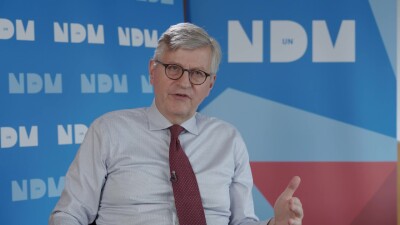
2. Medium: speaker during his interview.
3. SOUNDBITE (English) – Mungo Birch, Chief of the Mine Action Programme in the State of Palestine: “This is the most dangerous period; once people start returning to the north, that's when most accidents will occur, because they won't be familiar with where your unexploded ordnance is located. And so it's important that once the returns start, we're poised and ready to be able to provide the risk education they need.”
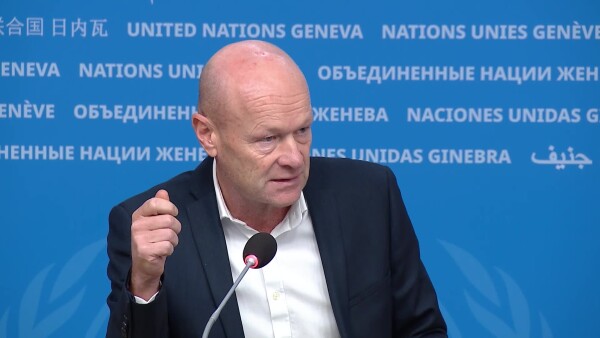
4. Medium: second speaker during his interview.
5. SOUNDBITE (English) – Jean-Pierre Lacroix, Under-Secretary-General for Peace Operations and Chair of the Inter-Agency Coordination Group on Mine Action: “Currently we do provide to UNMAS support to humanitarian efforts, to convoys, risk allocation, and so and so forth. And it's just, part of the overall UN efforts and when it comes to Gaza, certainly, again the priority’s a humanitarian ceasefire, the ability to provide much more humanitarian assistance to Gaza.”
6. Close: speaker on TV viewfinder and to rear, blurred.
7. SOUNDBITE (English) – Mungo Birch, Chief of the Mine Action Programme in the State of Palestine: “The figure for the amount of rubble in Gaza is 37 million tonnes. To put that in context, that's more rubble than in Ukraine; in Ukraine, the front is 600 miles, Gaza is 25 miles long. It's also 87 per cent urbanised. So it's very densely packed construction.”
8. Medium: camera viewfinder and back of interviewer’s head, guest speaker.
9. SOUNDBITE (English) – Mungo Birch, Chief of the Mine Action Programme in the State of Palestine: “We also estimate as part of that 37 million tonnes of rubble, there'll be 800,000 tonnes of asbestos, as well as various other contaminants that have to be taken into account. UNMAS has currently $5 million and we need over the next 18 months to start the process of clearance, et caetera, another 40 million.”
10. Medium: interview set, guest speaker and interviewer, camera, side shot.
11. SOUNDBITE (English) – Jean-Pierre Lacroix, Under-Secretary-General for Peace Operations and Chair of the Inter-Agency Coordination Group on Mine Action: “Talking about Lebanon, then you know what needs to be absolutely avoided is further escalation; that would be devastating to frankly to Lebanon, the whole region.”
12. Close: guest speaker, semi-profile.
13. SOUNDBITE (English) – Jean-Pierre Lacroix, Under-Secretary-General for Peace Operations and Chair of the Inter-Agency Coordination Group on Mine Action: “We have today 60 million people in 60 countries who do not know whether they will spend the day without being hit by a mine or an IED and who don't know basically you know whether they will make it to the next day or whether their children or their relatives will make it to the next day, and that is really unacceptable.”
14. Medium, guest speaker.
15. SOUNDBITE (English): Jean-Pierre Lacroix, Under-Secretary-General for Peace Operations and Chair of the Inter-Agency Coordination Group on Mine Action: “The war in Ukraine has terrible consequences, not only for the population in Ukraine - for the future of their country - but also for the world as a whole. I mean, I mentioned earlier in my statement to the participants of that meeting that the area that has been contaminated - the farmland that has been contaminated - used to provide food for 80 million people around the world, mostly middle-income and low-income countries.”
16. Medium shot, guest speaker sitting cross-legged, camera and viewfinder in shot.
17. SOUNDBITE (English): Paul Heslop, Programme Manager for Mine Action at UNDP Ukraine: “If the mined land or the suspected mined land in Ukraine is causing fuel to be one cent a litre or two cents a litre more than it needs to be, or a loaf of bread or a box of pasta to be 10 cents a box, or a loaf more than it needs to be, and you multiply that across how many loaves of bread are bought every day in the world - billions - how many litres of fuel are used every day – billions - you start to talk about the economic impact of the perception and the presence of mines and UXO (unexploded ordnance) in Ukraine as being a billions-of-dollar problem for every country in the world.”
18. Medium, guest speaker sitting cross-legged, camera and viewfinder in shot.
19. Medium, guest speaker, camera and viewfinder in shot.
20. SOUNDBITE (English): Paul Heslop, Programme Manager for Mine Action at UNDP Ukraine: “So it’s not just a lower limb you know, like we’ve seen a lot of in Africa over the years where you know, somebody's out gathering firewood or fruit and they step on the line and they blow their leg off. In Ukraine because of the nature and the intensity of the conflict, we're often seeing double or triple or even quadruple amputees, and a lot of the those injured are in their 20s and 30s.
21. Medium-close, guest speaker, camera and viewfinder in shot.
22. SOUNDBITE (English): Mungo Birch, Chief of the Mine Action Programme in the State of Palestine: “There were lulls, but the bombardment was like nothing I ever experienced. I was with a colleague who had been in Ukraine, in the Ukrainian security forces, he said the bombardment was worse than anything he'd experienced in the Donbass.”
23. Medium-close, guest speaker, camera and viewfinder in shot.
24. SOUNDBITE (English): Mohammad Sediq Rashid, Chief of the Mine Action Programme in Sudan: “It's a big change, a big risk is obviously for the civilians because the people, residents of the capital, they never experienced this kind of war in the in the history of Sudan.”
25. Medium, guest speaker, camera and interviewer in shot.
26. SOUNDBITE (English): Mohammad Sediq Rashid, Chief of the Mine Action Programme in Sudan: “Unfortunately, the unexploded ordinance accidents are happening now. There's a little bit of change in terms of access part of the capital is now gradually becoming accessible. So civilians are not waiting for clearance to happen.”
27. Medium, guest speaker, camera and interviewer in shot.
Similar Stories
1
1
1
Edited News | OCHA , UNICEF , WFP
Aid agencies warned on Friday of the fast-developing humanitarian emergency inside Taiz City in Yemen, which has been encircled by de facto Houthi forces fighting government troops along the country’s west coast.

2
17
1
2
Edited News , Press Conferences , Images | OCHA , WMO
Two UN agencies teamed up on Wednesday to issue an appeal for immediate assistance to help communities already being impacted by the strongest El Niño on record.
3
16
2
2
Edited News , B-roll , Conferences , Images | UNITED NATIONS , UNOG
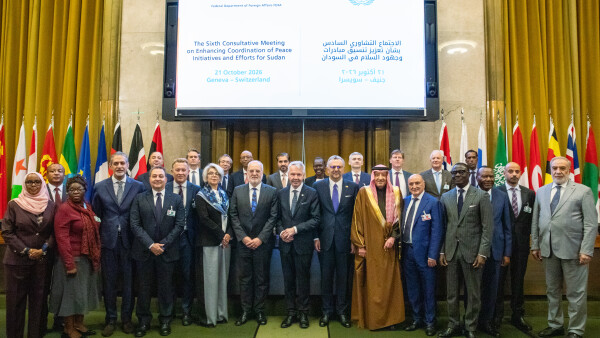
Sixth Consultative Meeting on Enhancing Coordination of Peace Initiatives and Efforts for Sudan

1
1
1
Edited News | UNICEF , WHO , UNHCR
Yemen war continues to force families from homes amid hunger and disease
More than 250,000 people have now fled renewed fighting in Yemen, the UN said on Tuesday, citing particular concern for those sheltering in the southwestern city of Taiz and the wider governorate, where access is “essentially blocked”.

1
1
1
Edited News | UNICEF
A little over one year since a ceasefire agreement was announced between Hamas fighters and Israel, more than 340 children have been reported killed and hundreds more injured, the UN Children’s Fund, UNICEF, said on Friday.

1
1
1
Edited News | UNICEF , IFRC
Six weeks after Nepal’s deadly flooding disaster, communities are still struggling to rebuild their lives, but they will need sustained help as global warming increases the risk of another Himalayan catastrophe, the UN Children’s Fund (UNICEF) said on Friday.

1
1
1
Edited News | WHO
In suspected Russia plague death, testing and monitoring underway – WHO
The death of a lab worker in Russia’s Siberia region has sparked concerns about plague being the cause, the UN World Health Organization (WHO) said on Tuesday, adding that it was following the situation closely.

1
1
Edited News | OHCHR , UNOG
UN Human Rights Chief Volker Türk on Friday provided and oral update to the 63rd session of the Human rights Council on Ukraine.

1
1
1
Edited News | OHCHR , UNOG
UN Human Rights Chief Volker Türk on Friday provided and oral update to the 63rd session of the Human rights Council on the human rights situation in Haiti.

1
1
1
Edited News | WHO
Repeated delays in bringing lifesaving medicines, prosthetics and more from Israel into Gaza risk having devastating consequences on Palestinians who urgently need them in the wartorn enclave, the UN World Health Organization (WHO) said on Friday. “A truck full of non-priority supplies or the right supplies arriving too late, doesn't save lives. That's the question that actually matters," said Dr Reinhilde Van De Weerdt, WHO Representative in the OPT.

1
1
1
Edited News | WHO
DRC: Early access to care and oxygen decisive for Ebola patients’ survival – WHO
In the Democratic Republic of the Congo (DRC), health workers fighting the country’s largest-ever Ebola outbreak are struggling to overcome critical challenges to patient care, the UN World Health Organization (WHO) warned on Tuesday.

1
1
1
Edited News | OCHA , UN
Civilians in Iran are continuing to feel the consequences of months of conflict and military escalation, the UN’s top official in the country has said, as loss of life, damage to civilian infrastructure and mounting economic pressures leave many facing continued uncertainty.