

The United Nations Office at Geneva
Multimedia Newsroom
Little protection for vulnerable travellers on major migration routes, warns UNHCR
Conflicts in Sudan and across the Sahel region have compromised protection for migrants who continue to face “unimaginable horrors” on major migration routes to Europe, UN humanitarians said on Tuesday.
A new report from the UN Refugee Agency (UNHCR) confirmed that each year, hundreds of thousands of people risk their lives to migrate from sub-Saharan countries in Africa without access to immediate assistance, shelter or information about the dangers they may face, even though the location of major movement hubs is well known.
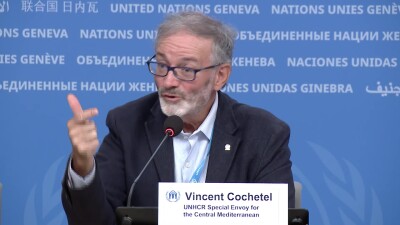
Vincent Cochetel, UNHCR Special Envoy for the Central Mediterranean Situation, said that the absence of critical services placed refugees and migrants “at great risk of harm and death” and also triggered dangerous secondary onward movements.
“Our capacity to partner directly with local authorities is missing. Yet, those local authorities are there, they are located on those routes that are used for migrants and refugees, they are located in places where humanitarian actors cannot be present, either because of safety concern or because authorities don’t want humanitarian actors to be present. But the local authorities are there and they would be able to provide those immediate protection services.”
To remedy the situation and save lives, the UNHCR official called on donors and stakeholders to support the agency’s humanitarian work and that of local partners in targeted locations. “This includes better access to legal pathways to safety and improving protection services for victims, as well as those at risk of becoming victims along the routes,” Mr. Cochetel said.
As well as African migrants, those on the move come from Asia and the Middle East. Many underestimate the risks and dangers and many die while crossing the desert or near borders, UNHCR said, noting that most also suffer serious human rights violations, including sexual violence, kidnappings, torture and physical abuse.
“Many don’t go to capital cities where humanitarian actors are based and well represented,” Mr. Cochetel told journalists in Geneva. “They embark to secondary routes, reaching smaller cities in hard-to-reach areas” including in the Sahara Desert. “This is where services should be located.”
With the right level of funding, supported services could provide immediate humanitarian assistance, shelter, referral mechanisms, information on the dangers involved in embarking on hazardous journeys and access to justice.
Taking the example of Agadez in central Niger - a major migration hub towards Libya and where the security situation remains extremely dangerous for migrants - Mr. Cochetel emphasized that “the local authorities are present, people who were born there. Let's work with these authorities. These authorities see the problem and they would like to do something. Desert search and rescue, that's something we'd like to develop with these local authorities. Technologically, it is possible.”
Measures promoted by UNHCR to protect migrants from trafficking include:
· Bolstering the early identification of refugees and migrants at risk or victims of trafficking both on the land routes and upon disembarkation.
· Facilitating access to solutions for VoTs including regular pathways, such as family reunification and humanitarian evacuation,
· enhancing regularization of migrants and longer-term support in host countries. Offering voluntary return to countries of origin “should not be the only solution considered, as it may lead to risks of re-trafficking upon return”, the UNHCR report insisted.
· Facilitating access to legal support, including for access to justice and remedies. Enhancing access to support for male victims of trafficking, as men are often not eligible for the limited support that is available.
· According to the UNHCR, 108.4 million people worldwide are forcibly displaced. Most refugees - 76 per cent - are hosted by low and middle-income countries.
· In addition, the UN migration agency IOM reports more than 280 million international migrants in the world, who represent 3.6 per cent of the global population.
Ends
Story: “Migrants and refugees protection - UNHCR” – 04 June 2024
Speaker: Vincent Cochetel, UNHCR Special Envoy for the Central Mediterranean Situation
TRT: 01’55”
SOURCE: UNTV CH
LANGUAGE: ENGLISH
ASPECT RATIO: 16:9
DATELINE: 04 June 2024 - GENEVA, SWITZERLAND
Geneva Press briefing
SHOTLIST
1. Exterior medium shot: UN flag alley.
2. Wide shot of the podium with speakers at the press conference room with journalists in the room.
3. SOUNDBITE (English) Vincent Cochetel, UNHCR Special Envoy for the Central Mediterranean Situation: “Many don’t go to capital cities where humanitarian actors are based, well represented. They embark to secondary routes reaching smaller cities, smaller communities, in hard-to-reach areas. This is where services should be located.”
4. Wide shot: speakers at podium from behind and journalists in the room.
5. SOUNDBITE (English) Vincent Cochetel, UNHCR Special Envoy for the Central Mediterranean Situation: “Our capacity to partner directly with local authorities is missing. Yet, those local authorities are there, they are located on those routes that are used for migrants and refugees, they are located in places where humanitarian actors cannot be present, either because of safety concern or because authorities don’t want humanitarian actors to be present. But the local authorities are there and they would be able to provide those immediate protection service.”
6. Medium shot: speakers at podium from behind and journalists in the room.
7. SOUNDBITE (French) Vincent Cochetel, UNHCR Special Envoy for the Central Mediterranean Situation: « Si on ne peut pas être présent au nord d'Agadez aujourd'hui, les autorités locales sont là. Des gens qui sont nés là-bas, qui étaient là-bas avant que cette route soit utilisée à des fins de migration vers la Libye. Mais travaillons avec ces autorités. Ces autorités voient le problème. Ces autorités aimeraient faire quelque chose.”
-- Translation into English: “If we can't be present in the north of Agadez today, the local authorities are present: people who were born there, who were there before this route was used for migration to Libya. Let's work with these authorities. These authorities see the problem. These authorities would like to do something."
8. Cutaway: wide shot of journalists in press conference room.
9. SOUNDBITE (French) Vincent Cochetel, UNHCR Special Envoy for the Central Mediterranean Situation: « On continue de parler de sauvetage en mer. Le concept de sauvetage dans le désert n'est pas très, très développé, la recherche et le sauvetage dans le désert, et c'est quelque chose qu'on aimerait développer avec ces autorités locales. Technologiquement, c'est possible. »
-- Translation into English: “We continue to talk about rescue at sea. The concept of desert rescue is not very, very developed. Desert search and rescue, that's something we'd like to develop with these local authorities. Technologically, it is possible.”
10. Medium, close ups and various shots of journalists and technicians in the press conference room and control room.
Similar Stories

1
1
1
Edited News | OCHA , UNICEF , WFP
Aid agencies warned on Friday of the fast-developing humanitarian emergency inside Taiz City in Yemen, which has been encircled by de facto Houthi forces fighting government troops along the country’s west coast.

2
17
1
2
Edited News , Press Conferences , Images | OCHA , WMO
Two UN agencies teamed up on Wednesday to issue an appeal for immediate assistance to help communities already being impacted by the strongest El Niño on record.

3
16
2
2
Edited News , B-roll , Conferences , Images | UNITED NATIONS , UNOG
Sixth Consultative Meeting on Enhancing Coordination of Peace Initiatives and Efforts for Sudan

1
1
1
Edited News | UNICEF , WHO , UNHCR
Yemen war continues to force families from homes amid hunger and disease
More than 250,000 people have now fled renewed fighting in Yemen, the UN said on Tuesday, citing particular concern for those sheltering in the southwestern city of Taiz and the wider governorate, where access is “essentially blocked”.

1
1
1
Edited News | UNICEF
A little over one year since a ceasefire agreement was announced between Hamas fighters and Israel, more than 340 children have been reported killed and hundreds more injured, the UN Children’s Fund, UNICEF, said on Friday.

1
1
1
Edited News | UNICEF , IFRC
Six weeks after Nepal’s deadly flooding disaster, communities are still struggling to rebuild their lives, but they will need sustained help as global warming increases the risk of another Himalayan catastrophe, the UN Children’s Fund (UNICEF) said on Friday.

1
1
1
Edited News | WHO
In suspected Russia plague death, testing and monitoring underway – WHO
The death of a lab worker in Russia’s Siberia region has sparked concerns about plague being the cause, the UN World Health Organization (WHO) said on Tuesday, adding that it was following the situation closely.

1
1
Edited News | OHCHR , UNOG
UN Human Rights Chief Volker Türk on Friday provided and oral update to the 63rd session of the Human rights Council on Ukraine.

1
1
1
Edited News | OHCHR , UNOG
UN Human Rights Chief Volker Türk on Friday provided and oral update to the 63rd session of the Human rights Council on the human rights situation in Haiti.

1
1
1
Edited News | WHO
Repeated delays in bringing lifesaving medicines, prosthetics and more from Israel into Gaza risk having devastating consequences on Palestinians who urgently need them in the wartorn enclave, the UN World Health Organization (WHO) said on Friday. “A truck full of non-priority supplies or the right supplies arriving too late, doesn't save lives. That's the question that actually matters," said Dr Reinhilde Van De Weerdt, WHO Representative in the OPT.

1
1
1
Edited News | WHO
DRC: Early access to care and oxygen decisive for Ebola patients’ survival – WHO
In the Democratic Republic of the Congo (DRC), health workers fighting the country’s largest-ever Ebola outbreak are struggling to overcome critical challenges to patient care, the UN World Health Organization (WHO) warned on Tuesday.

1
1
1
Edited News | OCHA , UN
Civilians in Iran are continuing to feel the consequences of months of conflict and military escalation, the UN’s top official in the country has said, as loss of life, damage to civilian infrastructure and mounting economic pressures leave many facing continued uncertainty.