

The United Nations Office at Geneva
Multimedia Newsroom
Edited News , Press Conferences | UNOG , UNITED NATIONS , UNCTAD
UNCTAD 60 opening and António Guterres stakeout 12 June 2024
Guterres highlights ‘unique level of destruction’ in Gaza and deep commitment to UNRWA's humanitarian aid ahead of G7 meet
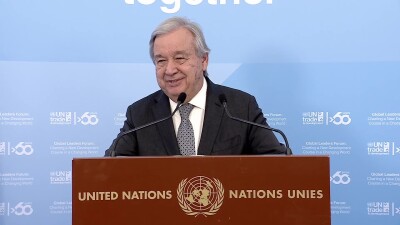
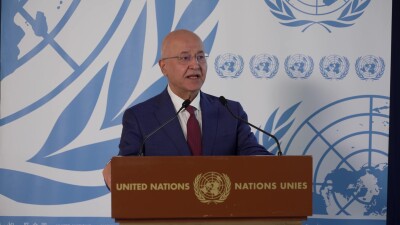
UN Secretary-General António Guterres reiterated his solidarity with the people of Gaza and the global body’s deep commitment to the UN agency for Palestinian refugees, UNRWA, on Wednesday, while also issuing a stark message to the world’s richest nations ahead of the G7 Summit in Italy to do more to help emerging economies crippled by debt repayments.
“In Gaza, we are deeply committed to humanitarian aid to the population in Gaza, where UNRWA is the backbone of that support,” Mr. Guterres told journalists in Geneva. “We have faced a number of difficulties and obstacles that are well known, but nothing diminishes our commitment,” he added, amid a long-running misinformation to discredit the UN agency.
Turning to the ongoing challenge of providing lifesaving humanitarian assistance to the people of Gaza, especially since early May when the Israeli military closed the vital Rafah border crossing, the UN chief noted that it remained “extremely difficult to support the population that is under fire; it's extremely difficult to support the population when there are so many restrictions to the entry of the necessary supplies for humanitarian aid”.
Asked to comment about the findings of a report published earlier in the day by a top Human Rights Council-appointed probe into the Gaza war that found Hamas and Israel guilty of war crimes, the UN chief underscored the enormous scale of destruction and death in the past eight months of hostilities.
“We have witnessed and we are perfectly aware of what was a unique level of destruction and the unique level of casualties in the Palestinian population during these months of war that has no precedent in any other situation that I've lived as Secretary-General of the United Nations.”
The Secretary-General was speaking on the sidelines of the Global Leaders Forum at UN Geneva, hosted by UN Trade and Development (UNCTAD), where he took the opportunity before heading to the G7 Summit in Italy beginning on Thursday to repeat his deep concerns about the unequal distribution of wealth in the global economy – and the need for richer nations to support those trying to embrace industrialization.
“Developing and emerging economies outside China have seen clean energy investments stuck at the same levels since 2015 and Africa was home to less than one per cent of last year’s renewables installations despite its wealth of resources and its vast potential,” Mr. Guterres said. “We need advanced economies to rally behind the emerging and developing ones and to show climate solidarity by providing the technological and financial support they need to cut emissions. We need a clear commitment from the G7 on doubling finance for adaptation by next year and closing the adaptation finance gap.”
Echoing that message, Rebeca Grynspan, Secretary-General of the UN Trade and Development agency UNCTAD, welcomed the “resurgence of industrial policy” in some parts of the world that vindicated the State’s “vital role” in economic development and transformation.
But she cautioned that for many developing nations burdened by debt and limited fiscal space, “this resurgence is a distant horizon”, just as the UN Secretary-General told delegates that new trade barriers introduced annually “have nearly tripled since 2019, many driven by geopolitical rivalry with no concern for their impact on developing countries”.
Such a trend must be avoided if the world’s most vulnerable countries and individuals are to enjoy the benefits of the UN-backed Sustainable Development Goals (SDGs), Mr. Guterres insisted, as he declared that the world “cannot afford splits into rival blocs. The implementation of the SDGs and the need to ensure peace and security makes essential to have one global market and one global economy in which there is no place for poverty and hunger.”
Some progress has been made in tackling these enduring problems and in the 60 years since UNCTAD was created, “over a billion people have been lifted out of poverty” and the developing world “is now the engine of global trade and economic activity”, Ms. Grynspan noted.
But she added that far while for some, this may “give the illusion that the ground is less uneven today than it was six decades ago”, for “the poor, the unconnected, the discriminated, the rural, but also the women, and the youth – the ground remains uneven, the climb too steep”.
ends
Story: UN Secretary-General Stakeout
TRT: 3’53”
SOURCE: UNTV CH
LANGUAGE: ENGLISH / NATS
ASPECT RATIO: 16:9
DATELINE: 12 June 2024 - GENEVA, SWITZERLAND
NO RESTRICTIONS
SHOTLIST
- Exterior wide shot: UN Geneva and UN flag.
- SOUNDBITE (English) – UN Secretary-General António Guterres: “In Gaza, we are deeply committed to humanitarian aid to the population in Gaza, where UNRWA is the backbone of that support. We have faced a number of difficulties and obstacles that are well known but nothing diminishes our commitment. Of course, it's extremely difficult to support the population that is under fire; it's extremely difficult to support the population when there are so many restrictions to the entry of the necessary supplies for humanitarian aid.”
- Medium-wide: Mr. Guterres speaking with journalists following at the stakeout venue, UN Geneva.
- SOUNDBITE (English) – UN Secretary-General António Guterres: “We have witnessed and we are perfectly aware of what was a unique level of destruction and the unique level of casualties in the Palestinian population during these months of war that has no precedent in any other situation that I've lived as Secretary-General of the United Nations.”
- Medium: journalists filming or listening to the UN Secretary-General at the stakeout venue.
- SOUNDBITE (English) – UN Secretary-General António Guterres: “Developing and emerging economies outside China have seen clean energy investments stuck at the same levels since 2015 and Africa was home to less than one per cent of last year’s renewables installations despite its wealth of resources and its vast potential. We need advanced economies to rally behind the emerging and developing ones and to show climate solidarity by providing the technological and financial support they need to cut emissions. We need a clear commitment from the G7 on doubling finance for adaptation by next year and closing the adaptation finance gap.”
- Wide: podium with VIP speakers at UN Trade and Development Global Leaders Conference, UN Geneva.
- SOUNDBITE (English) – Rebeca Grynspan, Secretary-General, UN Trade and Development (UNCTAD): “The resurgence of industrial policy signals a welcome recognition that the State has a vital role to play in fostering development and transformation. But for many developing nations burdened by debt and limited fiscal space, this resurgence is a distant horizon.”
- Medium: TV camera viewfinder showing Mr. Guterres in shot, UN Trade and Development panel to rear.
- SOUNDBITE (English) – UN Secretary-General António Guterres: “As you know, I am Portuguese and if you look at the results in my country, that doesn't apply. So, that is not necessarily something to take place everywhere. But obviously it is very important to strengthen European democracy, it's very important to strengthen a European commitment to multilateralism. It's very important to stress a European commitment to the rule of law, to the values of the Charter and to the principles of democratic societies. And I hope that that will prevail in Europe.”
- Medium: delegate at the UN Trade and Development Global Leaders Conference, UN Geneva.
- SOUNDBITE (English) – UN chief Secretary-General António Guterres: “New trade barriers introduced annually have nearly tripled since 2019, many driven by geopolitical rivalry with no concern for their impact on developing countries.”
- Medium, delegate holding conference listening aid to ear.
- SOUNDBITE (English) – UN chief Secretary-General António Guterres: “The world cannot afford splits into rival blocs. The implementation of the SDGs and the need to ensure peace and security makes essential to have one global market and one global economy in which there is no place for poverty and hunger.”
- Medium-wide, the Secretary-General and Spokesperson at his side, shot from below.
- Medium, video journalists filming with TV cameras.
- Medium, photographer preparing to take shot.
Similar Stories
1
12
1
1
Press Conferences , Images | UNOG
Closing Press Conference following the Sixth Consultative Meeting on Enhancing Coordination of Peace Initiatives and Efforts in Sudan

2
17
1
2
Edited News , Press Conferences , Images | OCHA , WMO
Two UN agencies teamed up on Wednesday to issue an appeal for immediate assistance to help communities already being impacted by the strongest El Niño on record.

3
16
2
2
Edited News , B-roll , Conferences , Images | UNITED NATIONS , UNOG
Sixth Consultative Meeting on Enhancing Coordination of Peace Initiatives and Efforts for Sudan
1
1
1
Press Conferences | CITES
Wildlife trade and conservation policy discussions at the 81st meeting of the CITES Standing Committee (SC81)

1
1
1
Edited News | UNICEF , WHO , UNHCR
Yemen war continues to force families from homes amid hunger and disease
More than 250,000 people have now fled renewed fighting in Yemen, the UN said on Tuesday, citing particular concern for those sheltering in the southwestern city of Taiz and the wider governorate, where access is “essentially blocked”.
1
1
1
Press Conferences | UNHCR , UNCTAD , WMO , OCHA , UNICEF , WHO
UNHCR Hungary’s 1956 Refugee Crisis: 70 Years On, UNCTAD World Investment Forum 2026, Doha, WMO Greenhouse Gas Bulletin and Climate Update for COP31, OCHA Afghanistan: Malnutrition, Girls’ Education and Recovery, UNICEF Yemen: Child Malnutrition and Unsafe Water in Taiz, WHO Inequalities in Noncommunicable Diseases and Risk Factors
1
1
1
Press Conferences | UNHCR
End of UNHCR's 77th Annual Executive Committee (ExCom) meeting week

1
1
1
Edited News | UNICEF
A little over one year since a ceasefire agreement was announced between Hamas fighters and Israel, more than 340 children have been reported killed and hundreds more injured, the UN Children’s Fund, UNICEF, said on Friday.
1
1
1
Press Conferences | UNICEF , IOM , UNHCR
UN Special Assistant to the Personal Envoy Office (SUDAN): Peace Initiatives and Efforts in Sudan; UNICEF: Dire situation of children in Gaza; IOM: Damaged Homes and Energy Attacks Risk Displacing Ukrainians for this winter; UNHCR: update on EXCOM week
1
1
1
Press Conferences | IOM , UNDRR
UN stresses importance of household preparedness for disaster risk reduction.

1
1
1
Edited News | UNICEF , IFRC
Six weeks after Nepal’s deadly flooding disaster, communities are still struggling to rebuild their lives, but they will need sustained help as global warming increases the risk of another Himalayan catastrophe, the UN Children’s Fund (UNICEF) said on Friday.
1
1
1
Statements , Press Conferences | OHCHR