

The United Nations Office at Geneva
Multimedia Newsroom
Vital Idlib aid deliveries resume after ‘heavy bombing’ - WFP
Urgently-needed aid deliveries have started again to embattled civilians in north-west Syria after a day-long break in distributions caused by escalating hostilities, the World Food Programme (WFP) said on Friday.
“WFP lorries have resumed their distribution work after a 24-hour pause,” WFP spokesperson Elisabeth Byrs told journalists in Geneva. “This shows the difficulties that WFP and its humanitarian partners are facing in the field to help people, a lot of whom have been displaced many times.”
The development comes after what the agency called the “heavy bombardment” of Idlib, the last opposition-held enclave in Syria. It is also home to nearly three million civilians.
According to the UN Office for the Coordination of Humanitarian Affairs (OCHA), more than 370 civilians have been killed there since 1 December, with 49 deaths recorded between 1 and 5 February alone in areas controlled by non-Government groups.
Amid the ongoing hostilities, which follow almost nine years of war in Syria, UN Special Envoy for Syria, Geir Pedersen, has appealed for a lasting ceasefire, his spokesperson said.
“He continues to appeal for an end of the hostilities, noting that it’s imperative to de-escalate the situation in the north-west,” said spokesperson Jenifer Fenton. “He again continues to say that there is an urgent need for a sustained ceasefire and immediate, unfettered humanitarian access to the civilian population…He continues to engage with all concerned parties to try to de-escalate the situation and call for the protection of civilians.”
Asked about the possible reconvening of the Syrian Constitutional Committee at the UN in Geneva, Ms. Fenton said that he had been working to “renew progress” in the political process. “There is a need to build trust and confidence which can contribute to opening the door to a broader political process,” she maintained.
In a briefing to the Security Council last week, Mr. Pedersen noted that Syrian Government forces launched a ground offensive in the area following the dissolution of a 12 January ceasefire agreement between Turkey and the Russian Federation.
He also described attacks by various UN-designated terrorist groups during the same period, as well as direct clashes between Turkish and Syrian Government forces
At the same briefing to the Council, Mark Lowcock, UN Emergency Relief Coordinator, described a “humanitarian catastrophe” in Syria linked to air and ground strikes, massive waves of displacement and a major loss of life.
“We have seen chaotic pictures in town after town as vehicles line up in every direction trying to flee,” he said. “People who have just moved cannot find adequate shelter. Tens of thousands are crammed into schools, mosques and unfinished buildings. Many are in tents in the mud, exposed to wind, rain and freezing weather.”
According to Mr. Lowcock, more than 1,220 aid trucks went through the Bab al-Hawa and Bab al-Salam border crossings between Syria and Turkey in January.
People in the city of Atareb – some 30 kilometres from the former opposition bastion of Aleppo city -
have suffered in particular from the latest uptick in violence, WFP’s Ms. Byrs said.
“Heavy bombardment in the city of Atareb over the past couple of days spurred significant population displacement. So far, airstrikes and armed clashes in north-west Syria have displaced over 800,000 people since December 2019.”
Amid harsh winter conditions and sub-zero temperatures, humanitarians have repeatedly urged the warring parties to respect international humanitarian law, in particular by safeguarding civilians, hospitals and other public infrastructure.
“I can just say that their situation is really dramatic,” Ms. Byrs said. “You can imagine with those freezing temperatures, the situation for families, for those mothers who try to feed their children, and the children have to walk and be on the move all the time.”
- Exterior shot, Palais des Nations flag alley, sunny, breezy.
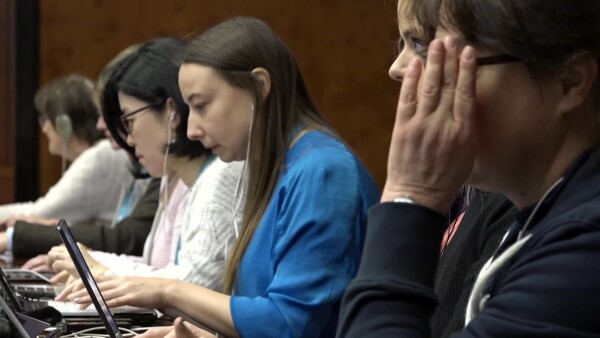
- Medium shot, journalists in foreground (seated), podium speakers to rear of shot.
- Close-up, journalists, semi-profile.
- SOUNDBITE (English) — Elisabeth Byrs, spokesperson, World Food Programme (WFP): “The United Nations World Food Programme continues to provide emergency food assistance to people in desperate need in north-west Syria despite escalating hostilities.”
- Close up, journalist in foreground, other journalists to rear of shot.
- SOUNDBITE (French) — Elisabeth Byrs, porte-parole, le Programme alimentaire mondial des Nations Unies (PAM) : « Les camions du Programme alimentaire mondial ont repris les distributions après une interruption de 24 heures. Ce qui montre les difficultés du Programme alimentaire mondiale et de ses partenaires humanitaires sur le terrain pour aider ces personnes qui ont été pour beaucoup déplacés plusieurs fois. »
- Medium shot, hands typing on laptop, podium speakers to rear.
- SOUNDBITE (English) — Elisabeth Byrs, spokesperson, World Food Programme (WFP): “Heavy bombardment in the city of Atareb over the past couple of days spurred significant population displacement. So far, airstrikes and armed clashes in north-west Syria have displaced over 800,000 people since December 2019.”
- Medium shot, journalists.
- SOUNDBITE (English) — Elisabeth Byrs, spokesperson, World Food Programme (WFP): “I can just say that their situation is really dramatic. You can imagine with those freezing temperatures, the situation for families, for those mothers who try to feed their children, and the children have to walk and be on the move all the time.”
- Wide shot, journalists, TV camera crews.
- SOUNDBITE (English) — Jenifer Fenton, spokesperson for the Office of the UN Special Envoy for Syria: “He continues to appeal for an end of the hostilities, noting that it’s imperative to de-escalate the situation in the north-west. He again continues to say that there is an urgent need for a sustained ceasefire and immediate, unfettered humanitarian access to the civilian population.”
- Close up, several pairs of hands typing on laptops, profile.
- SOUNDBITE (English) — Jenifer Fenton, spokesperson for the Office of the UN Special Envoy for Syria: “He continues to engage with all concerned parties to try to de-escalate the situation and call for the protection of civilians.”
- Close up, journalists in front and rear of shot.
- Medium shot, journalist looking down at laptop.
- Medium shot, journalist looking out of shot.
Similar Stories

1
1
1
Edited News | OCHA , UNICEF , WFP
Aid agencies warned on Friday of the fast-developing humanitarian emergency inside Taiz City in Yemen, which has been encircled by de facto Houthi forces fighting government troops along the country’s west coast.

2
17
1
2
Edited News , Press Conferences , Images | OCHA , WMO
Two UN agencies teamed up on Wednesday to issue an appeal for immediate assistance to help communities already being impacted by the strongest El Niño on record.

3
16
2
2
Edited News , B-roll , Conferences , Images | UNITED NATIONS , UNOG
Sixth Consultative Meeting on Enhancing Coordination of Peace Initiatives and Efforts for Sudan

1
1
1
Edited News | UNICEF , WHO , UNHCR
Yemen war continues to force families from homes amid hunger and disease
More than 250,000 people have now fled renewed fighting in Yemen, the UN said on Tuesday, citing particular concern for those sheltering in the southwestern city of Taiz and the wider governorate, where access is “essentially blocked”.

1
1
1
Edited News | UNICEF
A little over one year since a ceasefire agreement was announced between Hamas fighters and Israel, more than 340 children have been reported killed and hundreds more injured, the UN Children’s Fund, UNICEF, said on Friday.

1
1
1
Edited News | UNICEF , IFRC
Six weeks after Nepal’s deadly flooding disaster, communities are still struggling to rebuild their lives, but they will need sustained help as global warming increases the risk of another Himalayan catastrophe, the UN Children’s Fund (UNICEF) said on Friday.

1
1
1
Edited News | WHO
In suspected Russia plague death, testing and monitoring underway – WHO
The death of a lab worker in Russia’s Siberia region has sparked concerns about plague being the cause, the UN World Health Organization (WHO) said on Tuesday, adding that it was following the situation closely.

1
1
Edited News | OHCHR , UNOG
UN Human Rights Chief Volker Türk on Friday provided and oral update to the 63rd session of the Human rights Council on Ukraine.

1
1
1
Edited News | OHCHR , UNOG
UN Human Rights Chief Volker Türk on Friday provided and oral update to the 63rd session of the Human rights Council on the human rights situation in Haiti.

1
1
1
Edited News | WHO
Repeated delays in bringing lifesaving medicines, prosthetics and more from Israel into Gaza risk having devastating consequences on Palestinians who urgently need them in the wartorn enclave, the UN World Health Organization (WHO) said on Friday. “A truck full of non-priority supplies or the right supplies arriving too late, doesn't save lives. That's the question that actually matters," said Dr Reinhilde Van De Weerdt, WHO Representative in the OPT.

1
1
1
Edited News | WHO
DRC: Early access to care and oxygen decisive for Ebola patients’ survival – WHO
In the Democratic Republic of the Congo (DRC), health workers fighting the country’s largest-ever Ebola outbreak are struggling to overcome critical challenges to patient care, the UN World Health Organization (WHO) warned on Tuesday.

1
1
1
Edited News | OCHA , UN
Civilians in Iran are continuing to feel the consequences of months of conflict and military escalation, the UN’s top official in the country has said, as loss of life, damage to civilian infrastructure and mounting economic pressures leave many facing continued uncertainty.