

The United Nations Office at Geneva
Multimedia Newsroom
Syria’s needs are at their highest ever, says top rights probe
Syria’s humanitarian needs are at their highest ever and any move to block aid from reaching the war-torn country should be resisted strongly, a top UN Human Rights Council probe said on Wednesday.
According to the Commission of Inquiry on Syria, 14.6 million Syrians depend on humanitarian assistance, 12 million face acute food insecurity, and nine in 10 now live below the poverty line.
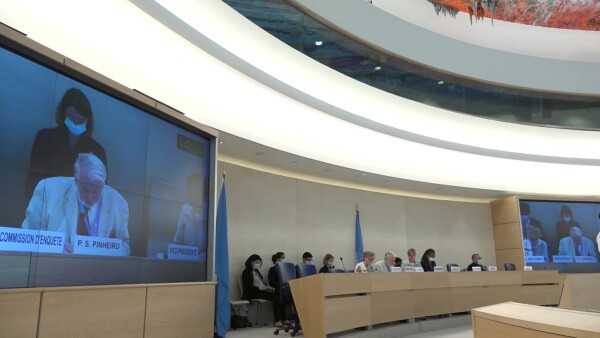
Just last month, humanitarians warned that the funds pledged for relief operations were too small to help, said Commission of Inquiry chair, Paulo Pinheiro:
“Given this disturbing reality, it is unconscionable that discussions at the Security Council are focused on whether to close the one remaining authorized border crossing for aid, rather than how to expand access to life-saving aid across the country and through every appropriate route.”
Mr. Pinheiro was referring to the imminent closure of the Bab al-Hawa humanitarian border crossing into northern Syria from Turkey, which will require a UN Security Council resolution to stay open beyond 10 July.
Bab al-Hawa is the last of four international cross-border operations still functioning in Syria after lack of consensus among Security Council Members about keeping the others open, as they had been, from 2014 until early 2020.
Through the sole cross-border operation still authorized by the Security Council, aid reaches around 2.4 million of them every month, a vital lifeline to the population in northwest Syria.
“Parties to the conflict have themselves consistently failed in their obligations to allow and facilitate rapid and unimpeded passage of humanitarian relief for civilians in need across Syria,” Mr. Pinheiro continued. “These and all other obstacles to humanitarian aid must be removed – including those caused by unilateral sanctions, even when unintentional.”
The top rights expert also highlighted concerns about whether it is safe to return for the more than 13.4 million Syrians who have fled their homes.
“Millions of refugees who fled the country are now under increasing pressure to return,” said Mr. Pinheiro. “When UNHCR recently polled refugees, nearly 92.8 per cent said they do not intend to return in the next year.”
The probe – established in August 2011 by the Human Rights Council to investigate alleged violations of international law – once again raised the alarm over the many thousands of relatives of foreign fighters still being held in dreadful conditions in camps in Syria’s northeast.
“We need to remind this body that 40,000 children are still held in appalling conditions in Al Hol and Al Roj camps in northeast Syria, alongside 20,000 adults, mainly women,” Mr. Pinheiro said. “Insecurity in Al Hol remains rife, with at least 24 murders reported this year. Even humanitarian workers have been targeted; a Red Crescent nurse was killed and an ICRC doctor stabbed.”
Replying to the Commission of Inquiry chair, Syria’s representative, Hussam Edin Aala, rejected “the allegations and fallacies” that he claimed were contained in the Commission’s reports.
He also refused to accept any attempt “to promote the establishment of new international mechanisms on Syria”, along with “prefabricated accusations, controversial decisions and false reports”.
ends
STORY: Commission Of Inquiry On Syria - Human Rights Council
TRT: 3 mins 6s
SOURCE: UNTV CH
RESTRICTIONS: NONE
LANGUAGE: ENGLISH/SYRIAN/NATS
ASPECT RATIO: 16:9
DATELINE: 29 June 2022 GENEVA, SWITZERLAND
SHOTLIST
- Exterior medium shot, flag alley, UN Geneva.
- Medium-wide, 50th Session of the UN Human Rights Council in Geneva, delegates’ view.
- Medium-wide, 50th Session of the UN Human Rights Council in Geneva, view of podium speakers and large screens showing speaker.
- SOUNDBITE (ENGLISH): Paulo Pinheiro, Chair, Independent International Commission of Inquiry on the Syrian Arab Republic: “Simply put, humanitarian needs throughout Syria are at their highest ever, with the UN estimating that 14.6 million Syrians are now dependent on humanitarian assistance; across Syria, 12 million people face acute food insecurity, and 90 per cent live in poverty.”
- Medium, Hussam Edin Aala, Permanent Representative of Syria to UN Geneva, in focus among other delegates at the Council.
- SOUNDBITE (ENGLISH): Paulo Pinheiro, Chair, Independent International Commission of Inquiry on the Syrian Arab Republic: “Given this disturbing reality, it is unconscionable that discussions at the Security Council are focused on whether to close the one remaining authorized border crossing for aid, rather than how to expand access to lifesaving aid across the country and through every appropriate route.”
- Medium, many country representatives listening to proceedings, many wearing facemasks, at the Council.
- SOUNDBITE (ENGLISH): Paulo Pinheiro, Chair, Independent International Commission of Inquiry on the Syrian Arab Republic: “Parties to the conflict have themselves consistently failed in their obligations to allow and facilitate rapid and unimpeded passage of humanitarian relief for civilians in need across Syria. These and all other obstacles to humanitarian aid must be removed – including those caused by unilateral sanctions, even when unintentional.”
- Medium, delegates in foreground, blurred, podium speakers to rear.
- SOUNDBITE (ENGLISH): Paulo Pinheiro, Chair, Independent International Commission of Inquiry on the Syrian Arab Republic: “Millions of refugees who fled the country are now under increasing pressure to return. When UNHCR recently polled refugees, nearly 92.8 per cent said they do not intend to return in the next year.”
- Close-up, Paulo Pinheiro in TV camera viewfinder and to rear.
- SOUNDBITE (ENGLISH): Paulo Pinheiro, Chair, Independent International Commission of Inquiry on the Syrian Arab Republic: “We need to remind this body that 40,000 children are still held in appalling conditions in Al Hol and Al Roj camps in northeast Syria, alongside 20,000 adults, mainly women. Insecurity in Al Hol remains rife, with at least 24 murders reported this year. Even humanitarian workers have been targeted; a Red Crescent nurse was killed and an ICRC doctor stabbed.”
- Close-up, TV camera and viewfinder showing Syria representative.
- SOUNDBITE (ARABIC/ENGLISH): Hussam Edin Aala, Permanent Representative of Syria to UN Geneva: “My delegation rejects the allegations and fallacies in the Commission’s reports and the statements of its sponsors and their attempts to promote the establishment of new international mechanisms on Syria. We stress that allegations of human rights or the promotion of human rights and the support of the political solution and ending the suffering of refugees and their host communities cannot be taken through the promotion of accusations, controversial – prefabricated accusations, controversial decisions and false reports”.
- Medium shot: US delegate.
- Medium shot: Lithuanian delegate in foreground.
- Medium shot: Benin delegate in foreground.
Similar Stories

1
1
1
Edited News | OCHA , UNICEF , WFP
Aid agencies warned on Friday of the fast-developing humanitarian emergency inside Taiz City in Yemen, which has been encircled by de facto Houthi forces fighting government troops along the country’s west coast.

2
17
1
2
Edited News , Press Conferences , Images | OCHA , WMO
Two UN agencies teamed up on Wednesday to issue an appeal for immediate assistance to help communities already being impacted by the strongest El Niño on record.

3
16
2
2
Edited News , B-roll , Conferences , Images | UNITED NATIONS , UNOG
Sixth Consultative Meeting on Enhancing Coordination of Peace Initiatives and Efforts for Sudan

1
1
1
Edited News | UNICEF , WHO , UNHCR
Yemen war continues to force families from homes amid hunger and disease
More than 250,000 people have now fled renewed fighting in Yemen, the UN said on Tuesday, citing particular concern for those sheltering in the southwestern city of Taiz and the wider governorate, where access is “essentially blocked”.

1
1
1
Edited News | UNICEF
A little over one year since a ceasefire agreement was announced between Hamas fighters and Israel, more than 340 children have been reported killed and hundreds more injured, the UN Children’s Fund, UNICEF, said on Friday.

1
1
1
Edited News | UNICEF , IFRC
Six weeks after Nepal’s deadly flooding disaster, communities are still struggling to rebuild their lives, but they will need sustained help as global warming increases the risk of another Himalayan catastrophe, the UN Children’s Fund (UNICEF) said on Friday.

1
1
1
Edited News | WHO
In suspected Russia plague death, testing and monitoring underway – WHO
The death of a lab worker in Russia’s Siberia region has sparked concerns about plague being the cause, the UN World Health Organization (WHO) said on Tuesday, adding that it was following the situation closely.

1
1
Edited News | OHCHR , UNOG
UN Human Rights Chief Volker Türk on Friday provided and oral update to the 63rd session of the Human rights Council on Ukraine.

1
1
1
Edited News | OHCHR , UNOG
UN Human Rights Chief Volker Türk on Friday provided and oral update to the 63rd session of the Human rights Council on the human rights situation in Haiti.

1
1
1
Edited News | WHO
Repeated delays in bringing lifesaving medicines, prosthetics and more from Israel into Gaza risk having devastating consequences on Palestinians who urgently need them in the wartorn enclave, the UN World Health Organization (WHO) said on Friday. “A truck full of non-priority supplies or the right supplies arriving too late, doesn't save lives. That's the question that actually matters," said Dr Reinhilde Van De Weerdt, WHO Representative in the OPT.

1
1
1
Edited News | WHO
DRC: Early access to care and oxygen decisive for Ebola patients’ survival – WHO
In the Democratic Republic of the Congo (DRC), health workers fighting the country’s largest-ever Ebola outbreak are struggling to overcome critical challenges to patient care, the UN World Health Organization (WHO) warned on Tuesday.

1
1
1
Edited News | OCHA , UN
Civilians in Iran are continuing to feel the consequences of months of conflict and military escalation, the UN’s top official in the country has said, as loss of life, damage to civilian infrastructure and mounting economic pressures leave many facing continued uncertainty.