

The United Nations Office at Geneva
Multimedia Newsroom
Ukraine: Top UN aid official appeals for access across contact line
STORYLINE
“Winter is coming,… [and] all we want to do [is] provide insulin to the hospitals, provide blankets, provide mattresses… it's not complicated,” the United Nations’ top aid official in Ukraine said on Friday.
Speaking from Kharkiv in northeast Ukraine, where shelling has intensified in the last week, Denise Brown issued an urgent appeal for guarantees from Russia and affiliated forces to allow humanitarians to deliver “absolutely necessary” relief items across the contact line.
The Resident Coordinator for the Office for the Coordination of Humanitarian Affairs (OCHA) is currently on a three-day mission to eastern and central Ukraine (Kryivyi Rih, Kharkiv and Dnipro) to assess the humanitarian situation first-hand.
She told reporters in Geneva that the UN was “constantly negotiating” for access, “up and down” the line that divides those fighting the war in the south and east. Mrs. Brown also said that she had no way of confirming what relief items, “if anything” Russia had reportedly sent to non-Government-controlled areas. Aid organizations “just have no reliable way of crossing the frontline”. But she said that she was “hopeful that the Russian Federation will provide the security guarantees that we require to go across”.
So far they have “reached less than a million people in the non-government controlled areas” and she warned, “if farmers can't reach their land, that's going to have a huge impact on their economic situation.”
The UN aid coordinator also warned that winter is fast approaching in Ukraine and that she did not believe that vulnerable communities in the east and south had what they needed to survive.
Six months since Russia’s invasion of Ukraine, nearly 18 million people, around 40 per cent of the country’s entire population, need humanitarian aid. Many elderly people were living in damaged houses and the lack of access to gas or electricity in large parts of the east “could be a matter of life or death” if people could not heat their homes, Mrs. Brown said in a statement.
Regarding OCHA’s plans for winter, Mrs. Brown explained, “we will have to work differently …we can only assume” that people caught in a war “do not have what is necessary to make it through,” the season, “which starts early and lasts long”.
In a positive note, the Humanitarian Coordinator pointed out that the war has not prevented the humanitarian community from delivering: “Since the start of the war, we've reached over 12 million people,” providing “cash transfers, health care, shelter… access to clean water, protection, rehabilitation”.
Agricultural production is also “now finally moving” due to the UN-brokered Black Sea initiative. This “will have an impact on families, on farmers and their communities and on the food insecure, particularly in the Horn of Africa right now,” she added.
Having met people uprooted by the war, Mrs. Brown said “moral and hope was still there”. While internally displaced people told her they are grateful for support from the UN and NGOs, they “still want to go home”.
ENDS
STORY: Ukraine Humanitarian Impact OCHA
TRT: 02:39”
SOURCE: UNTV CH
RESTRICTIONS: NONE
LANGUAGE: ENGLISH / NATS
ASPECT RATIO: 16:9
DATELINE: 26 August 2022, GENEVA, SWITZERLAND
SHOTLIST
1. Exterior wide shot, United Nations flag flying.
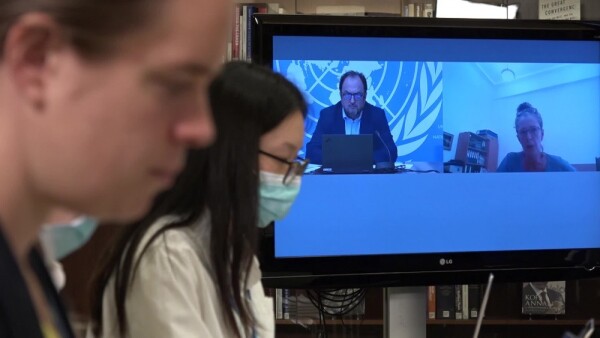
2. Wide shot, panel at briefing.
3. Soundbite: (ENGLISH) Denise Brown, OCHA Humanitarian Coordinator in Ukraine:
“The winter is coming. These people have been caught in a war. Do they have what is necessary to make it through the winter months? I don't have anyone telling me that they do. So I can only assume that they don't. So every week or every two weeks, we're issuing notifications trying to access these populations.”
4. Close of journalist writing.
5. Soundbite: (ENGLISH) Denise Brown, OCHA Humanitarian Coordinator in Ukraine:
“We have to help people wherever they are and I'm hopeful that the Russian Federation will provide the security guarantees that we require to go across. That's all we want to do. Provide insulin to the hospitals, provide blankets, provide mattresses, fuel if we can, repair windows and doors. It's not complicated.”
6. Mid side view of attendees, screen showing briefing in background.
7. Soundbite: (ENGLISH) Denise Brown, OCHA Humanitarian Coordinator in Ukraine:
“The war has not prevented the humanitarian community from delivering. Since the start of the war, we've reached over 12 million people, which is a tremendous achievement. That's in cash transfers, that's in health, that's in shelter, that's access to clean water, protection, rehabilitation. So the team on the ground is really working extremely hard.”
8.Mid shot of attendees at briefing.
9. Soundbite: (ENGLISH) Denise Brown, OCHA Humanitarian Coordinator in Ukraine:
“In that time we have reached less than a million people in the non-government controlled areas. We just have no reliable way of crossing the frontline.”
10. Close shot of panellist, speaker on screen in background.
11. Soundbite: (ENGLISH) Denise Brown, OCHA Humanitarian Coordinator in Ukraine:
“People in this country have suffered enormously, enormous loss of lives, enormous loss of livelihood. The agricultural production, which, thanks to the Black Sea initiative, is now finally moving, will have an impact on families, on farmers and their communities and on the food insecure, particularly in the Horn of Africa right now.”
12. Mid shot of attendees at briefing.
13. Soundbite: (ENGLISH) Denise Brown, OCHA Humanitarian Coordinator in Ukraine:
“You just have to see as you drive across this country, it's an agricultural country. There's production everywhere. So we can only imagine that if farmers can't reach their land, that's going to have a huge impact on their economic situation.”
14. Mid shot of screen with speaker and panellist, camera in foreground.
15. Mid shot of attendees at briefing.
16. Close shot of reporter typing.
Similar Stories

2
17
1
2
Edited News , Press Conferences , Images | OCHA , WMO
Two UN agencies teamed up on Wednesday to issue an appeal for immediate assistance to help communities already being impacted by the strongest El Niño on record.

3
16
2
2
Edited News , B-roll , Conferences , Images | UNITED NATIONS , UNOG
Sixth Consultative Meeting on Enhancing Coordination of Peace Initiatives and Efforts for Sudan

1
1
1
Edited News | UNICEF , WHO , UNHCR
Yemen war continues to force families from homes amid hunger and disease
More than 250,000 people have now fled renewed fighting in Yemen, the UN said on Tuesday, citing particular concern for those sheltering in the southwestern city of Taiz and the wider governorate, where access is “essentially blocked”.

1
1
1
Edited News | UNICEF
A little over one year since a ceasefire agreement was announced between Hamas fighters and Israel, more than 340 children have been reported killed and hundreds more injured, the UN Children’s Fund, UNICEF, said on Friday.

1
1
1
Edited News | UNICEF , IFRC
Six weeks after Nepal’s deadly flooding disaster, communities are still struggling to rebuild their lives, but they will need sustained help as global warming increases the risk of another Himalayan catastrophe, the UN Children’s Fund (UNICEF) said on Friday.

1
1
1
Edited News | WHO
In suspected Russia plague death, testing and monitoring underway – WHO
The death of a lab worker in Russia’s Siberia region has sparked concerns about plague being the cause, the UN World Health Organization (WHO) said on Tuesday, adding that it was following the situation closely.

1
1
Edited News | OHCHR , UNOG
UN Human Rights Chief Volker Türk on Friday provided and oral update to the 63rd session of the Human rights Council on Ukraine.

1
1
1
Edited News | OHCHR , UNOG
UN Human Rights Chief Volker Türk on Friday provided and oral update to the 63rd session of the Human rights Council on the human rights situation in Haiti.

1
1
1
Edited News | WHO
Repeated delays in bringing lifesaving medicines, prosthetics and more from Israel into Gaza risk having devastating consequences on Palestinians who urgently need them in the wartorn enclave, the UN World Health Organization (WHO) said on Friday. “A truck full of non-priority supplies or the right supplies arriving too late, doesn't save lives. That's the question that actually matters," said Dr Reinhilde Van De Weerdt, WHO Representative in the OPT.

1
1
1
Edited News | WHO
DRC: Early access to care and oxygen decisive for Ebola patients’ survival – WHO
In the Democratic Republic of the Congo (DRC), health workers fighting the country’s largest-ever Ebola outbreak are struggling to overcome critical challenges to patient care, the UN World Health Organization (WHO) warned on Tuesday.

1
1
1
Edited News | OCHA , UN
Civilians in Iran are continuing to feel the consequences of months of conflict and military escalation, the UN’s top official in the country has said, as loss of life, damage to civilian infrastructure and mounting economic pressures leave many facing continued uncertainty.
1
1
1
Edited News | WHO , UNICEF
Aid agencies in Yemen highlighted the growing hunger emergency sparked by renewed fighting between Houthi opposition forces and Government troops, after mobile health clinics reported that hundreds of children displaced by the violence are suffering from the most deadly form of malnutrition.