

The United Nations Office at Geneva
Multimedia Newsroom
UN Secretary-General António Guterres denounced on Monday at the opening of nearly six weeks of the UN Human Rights Council in Geneva setbacks in human rights around the world.
“The Universal Declaration (of Human Rights) is under assault from all sides”, he said. “The Russian invasion of Ukraine has triggered the most massive violations of human rights we are living today. It has unleashed widespread death, destruction and displacement. Attacks on civilians and civilian infrastructure have caused many casualties and terrible suffering.”
Mr. Guterres pointed out dozens of cases of conflict-related sexual violence against men, women and girls, while serious violations of international humanitarian law and human rights law against prisoners of war have been documented in Ukraine by the UN human rights office.
Mr. Guterres called for a revitalized Universal Declaration to face today’s new challenges. “This is a moment to stand on the right side of history”, the UN Secretary-General said. “A moment to stand up for the human rights of everyone, everywhere. We must revitalize the Universal Declaration and ensure its full implementation to face the new challenges of today and tomorrow.”
Although people’s average lifespan in the last 100 years ago has increased from 32 years to more than 70, and seven out of every 10 people were illiterate, now it’s less than two in 10, the UN chief warned that numerous 21st century challenges confront us.
“Extreme poverty and hunger are rising for the first time in decades”, Mr. Guterres said. “Nearly half of the world’s population, 3.5 billion people, live in climate hotspots. These vast areas are fast becoming human rights disaster zones where floods, droughts and storms mean people are 15 times more likely to die of climate impacts. A record 100 million people have been forced to flee by violence, conflict and human rights violations.“
Csaba Kőrösi, President of the 77th session of the General Assembly, who also addressed the Council, said that whilst there were reasons to celebrate, these were clearly superseded by the reality of a world in a state of disarray, with unprecedented, cascading, and interlocking crises.
The world has far from recovered from the COVID-19 pandemic, with over 70 countries in debt distress, women and girls in systematically sidelined in many countries, and the world not on track to achieve the 2030 Agenda. The Security Council, like the General Assembly, was at a crossroads.
“Today, I want to advocate for a transformation of how we do things”, Mr. Kőrösi said. “I am calling for a fundamental shift in how we manage interlocking crises. Now, nowhere is that more apparent than in tackling climate change.”
Volker Türk, United Nations High Commissioner for Human Rights, who addressed the Council for the first time since taking office last December, said over the past 75 years, there had been profound gains and many achievements. However, the oppression of the past could return, in various disguises, including wars of aggression, as witnessed in Europe with the Russian invasion of Ukraine.
“If there was ever a moment to revitalize the hope of human rights for every person, it is now”, Mr. Türk said. “Yet, much of the progress made over decades is being reined back and even reversed in some parts – most conspicuously for women and girls, the civic space and the freedoms enjoyed at times of peace and through sustainable development, and the list is long.“
In July this year, Mr. Guterres and the UN High Commissioner will launch a new Agenda for Protection. The important initiative will seek to strengthen support from across the United Nations system to Member States to protect people and their rights, in times of peace and conflict.
“It is against this backdrop that we have embarked this year on the Human Rights 75 Initiative, first and foremost, to rebuild trust,” said Mr. Türk. “Trust between States that they will act in line with international law and the agreements which they themselves have drafted, and jointly work to advance the common good.”
More than 100 Heads of State and ministers are taking part in the 52nd UN Human Rights Council session in Geneva which started today. On the agenda: an extensive array of human rights issues- including discrimination, the freedom of religion, right to housing – as well as country situations like those in Afghanistan, Syria, Myanmar, Nicaragua and South Sudan.
The Geneva-based UN Human Rights Council is made up of governments to protect human rights worldwide. It does not have legally binding powers but its debates often bring heightened scrutiny to issues and it can initiate investigations that provide evidence to national and international courts.
-ends-
STORY: Opening Statements HRC 52
TRT: 3:05”
SOURCE: UNTV CH
RESTRICTIONS: NONE
LANGUAGE: ENGLISH/NATS
ASPECT RATIO: 16:9
DATELINE: 27 February 2023 GENEVA, SWITZERLAND
SHOTLIST
- Medium shot, UN Geneva flag alley.
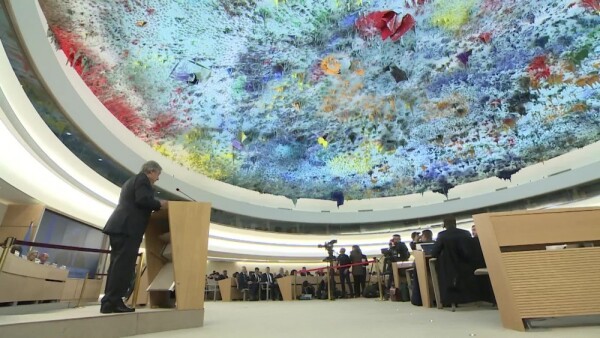
- Wide shot, Human Rights Room with delegates
- SOUNDBITE (ENGLISH) – António Guterres, UN Secretary-General: “The Universal Declaration is under assault from all sides. The Russian invasion of Ukraine has triggered the most massive violations of human rights we are living today. It has unleashed widespread death, destruction and displacement. Attacks on civilians and civilian infrastructure have caused many casualties and terrible suffering.”
- Medium shot, Secretary-General on screen while speaking at podium
- SOUNDBITE (ENGLISH) – António Guterres, UN Secretary-General: “This is a moment to stand on the right side of history. A moment to stand up for the human rights of everyone, everywhere. We must revitalize the Universal Declaration and ensure its full implementation to face the new challenges of today and tomorrow.”
- Wide shot, Secretary-General speaking at podium with ceiling and delegates
- SOUNDBITE (ENGLISH) - António Guterres, UN Secretary-General: “Extreme poverty and hunger are rising for the first time in decades. Nearly half of the world’s population, 3.5 billion people, live in climate hotspots. These vast areas are fast becoming human rights disaster zones where floods, droughts and storms mean people are 15 times more likely to die of climate impacts. A record one hundred million people have been forced to flee by violence, conflict and human rights violations.“
- Wide shot, Human Rights Room with delegates
- SOUNDBITE (ENGLISH) - Csaba Kőrösi, President of the General Assembly: “Today, I want to advocate for a transformation of how we do things. I am calling for a fundamental shift in how we manage interlocking crises. Now, nowhere is that more apparent than in tackling climate change.”
- Wide shot, Human Rights Room with Human Rights Commission Volker Türk at podium
- SOUNDBITE (ENGLISH) - Volker Türk, UN High Commissioner for Human Rights: “If there was ever a moment to revitalize the hope of human rights for every person, it is now. Yet, much of the progress made over decades is being reined back and even reversed in some parts – most conspicuously for women and girls, the civic space and the freedoms enjoyed at times of peace and through sustainable development, and the list is long.“
- Medium shot, UN High Commissioner for Human Rights speaking at the podium
- SOUNDBITE (ENGLISH) - Volker Türk, UN High Commissioner for Human Rights: “It is against this backdrop that we have embarked this year on the Human Rights 75 Initiative, first and foremost, to rebuild trust. Trust between States that they will act in line with international law and the agreements which they themselves have drafted, and jointly work to advance the common good.”
- Close up, Cameraman filming with colorful ceiling in the background
- Wide shot, Delegates and photographers in front of screen which shows UN SG
- Wide shot, Human Rights Room with delegates and colourful ceiling
Similar Stories
1
1
1
Edited News | OCHA , UNICEF , WFP
Aid agencies warned on Friday of the fast-developing humanitarian emergency inside Taiz City in Yemen, which has been encircled by de facto Houthi forces fighting government troops along the country’s west coast.

2
17
1
2
Edited News , Press Conferences , Images | OCHA , WMO
Two UN agencies teamed up on Wednesday to issue an appeal for immediate assistance to help communities already being impacted by the strongest El Niño on record.

3
16
2
2
Edited News , B-roll , Conferences , Images | UNITED NATIONS , UNOG
Sixth Consultative Meeting on Enhancing Coordination of Peace Initiatives and Efforts for Sudan

1
1
1
Edited News | UNICEF , WHO , UNHCR
Yemen war continues to force families from homes amid hunger and disease
More than 250,000 people have now fled renewed fighting in Yemen, the UN said on Tuesday, citing particular concern for those sheltering in the southwestern city of Taiz and the wider governorate, where access is “essentially blocked”.

1
1
1
Edited News | UNICEF
A little over one year since a ceasefire agreement was announced between Hamas fighters and Israel, more than 340 children have been reported killed and hundreds more injured, the UN Children’s Fund, UNICEF, said on Friday.

1
1
1
Edited News | UNICEF , IFRC
Six weeks after Nepal’s deadly flooding disaster, communities are still struggling to rebuild their lives, but they will need sustained help as global warming increases the risk of another Himalayan catastrophe, the UN Children’s Fund (UNICEF) said on Friday.

1
1
1
Edited News | WHO
In suspected Russia plague death, testing and monitoring underway – WHO
The death of a lab worker in Russia’s Siberia region has sparked concerns about plague being the cause, the UN World Health Organization (WHO) said on Tuesday, adding that it was following the situation closely.

1
1
Edited News | OHCHR , UNOG
UN Human Rights Chief Volker Türk on Friday provided and oral update to the 63rd session of the Human rights Council on Ukraine.

1
1
1
Edited News | OHCHR , UNOG
UN Human Rights Chief Volker Türk on Friday provided and oral update to the 63rd session of the Human rights Council on the human rights situation in Haiti.

1
1
1
Edited News | WHO
Repeated delays in bringing lifesaving medicines, prosthetics and more from Israel into Gaza risk having devastating consequences on Palestinians who urgently need them in the wartorn enclave, the UN World Health Organization (WHO) said on Friday. “A truck full of non-priority supplies or the right supplies arriving too late, doesn't save lives. That's the question that actually matters," said Dr Reinhilde Van De Weerdt, WHO Representative in the OPT.

1
1
1
Edited News | WHO
DRC: Early access to care and oxygen decisive for Ebola patients’ survival – WHO
In the Democratic Republic of the Congo (DRC), health workers fighting the country’s largest-ever Ebola outbreak are struggling to overcome critical challenges to patient care, the UN World Health Organization (WHO) warned on Tuesday.

1
1
1
Edited News | OCHA , UN
Civilians in Iran are continuing to feel the consequences of months of conflict and military escalation, the UN’s top official in the country has said, as loss of life, damage to civilian infrastructure and mounting economic pressures leave many facing continued uncertainty.