

The United Nations Office at Geneva
Multimedia Newsroom
Edited News , Statements | OHCHR , UNOG
HRC 53 - UN Human Rights Office on recording civilian casualties
Recording casualties in complex and conflict situations is an essential part of the work of the UN Human Rights Office, rooted in the conviction that every single human life matters as does every single human death.
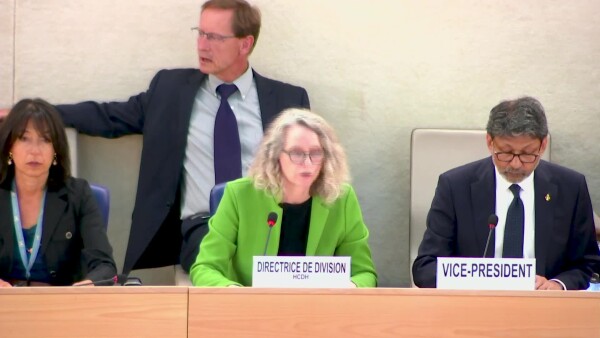
That was the message delivered by senior UN Human Rights official Peggy Hicks as she presented a report by the Office on casualty recording to the Human Rights Council in Geneva.
“Casualty recording is a painstaking, arduous and essential form of human rights monitoring. It entails systematically collecting and verifying information on individual deaths and, also injuries in complex and conflict situations,” Hicks said.
The report outlines the impact of casualty recording on the promotion and protection of human rights. It showcases the profound value of the work in this area since 2007, including in Afghanistan, Iraq, Libya, Mali, Somalia, South Sudan, the Occupied Palestinian Territory, Ukraine and Yemen.
Hicks, the director of the Thematic Engagement Division at the UN Human Rights Office, described how such work is done and why it matters.
“We establish the facts, as best we are able; we pursue accountability -- and therefore deterrence; and we reveal the true cost of crisis or conflict, including to those who are responsible for their violence and to their sponsors,” Hicks said.
Most of the time, confirmed information about each casualty will include the circumstances and location of the casualty event; where possible, the alleged perpetrator; and the sex, estimated age, and even the name of each individual victim. These data enable comparisons over time, across regions and between actors, contributing to better understanding of an often tense, volatile and shifting situation.
Hicks said colleagues working on casualty recording may first learn about a casualty event from open-source material, media reports or information received from a network of community monitors. Subsequently, each piece of information is verified – often with the families of victims, but sometimes with medical and emergency staff, community leaders, officials, human rights defenders, and survivors or witnesses of the event as well. Where possible, photographs or videos are checked and verified.
Francesca Marotta is the Chief of Methodology, Education and Training Section at the Office of the High Commissioner for Human Rights and has been leading the methodological development of casualty recording.
“We always strive to compile information with a minimum set of data that include the location of every incident, the date and the type of incident and the number of individuals that have been killed or injured. The cause of this, which is also particularly important for analysis purposes to understand, for example, which kind of tactics or which kind of weapons might be causing casualties in each specific context or in each region. Uh, the status of the victim. In most cases, we focus on civilians and as much as possible information on alleged perpetrators,” Marotta said.
Marotta explained that the Office’s methodology is based on using multiple sources to verify each aspect of each incident where there are civilian casualties.
“It is also based on using a broad variety of sources or diversify our sources in order to ensure an impartial and objective assessment of each incident involving casualties and on the application of our standard of proof, which is usually reasonable grounds to believe that certain facts occurred. Um, and if we are concluding for violations that they also amount to certain violations of international law,” she said.
Casualty recording is also done for situations of violence and unrest. An example of this is Haiti, where the UN in 2022 recorded the deaths of 160 prisoners, prompting an investigation by the UN Human Rights Office. This found that the deaths were mainly due to detention conditions, particularly the constant lack of food, medicine, water and proper sanitation. In addition, access to prisons is limited amid gang violence.
“The United Nations country team, including UN human rights, advocated for with a national international stakeholder for the prisons to receive supplies, including food and medicines, in a way that could protect the prisoners right to life,” Marotta said.
Casualty recording can also support efforts to ensure accountability for deaths and injuries, helping to build a picture of trends, perpetrators, military tactics and weapons being used, and give context to what has happened, including with regard to holding specific individuals accountable.
Hicks also stressed how the Office’s casualty monitoring can help to build some degree of dialogue and trust, and in so doing, provide a basis for the Office to advocate for mitigation measures, and changes to tactics, operations and policies.
“In a context of violent conflict that is thick with distrust and misinformation, our stringent verification of casualty counts means they are often recognised by all actors as one of the few reliable sources of information available,” Peggy Hicks said.
“This ultimately leads to better protection of civilians, and the prevention of violations of international humanitarian and human rights law. In several circumstances, “no-strike lists” and targeting protocols by parties to a conflict have been revised because of information on civilian casualties that we provided,” she said.
For more information and media requests, please contact:
Ravina Shamdasani - + 41 22 917 9169 / ravina.shamdasani@un.org or Marta Hurtado - + 41 22 917 9466 / marta.hurtadogomez@un.org Liz Throssell + 41 22 917 9296 / elizabeth.throssell@un.org
Tag and share
Twitter @UNHumanRights
Facebook unitednationshumanrights
Instagram @unitednationshumanrights
Tag and share - Twitter: @UNHumanRights and Facebook: unitednationshumanrights
Monday 3 July 2023
- Exterior shots: Palais des Nations
- Wide shot Interior: Room 20
- Wide shot: Podium
- SOUNDBITE (English)—Peggy Hicks, Director, Thematic Engagement, Special Procedures, and Right to Development Division, Office of the High Commissioner for Human Rights (OHCHR):“Casualty recording is a painstaking, arduous and essential form of human rights monitoring. It entails systematically collecting and verifying information on individual deaths and, also injuries in complex and conflict situations.”
- Still picture: Caption: A military vehicle dugout next to the school in Katiuzhanka, Kyiv Region. 29/04/22 ©OHCHR
- Two still pictures: Damaged cars in a yard in Bucha, where local authorities collect all damaged civilian cars and military vehicles. 30/04/22 ©OHCHR
- Still picture: Caption:A destroyed apartment block in Borodianka, Kyiv Region 01/05/22 ©OHCHR
- SOUNDBITE (English)—Peggy Hicks, Director, Thematic Engagement, Special Procedures, and Right to Development Division, Office of the High Commissioner for Human Rights (OHCHR):“We establish the facts, as best we are able; we pursue accountability -- and therefore deterrence; and we reveal the true cost of crisis or conflict, including to those who are responsible for their violence and to their sponsors.”
- Various shots: UN mission to Izium, collapsed building 06-12-2022 Izium, Ukraine
- SOUNDBITE (English)— Francesca Marotta, Chief of Methodology, Education and Training Section at the Office of the High Commissioner for Human Rights: “We always strive to compile information with a minimum set of data that include the location of every incident, the date and the type of incident and the number of individuals that have been killed or injured. The cause of this, which is also particularly important for analysis purposes to understand, for example, which kind of tactics or which kind of weapons might be causing casualties in each specific context or in each region. Uh, the status of the victim. In most cases, we focus on civilians and as much as possible information on alleged perpetrators.”
- Video of Animation figures on Casualty recording ©OHCHR
- SOUNDBITE (English)— Francesca Marotta, Chief of Methodology, Education and Training Section at the Office of the High Commissioner for Human Rights: “It is also based on using a broad variety of sources or diversify our sources in order to ensure an impartial and objective assessment of each incident involving casualties and on the application of our standard of proof, which is usually reasonable grounds to believe that certain facts occurred. Um, and if we are concluding for violations that they also amount to certain violations of international law.”
- Still pictures: Caption: centre carcéral de port au Prince, Haiti 26/06/23 ©OHCHR
- SOUNDBITE (English)— Francesca Marotta, Chief of Methodology, Education and Training Section at the Office of the High Commissioner for Human Rights: “The United Nations country team, including UN human rights, advocated for with a national international stakeholder for the prisons to receive supplies, including food and medicines, in a way that could protect the prisoners right to life.”
- Cut away: room 20
- SOUNDBITE (English)—Peggy Hicks, Director, Thematic Engagement, Special Procedures, and Right to Development Division, Office of the High Commissioner for Human Rights (OHCHR): “In a context of violent conflict that is thick with distrust and misinformation, our stringent verification of casualty counts means they are often recognised by all actors as one of the few reliable sources of information available.”
- Cut away: room 20
- SOUNDBITE (English)—Peggy Hicks, Director, Thematic Engagement, Special Procedures, and Right to Development Division, Office of the High Commissioner for Human Rights (OHCHR):“This ultimately leads to better protection of civilians, and the prevention of violations of international humanitarian and human rights law. In several circumstances, “no-strike lists” and targeting protocols by parties to a conflict have been revised because of information on civilian casualties that we provided.”
Similar Stories

1
1
1
Edited News | OCHA , UNICEF , WFP
Aid agencies warned on Friday of the fast-developing humanitarian emergency inside Taiz City in Yemen, which has been encircled by de facto Houthi forces fighting government troops along the country’s west coast.

2
17
1
2
Edited News , Press Conferences , Images | OCHA , WMO
Two UN agencies teamed up on Wednesday to issue an appeal for immediate assistance to help communities already being impacted by the strongest El Niño on record.

3
16
2
2
Edited News , B-roll , Conferences , Images | UNITED NATIONS , UNOG
Sixth Consultative Meeting on Enhancing Coordination of Peace Initiatives and Efforts for Sudan

1
1
1
Edited News | UNICEF , WHO , UNHCR
Yemen war continues to force families from homes amid hunger and disease
More than 250,000 people have now fled renewed fighting in Yemen, the UN said on Tuesday, citing particular concern for those sheltering in the southwestern city of Taiz and the wider governorate, where access is “essentially blocked”.

1
1
1
Edited News | UNICEF
A little over one year since a ceasefire agreement was announced between Hamas fighters and Israel, more than 340 children have been reported killed and hundreds more injured, the UN Children’s Fund, UNICEF, said on Friday.

1
1
1
Edited News | UNICEF , IFRC
Six weeks after Nepal’s deadly flooding disaster, communities are still struggling to rebuild their lives, but they will need sustained help as global warming increases the risk of another Himalayan catastrophe, the UN Children’s Fund (UNICEF) said on Friday.

1
1
1
Statements , Press Conferences | OHCHR

1
1
1
Edited News | WHO
In suspected Russia plague death, testing and monitoring underway – WHO
The death of a lab worker in Russia’s Siberia region has sparked concerns about plague being the cause, the UN World Health Organization (WHO) said on Tuesday, adding that it was following the situation closely.

1
1
Edited News | OHCHR , UNOG
UN Human Rights Chief Volker Türk on Friday provided and oral update to the 63rd session of the Human rights Council on Ukraine.
2
1
2
Statements , Conferences | HRC , OHCHR
Interactive dialogue with the High Commissioner for Human Rights, Volker Türk on the oral update on Ukraine.

1
1
1
Edited News | OHCHR , UNOG
UN Human Rights Chief Volker Türk on Friday provided and oral update to the 63rd session of the Human rights Council on the human rights situation in Haiti.

1
1
1
Edited News | WHO
Repeated delays in bringing lifesaving medicines, prosthetics and more from Israel into Gaza risk having devastating consequences on Palestinians who urgently need them in the wartorn enclave, the UN World Health Organization (WHO) said on Friday. “A truck full of non-priority supplies or the right supplies arriving too late, doesn't save lives. That's the question that actually matters," said Dr Reinhilde Van De Weerdt, WHO Representative in the OPT.