

The United Nations Office at Geneva
Multimedia Newsroom
Press Conferences , Edited News | HRC
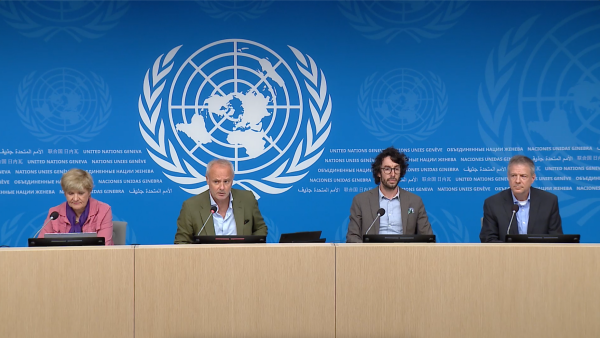
HRC Press Conference: Special Rapporteur on the Right to Health on health situation in Gaza - 22 April 2024
“A war on the right to health” – UN expert raised concern about Gazans mental health due to conflict
A UN expert on health cautioned on Monday (22 Apr) that the ongoing conflict in Gaza could potentially lead to the emergence of mental health issues among its residents in the years to come.
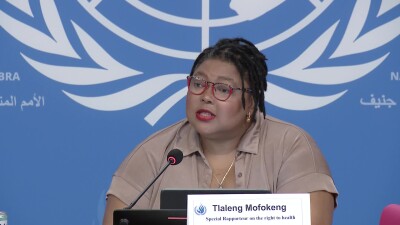
Speaking to journalists at the United Nations in Geneva, UN Special Rapporteur on the right to health, Dr. Tlaleng Mofokeng, said that “as a practicing medical doctor, I know that the long-term trauma that the people of Gaza, its children, will carry with them because of enduring intergenerational physical and mental health, health impacts of racism, structural discrimination, violence and imperialism.”
According to the latest figures by the UN Office for Humanitarian Affairs (OCHA), which quotes the Ministry of health in Gaza, between 7 October 2023 and 19 April 2024, at least 34,012 Palestinians were killed in Gaza and 76,833 Palestinians were injured.
Israel began its assault after Hamas fighters attacked Israel on Oct. 7, killing some 1,200 people and abducting another 253 to Gaza, according to Israeli tallies.
“The right to health has been in the spotlight, from my perspective, in a way that we've never seen before in the times of a crisis, in a conflict in that those protected sites under international human rights law and international humanitarian law have been bombed and attacked, and Israel has failed, firstly as an occupying power, but also as a member of the UN to uphold those rights and meet the obligations,” said Dr. Mofokeng.
Numerous hospitals in the Gaza Strip, including Al Shifa Hospital, which was the largest in the area prior to the conflict, have been severely damaged or destroyed as a result of the Israeli military campaign, said the World Health Organization (WHO).
For Dr. Mofokeng “the health system in Gaza has been completely obliterated and the right to health has been decimated at every level. The conditions are incompatible with the realization of everyone to the highest attainable standard of physical and mental health.”
Health workers have also been among the casualties. Israel accuses Hamas of frequently utilizes hospitals, ambulances, and other medical facilities for military operations. “The attacks, the harassment, the killings of many of my own colleagues, the health care workers, the destructions of health facilities, and the destruction of humanitarian aid organizations continue to catapult to proportions yet to be fully quantified, if at all possible,” stressed Dr. Mofokeng.
According to WHO, there have so far been at least 435 attacks on health facilities or personnel across Gaza in six months of conflict between 7 October 2023 and early April 2024 – equivalent to 73 attacks per month of war. This number, so WHO, exceeds the number of attacks per month in all other war-torn countries since 2018, including Ukraine who have the second highest number at 67 attacks per month, and the Democratic Republic of Congo with an average of 11 attacks per month.
“Just days into the war on Gaza, the medical infrastructure was irreparably damaged, health care providers were working on a dire situation with limited access to medical supplies under conditions that did not allow them to provide timely and quality health care,” reported Dr. Mofokeng. “They themselves, as healthcare workers under bombardment in the enclave. I bear witness is the very practice of medicine is under attack, and this has been a war on the right to health from the beginning, as well as underlying determinants of health.”
In its latest update, OCHA informed that every ten minutes, one child is killed or injured in Gaza, quoting the UN Children’s Fund (UNICEF) which based that information on figures by the Ministry of Health, stressing the urgent need to increase medical evacuations of children.
“Imagine living under the constant anticipation of a bomb, of a gun or being shot while you're trying to get food or water or play, that is in itself a form of violence to anticipate that your life could be distinguished in any moment,” said Dr. Mofokeng. “For children to grow up with that level of trauma is not normal. But for decades, that has been normalized for the people of occupied Palestinian territory and I'm saying that October 7th is an episode amongst the many in which the world leaders have let the people down.”
In February, UNICEF reported an estimate of 17,000 children in Gaza who were either unaccompanied or had become separated from their families due to the conflict. Additionally, UNICEF informed that nearly all children in the region were believed to be in need of mental health assistance, more than one million children. Before the conflict erupted, UNICEF estimated that more than 500,000 children in the Gaza strip required mental health and psycho-social support.
“Not only is Israel killing and causing irreparable harm against Palestinian civilians with its bombardments and their allies, they are also knowingly and intentionally imposing famine, prolonged malnutrition and dehydration”, Dr. Mofokeng said. “I remain concerned at the ongoing risks of water and air borne diseases, lack of medical and surgical supplies and commodities, and the lack of sexual and productive health and mental services.”
-ends-
STORY: UN Special Rapporteur on Health – Gaza
TRT: 3:29”
SOURCE: UNTV CH
RESTRICTIONS: NONE
LANGUAGE: ENGLISH / NATS
ASPECT RATIO: 16:9
DATELINE: 22 April 2024 GENEVA, SWITZERLAND
- Exterior med shot: UN flag alley
- Wide shot: speakers at the podium during press conference with journalists in press room
- SOUNDBITE (English) – Tlaleng Mofokeng, UN Special Rapporteur on the right to health: “As a practicing medical doctor, I know that the long-term trauma that the people of Gaza, its children, will carry with them because of enduring intergenerational physical and mental health, health impacts of racism, structural discrimination, violence and imperialism.”
- Med shot: Speaker at the podium
- SOUNDBITE (English) – Tlaleng Mofokeng, UN Special Rapporteur on the right to health: “Just days into the war on Gaza, the medical infrastructure was irreparably damaged, health care providers were working on a dire situation with limited access to medical supplies under conditions that did not allow them to provide timely and quality health care. They themselves, as healthcare workers under bombardment in the enclave. I bear witness is the very practice of medicine is under attack, and this has been a war on the right to health from the beginning, as well as underlying determinants of health.”
- Med shot: Technical staff working behind the window with photographer in front taking pictures of the briefing
- SOUNDBITE (English) – Tlaleng Mofokeng, UN Special Rapporteur on the right to health: “The health system in Gaza has been completely obliterated and the right to health has been decimated at every level. The conditions are incompatible with the realization of everyone to the highest attainable standard of physical and mental health. The attacks, the harassment, the killings of many of my own colleagues, the health care workers, the destructions of health facilities, and the destruction of humanitarian aid organizations continue to catapult to proportions yet to be fully quantified if at all possible.”
- Wide shot: Speakers at the podium
- SOUNDBITE (English) – Tlaleng Mofokeng, UN Special Rapporteur on the right to health: “Not only is Israel killing and causing irreparable harm against Palestinian civilians with its bombardments and their allies, they are also knowingly and intentionally imposing famine, prolonged malnutrition and dehydration. I remain concerned at the ongoing risks of water and air borne diseases, lack of medical and surgical supplies and commodities, and the lack of sexual and productive health and mental services.”
- Med shot: Journalists in press room
- SOUNDBITE (English) - Tlaleng Mofokeng, UN Special Rapporteur on the right to health: “The right to health has been in the spotlight, from my perspective, in a way that we've never seen before in the times of a crisis, in a conflict in that those protected sites under international human rights law and international humanitarian law have been bombed and attacked, and Israel has failed, firstly as an occupying power, but also as a member of the UN to uphold those rights and meet the obligations.”
- Wide shot: journalists listening
- SOUNDBITE (English) - Tlaleng Mofokeng, UN Special Rapporteur on the right to health: “Imagine living under the constant anticipation of a bomb, of a gun or being shot while you're trying to get food or water or play, that is in itself a form of violence to anticipate that your life could be distinguished in any moment. And for children to grow up with that level of trauma is not normal. But for decades, that has been normalized for the people of occupied Palestinian territory. And I'm saying that October 7th is an episode amongst the many in which the world leaders have let the people down.”
- Wide shot, panelists at the podium with journalists in press room
- Wide shot, panelists at the podium with journalists in press room
- Wide shot, panelists at the podium with journalists in press room
Similar Stories
1
1
1
Press Conferences | UNHCR
End of UNHCR's 77th Annual Executive Committee (ExCom) meeting week

1
1
1
Edited News | UNICEF
A little over one year since a ceasefire agreement was announced between Hamas fighters and Israel, more than 340 children have been reported killed and hundreds more injured, the UN Children’s Fund, UNICEF, said on Friday.
1
1
1
Press Conferences | UNICEF , IOM , UNHCR
UN Special Assistant to the Personal Envoy Office (SUDAN): Peace Initiatives and Efforts in Sudan; UNICEF: Dire situation of children in Gaza; IOM: Damaged Homes and Energy Attacks Risk Displacing Ukrainians for this winter; UNHCR: update on EXCOM week

1
1
1
Press Conferences | IOM , UNDRR
UN stresses importance of household preparedness for disaster risk reduction.

1
1
1
Edited News | UNICEF , IFRC
Six weeks after Nepal’s deadly flooding disaster, communities are still struggling to rebuild their lives, but they will need sustained help as global warming increases the risk of another Himalayan catastrophe, the UN Children’s Fund (UNICEF) said on Friday.

1
1
1
Statements , Press Conferences | OHCHR

1
1
1
Press Conferences | UNHCR , UNICEF , IFRC , OHCHR , UN WOMEN , IOM , OCHA , WHO
UNHCR – ExCom Meeting, UNICEF – Nepal Recovery, IFRC – Flash Floods, WHO – Mental Health, IOM – South Sudan Floods, OCHA – DRC Humanitarian aid, UNHCR – Sahel Displacement, UNICEF – Yemen Update, IOM – Gaza Shelter, UN Women – Gaza Women, OHCHR – Arrests and detentions of Syrians by Israeli force

2
1
2
Press Conferences | UNCTAD
Presentation of the Trade and Developement Report 2026
Embargoed until 9 October 2026 at 11 a.m. (Geneva Time)
UNCTAD: UNCTAD’s flagship report finds that governments increasingly use industrial, trade, financial and technology policies to pursue economic and national security objectives. Market access and the ability to move into higher-value activities now depend more heavily on technology, finance and geopolitics.

1
1
1
Press Conferences | UPU
Release of the State of the Postal Sector Report 2026

1
1
1
Edited News | WHO
In suspected Russia plague death, testing and monitoring underway – WHO
The death of a lab worker in Russia’s Siberia region has sparked concerns about plague being the cause, the UN World Health Organization (WHO) said on Tuesday, adding that it was following the situation closely.
1
1
1
Press Conferences | IOM , ITU , UNECE , UNICEF , WHO , WMO
UNICEF: Ebola, DRC - children orphans or separating them from parents and caregivers; IOM: Humanitarian needs in Djibouti amid arrivals from Yemen and increased migrant movements; WHO: Darfur, scale of health needs far exceeds available resources; WMO co-sponsored Global Heat Forum, Bangkok, monthly Global Seasonal Climate Update; UNECE: UN Forum of Mayors; ITU Plenipotentiary Conference 2026; WHO: child and adolescent obesity guidelines and new global roadmap to tackle pregnancy hypertension, a leading cause of maternal mortality

1
1
Edited News | OHCHR , UNOG
UN Human Rights Chief Volker Türk on Friday provided and oral update to the 63rd session of the Human rights Council on Ukraine.