

The United Nations Office at Geneva
Multimedia Newsroom
Humanitarian pauses in Gaza fighting will enable polio vaccine campaign to begin Sunday, says WHO
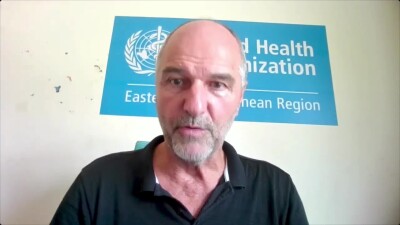
The United Nations has reached a tentative agreement with parties involved in the war in Gaza for humanitarian pauses to allow 640,000 children to be vaccinated amid an outbreak of the virus. According to UN World Health Organization (WHO) Representative for the Occupied Palestinian Territories, Dr. Rik Peeperkorn, the two-round vaccination campaign is due to begin on 1 September in central Gaza for three days, then move to the southern and northern areas. A second dose will be administered after four weeks.
“During each round of the campaign, the Palestinian Ministry of Health, in collaboration with the World Health Organization, UNICEF, UNRWA and partners, will provide two drops of novel oral polio vaccine type 2 (nOPV2) to more than 640,000 children under 10 years of age,” Dr. Peeperkorn told journalists in Geneva.
The campaign is all set after the delivery of 1.26 million doses of vaccines to Gaza and 500 vaccine carriers. According to the UN health agency, 400,000 additional vaccine doses will arrive in Gaza soon.
Speaking from Gaza, Dr. Peeperkorn welcomed a preliminary commitment with the Israeli military to “area-specific humanitarian pauses” during the vaccination campaign. “We call on all parties to pause fighting to allow children and families to safely access health facilities and community outreach workers to get to children who cannot access health facilities for polio vaccination,” he said.
Without humanitarian pauses, the campaign – a massive task in any setting, let alone after more than 10 months of heavy fighting, mass casualties and displacement together with disease spread - will not be possible, warned the WHO.
The campaign will be rolled out in phases of three days each, starting with central Gaza followed by south and finally north Gaza. Vaccinations will be extended by one day wherever necessary to account for upticks in violence, destroyed roads and infrastructure damage - all additional hurdles that could hamper the objective of achieving sufficient vaccine coverage within three days in each area. At least 90 per cent vaccination coverage during each round of the campaign is needed to stop the outbreak and prevent international spread of polio.
The UN health agency will coordinate with all parties, including the Israeli humanitarian coordination unit, COGAT, to ensure safe access to health facilities for children and families.
“Security is paramount” for more than 2,180 health workers and community outreach workers ready to support the campaign, insisted Dr. Peeperkorn. Vaccines will be delivered to 392 locations and complemented by some 300 mobile teams – a “not ideal” arrangement - but one that has been agreed “with all the parties,” he continued. “We will do our best to reach 90 per cent coverage.”
According to the WHO, routine immunization has been “very well received” in Gaza and the West Bank historically, with parents eager to bring their children for vaccination. Coverage was as high as 95 per cent in past years, higher than in many countries.
Amid a fourth day of Israeli military operations in the West Bank, humanitarians voiced concerns about the safety of civilians and aid teams.
Raids by the Israeli Security Forces (ISF) in densely populated Jenin and Tulkarem have reportedly killed at least 15 people. “Unimpeded accessibility of facilities is crucial for reaching and receiving care, but also to deliver health aid. We call on the infrastructure, ambulances, health workers around hospitals, health facilities to be protected,” reiterated Dr. Peeperkorn.
UN Secretary-General António Guterres condemned the situation late Wednesday, calling for an "immediate cessation" of Israeli operations in the OPT.
Since the start of the war, 652 Palestinians have also been killed in the West Bank and East Jerusalem, including 150 children, according to the Palestinian Ministry of Health. More than 5,400 people have been injured.
Ends.
Story: “Gaza polio campaign – WHO” – 30 August 2024
Speaker:
- Dr. Rik Peeperkorn, UN World Health Organization (WHO) Representative for the Occupied Palestinian Territories (OPT) - (speaking from Gaza)
TRT: 02’36”
SOURCE: UNTV CH
LANGUAGE: ENGLISH / NATS
ASPECT RATIO: 16:9
DATELINE: 30 August 2024 - GENEVA, SWITZERLAND
Geneva Press briefing
SHOTLIST
- Exterior medium shot: UN flag alley.
- Wide shot of the podium at the press conference room.
- SOUNDBITE (English) Dr. Rik Peeperkorn, UN World Health Organization (WHO) Representative for the Occupied Palestinian Territories (OPT): “A two-round polio vaccination campaign is set to begin on 1 September in the Gaza Strip. During each round of the campaign, the Palestinian Ministry of Health, in collaboration with the World Health Organization, UNICEF, UNRWA and partners, will provide two drops of novel oral polio vaccine type 2 (nOPV2) to more than 640,000 children under 10 years of age.”
- Medium shot of the podium and screen at the press conference room.
- SOUNDBITE (English) Dr. Rik Peeperkorn, UN World Health Organization (WHO) Representative for the Occupied Palestinian Territories (OPT): “We very much welcome the preliminary commitment to this, what we call area-specific humanitarian pauses during the campaign. We call on all parties to pause fighting to allow children and families to safely access health facilities and community outreach workers to get to children who cannot access health facilities for polio vaccination.”
- Medium shot: screen and journalists taking notes at the press conference room.
- SOUNDBITE (English) Dr. Rik Peeperkorn, UN World Health Organization (WHO) Representative for the Occupied Palestinian Territories (OPT): “Over 2,180 health workers and community outreach workers are ready and will support the campaign. The campaign will be delivered through 392 fixed points and 200, almost 300, mobile teams. This is a massive operation. Their security, of course, is paramount.”
- Medium shot of cameraman at the press conference room and control room at the back.
- SOUNDBITE (English) Dr. Rik Peeperkorn, UN World Health Organization (WHO) Representative for the Occupied Palestinian Territories (OPT): “The teams are ready to move forward and we expect that this will happen in the best possible way. [It is] possible, not ideal, I just want to stress that, [It is] not ideal, but I think we, with all the parties, we agreed this is a way forward. And we will do our level best to reach 90 per cent-plus coverage.”
- Wide shot of the press conference room and control room.
- SOUNDBITE (English) Dr. Rik Peeperkorn, UN World Health Organization (WHO) Representative for the Occupied Palestinian Territories (OPT): “We always raise this again and again: unimpeded accessibility of facilities is crucial for reaching and receiving care, but also to deliver health aid, etc. So, we call on the infrastructure, ambulances, health workers around hospitals, health facilities to be protected.”
- Various shots of the press conference room, control room and journalists.
Similar Stories
1
1
1
Edited News | OCHA , UNICEF , WFP
Aid agencies warned on Friday of the fast-developing humanitarian emergency inside Taiz City in Yemen, which has been encircled by de facto Houthi forces fighting government troops along the country’s west coast.

2
17
1
2
Edited News , Press Conferences , Images | OCHA , WMO
Two UN agencies teamed up on Wednesday to issue an appeal for immediate assistance to help communities already being impacted by the strongest El Niño on record.
3
16
2
2
Edited News , B-roll , Conferences , Images | UNITED NATIONS , UNOG
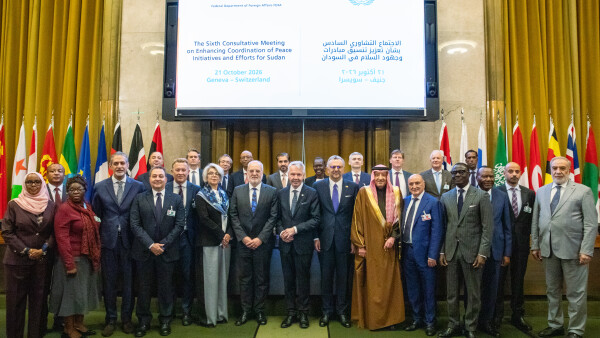
Sixth Consultative Meeting on Enhancing Coordination of Peace Initiatives and Efforts for Sudan

1
1
1
Edited News | UNICEF , WHO , UNHCR
Yemen war continues to force families from homes amid hunger and disease
More than 250,000 people have now fled renewed fighting in Yemen, the UN said on Tuesday, citing particular concern for those sheltering in the southwestern city of Taiz and the wider governorate, where access is “essentially blocked”.

1
1
1
Edited News | UNICEF
A little over one year since a ceasefire agreement was announced between Hamas fighters and Israel, more than 340 children have been reported killed and hundreds more injured, the UN Children’s Fund, UNICEF, said on Friday.

1
1
1
Edited News | UNICEF , IFRC
Six weeks after Nepal’s deadly flooding disaster, communities are still struggling to rebuild their lives, but they will need sustained help as global warming increases the risk of another Himalayan catastrophe, the UN Children’s Fund (UNICEF) said on Friday.

1
1
1
Edited News | WHO
In suspected Russia plague death, testing and monitoring underway – WHO
The death of a lab worker in Russia’s Siberia region has sparked concerns about plague being the cause, the UN World Health Organization (WHO) said on Tuesday, adding that it was following the situation closely.

1
1
Edited News | OHCHR , UNOG
UN Human Rights Chief Volker Türk on Friday provided and oral update to the 63rd session of the Human rights Council on Ukraine.

1
1
1
Edited News | OHCHR , UNOG
UN Human Rights Chief Volker Türk on Friday provided and oral update to the 63rd session of the Human rights Council on the human rights situation in Haiti.

1
1
1
Edited News | WHO
Repeated delays in bringing lifesaving medicines, prosthetics and more from Israel into Gaza risk having devastating consequences on Palestinians who urgently need them in the wartorn enclave, the UN World Health Organization (WHO) said on Friday. “A truck full of non-priority supplies or the right supplies arriving too late, doesn't save lives. That's the question that actually matters," said Dr Reinhilde Van De Weerdt, WHO Representative in the OPT.

1
1
1
Edited News | WHO
DRC: Early access to care and oxygen decisive for Ebola patients’ survival – WHO
In the Democratic Republic of the Congo (DRC), health workers fighting the country’s largest-ever Ebola outbreak are struggling to overcome critical challenges to patient care, the UN World Health Organization (WHO) warned on Tuesday.

1
1
1
Edited News | OCHA , UN
Civilians in Iran are continuing to feel the consequences of months of conflict and military escalation, the UN’s top official in the country has said, as loss of life, damage to civilian infrastructure and mounting economic pressures leave many facing continued uncertainty.