

The United Nations Office at Geneva
Multimedia Newsroom
Greenhouse gases reached another record high in 2023, warns UN weather agency
New data released by the UN on Monday indicating that greenhouse gases have hit a record high shows once again that urgent action and not words is needed from the world’s major polluters to protect us all from climate change, the World Meteorological Organization (WMO) insisted.
The appeal comes as global leaders prepare to gather for the UN’s Climate Change Conference in Baku next month, amid repeated dire warnings about the human cost of ignoring the existential crisis from UN Secretary-General António Guterres and others.
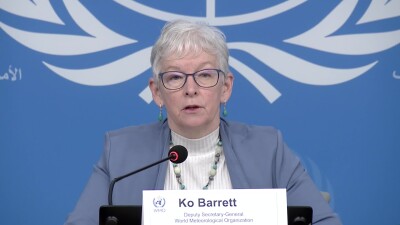
Echoing the UN chief’s longstanding appeals, WMO Deputy Secretary-General Ko Barrett told journalists that carbon dioxide (CO2) – one of the three main greenhouse gases, along with methane and nitrous oxide - is now accumulating in the atmosphere “faster than at any time experienced during human existence”. Because of the extremely long lifetime of CO2 in the atmosphere, “we are committed to rising temperatures for many, many years to come”, she added.
WMO’s 2024 Greenhouse Gas Bulletin offers a stark, scientific reminder that rising CO2 levels need to be slowed. In 2004, the concentration of carbon dioxide in the atmosphere was 377.1 parts per million (ppm), while in 2023, this reached 420 ppm, according to WMO’s Global Atmosphere Watch Network. “This is an increase of 42.9 parts per million, or 11.4 per cent in just 20 years,” Ms. Barrett explained.
“These are more than statistics," the WMO deputy chief insisted. "Every part per million matters, every fraction of a degree of temperature increase matters; it matters in terms of the speed of glacier and ice retreat, the acceleration of sea level rise, ocean heat and acidification. It matters in terms of the number of people who will be exposed to extreme heat every year, the extinction of species, the impact on our ecosystems and economies.”
Key greenhouse gas-producing events include forest fires and the El Niño weather phenomenon which fuelled drier conditions and a “surge” in concentrations in the latter part of 2023, according to WMO. Its analysis shows that just under half of CO2 emissions remain in the atmosphere, just over one quarter are absorbed by the ocean and just under 30 per cent are retained on land.
Senior scientific officer at WMO, Oksana Tarasova, described last year’s wildfires in Canada as “absolutely dramatic” in terms of the amount of greenhouse gases produced.
Today’s CO2 levels have not been seen “in the history of humanity”, she said. “The last time we see 400 parts per million of CO2 was three to five million years ago, and during that time, the temperature was three to four degrees warmer” and sea levels 10-20 metres higher.
The WMO report pointed out that from 1990 to 2023, radiative forcing – the warming effect on our climate from greenhouse gases increased by 51.5 per cent. CO2 accounted for more than 80 per cent of this increase, according to data from the National Oceanic and Atmospheric Administration Annual Greenhouse Gas Index.
“As long as emissions continue, greenhouse gases will continue accumulating in the atmosphere leading to global temperature rise,” the UN agency said. “Given the extremely long life of CO2 in the atmosphere, the temperature level already observed will persist for several decades even if emissions are rapidly reduced to net zero.”
Asked about whether the UN climate conference might be expected to yield tangible commitments from countries, the WMO Deputy Secretary-General noted that politicians worldwide do reference the latest scientific climate findings and forecasts in their public declarations. “So I do think they are listening, the question is to what degree will we see that manifest at COP29 in action,” she said.
Ms. Barrett noted that measures taken at a national level to transition to a “lower fossil fuel economy” were massively important to safeguard future generations.
“Even though there is a lag and temperatures will rise, we are not to be dissuaded from action,” she said, “because there will be a transformation and a downward trend in temperature in future. It all just depends on how quickly we take action and how fast we can reduce those temperatures.”
Story: Record greenhouse gas levels - WMO
Speakers:
Ko Barrett, WMO Deputy Secretary-General
Oksana Tarasova, Senior scientific officer, WMO
TRT: 0x’”
SOURCE: UNTV CH
LANGUAGE: ENGLISH / NATS
ASPECT RATIO: 16:9
DATELINE: 28 October 2024 - GENEVA, SWITZERLAND
RESTRICTIONS: None
SHOTLIST
- Exterior medium shot: UN flag alley.
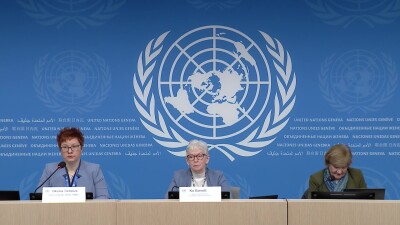
- Wide shot of the press conference room with speakers at the podium.
- SOUNDBITE (English) Ko Barrett, Deputy Secretary-General, World Meteorological Organization (WMO): “Carbon dioxide is accumulating in the atmosphere faster than at any time experienced during human existence, and because of the extremely long lifetime of CO2 in the atmosphere we are committed to rising temperatures for many, many years to come.”
- Medium shot of the podium’s speakers.
- SOUNDBITE (English) Ko Barrett, Deputy Secretary-General, World Meteorological Organization (WMO): “These are more than statistics; every part per million matters, every fraction of a degree of temperature increase matters; it matters in terms of the speed of glacier and ice retreat, the acceleration of sea level rise, ocean heat and acidification. It matters in terms of the number of people who will be exposed to extreme heat every year, the extinction of species, the impact on our ecosystems and economies.”
- Medium shot, TV screen showing CO2 dataset and graph with automatic TV camera in shot.
- SOUNDBITE (English) Ko Barrett, Deputy Secretary-General, World Meteorological Organization (WMO): “Yet again, unfortunately, we have to report that the main greenhouse gases, CO2, methane and nitrous oxide are all at record levels. In 2004, the concentration of carbon dioxide in the atmosphere was 377.1 parts per million. In 2023, 20 years later, it was at 420 parts per million, according to data from WMO’s Global Atmosphere Watch Network. This is an increase of 42.9 parts per million, or 11.4 per cent in just 20 years.”
- Medium-wide shot of speakers and Press room.
- SOUNDBITE (English) Oksana Tarasova, Senior scientific officer, WMO: “We have not seen these levels of CO2 in the history of humanity. The last time we see 400 parts per million of CO2 was three to five million years ago, and during that time, the temperature was three to four degrees warmer.”
- Medium, journalist typing on laptop.
- SOUNDBITE (English) Ko Barrett, Deputy Secretary-General, World Meteorological Organization (WMO): “The reason you’re seeing such variations even in the projections of what temperature rise might be in our future, it’s because it’s very much linked to the actions countries take now and the rapid - the ability to - make a rapid transition to a lower fossil fuel economy. And even though there is a lag and temperatures will rise, we are not to be dissuaded from action, because there will be a transformation and a downward trend in temperature in future. It all just depends on how quickly we take action and how fast we can reduce those temperatures.”
- Medium, podium speakers, UN logo as backdrop.
- SOUNDBITE (English) Ko Barrett, Deputy Secretary-General, World Meteorological Organization (WMO): “Personally, I see a lot of attention to science in the statements that are being made from politicians worldwide. So I do think they are listening, the question is to what degree will we see that manifest at COP29 in action.”
- Medium shot of TV screen showing data on greenhouse gas concentrations.
- Wide shot, Press room, TV screens showing Ms. Barrett and dataset.
- Medium shot, TV screen showing greenhouse gases dataset and graph with automatic TV camera in shot.
Similar Stories
1
1
1
Edited News | OCHA , UNICEF , WFP
Aid agencies warned on Friday of the fast-developing humanitarian emergency inside Taiz City in Yemen, which has been encircled by de facto Houthi forces fighting government troops along the country’s west coast.
1
1
1
Press Conferences | UN WOMEN , WFP , WHO
UN WOMEN: Sudan Women and girls one year after the fall of El Fasher; increasing drone attacks across the country; WFP: DRC - Ebola spreads to eighth DRC province as WFP delivers food, builds treatment centres and keeps supplies moving; WHO - Update on Ebola (Bundibugyo Virus Disease)
1
12
1
1
Press Conferences , Images | UNOG
Closing Press Conference following the Sixth Consultative Meeting on Enhancing Coordination of Peace Initiatives and Efforts in Sudan

2
17
1
2
Edited News , Press Conferences , Images | OCHA , WMO
Two UN agencies teamed up on Wednesday to issue an appeal for immediate assistance to help communities already being impacted by the strongest El Niño on record.

3
16
2
2
Edited News , B-roll , Conferences , Images | UNITED NATIONS , UNOG
Sixth Consultative Meeting on Enhancing Coordination of Peace Initiatives and Efforts for Sudan
1
1
1
Press Conferences | CITES
Wildlife trade and conservation policy discussions at the 81st meeting of the CITES Standing Committee (SC81)

1
1
1
Edited News | UNICEF , WHO , UNHCR
Yemen war continues to force families from homes amid hunger and disease
More than 250,000 people have now fled renewed fighting in Yemen, the UN said on Tuesday, citing particular concern for those sheltering in the southwestern city of Taiz and the wider governorate, where access is “essentially blocked”.

1
1
1
Press Conferences | UNHCR , UNCTAD , WMO , OCHA , UNICEF , WHO
UNHCR Hungary’s 1956 Refugee Crisis: 70 Years On, UNCTAD World Investment Forum 2026, Doha, WMO Greenhouse Gas Bulletin and Climate Update for COP31, OCHA Afghanistan: Malnutrition, Girls’ Education and Recovery, UNICEF Yemen: Child Malnutrition and Unsafe Water in Taiz, WHO Inequalities in Noncommunicable Diseases and Risk Factors
1
1
1
Press Conferences | UNHCR
End of UNHCR's 77th Annual Executive Committee (ExCom) meeting week

1
1
1
Edited News | UNICEF
A little over one year since a ceasefire agreement was announced between Hamas fighters and Israel, more than 340 children have been reported killed and hundreds more injured, the UN Children’s Fund, UNICEF, said on Friday.
1
1
1
Press Conferences | UNICEF , IOM , UNHCR
UN Special Assistant to the Personal Envoy Office (SUDAN): Peace Initiatives and Efforts in Sudan; UNICEF: Dire situation of children in Gaza; IOM: Damaged Homes and Energy Attacks Risk Displacing Ukrainians for this winter; UNHCR: update on EXCOM week

1
1
1
Press Conferences | IOM , UNDRR
UN stresses importance of household preparedness for disaster risk reduction.