

The United Nations Office at Geneva
Multimedia Newsroom
UNAIDS chief warns of ‘real surge’ in deaths without US funding
Amid continuing uncertainty about the impact of deep US funding cuts to humanitarian work worldwide, the head of the UN agency coordinating the fight against HIV-AIDS warned that an addition 6.3 million people will die in the next four years, unless the support is reinstated.
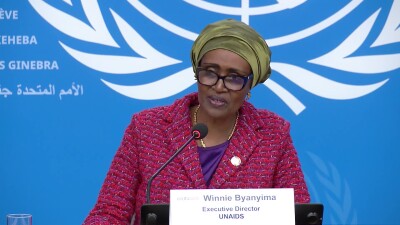
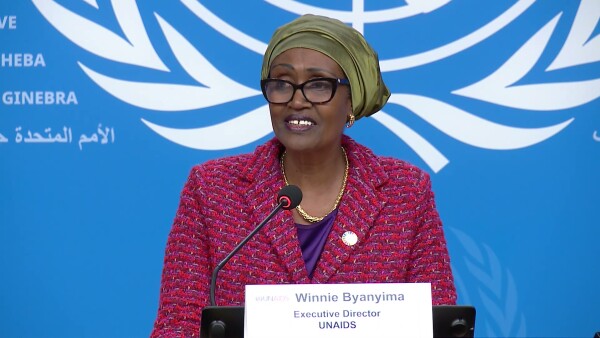
“We will see a …real surge in this disease - [we] will see it come back and we see people dying the way we saw them in the 90s and in 2000s,” said Winnie Byanyima, UNAIDS Executive Director, pointing to a “tenfold increase” from the 600,000 AIDS-related deaths recorded globally in 2023.
“We also expect an additional 8.7 million new infections. At the last count, there were 1.3 million new infections globally (in) 2023”.
Speaking in Geneva, Ms. Byanyima noted that the funding freeze announced by the White House on 20 January was due to end next month, after a 90-day review.
“We have not heard of other governments pledging to fill the gap,” she told journalists.
Already, drop-in centres where HIV patients can pick up the anti-retroviral medicines they need are not reopening, “for fear that this might not be consistent with the new guidelines”, she maintained.
“This sudden withdrawal of US funding has led (to) shutting down of many clinics, laying off of thousands of health workers, these are nurses, doctors, lab technicians, pharmacy workers…it's a lot.”
Focusing on Africa – where the east and south of the continent share 53 per cent of the global HIV burden - Ms. Byanyima warned that closing down “all of a sudden drop-in centres for girls and young women will be disastrous, because more than 60 per cent of new infections - amongst young - new infections on the continent are amongst girls and young women”.
Several other UN agencies that are heavily reliant on US funding have also warned that the cut in support – in addition to chronic under-investment in humanitarian work globally - is already having a serious impact on the communities they serve.
On Friday, the UN refugee agency, UNHCR, said that thousands have been left without lifesaving aid in the war-torn eastern Democratic Republic of the Congo.
The UN International Organization for Migration (IOM) also announced that funding cuts have severe repercussions for vulnerable migrant communities, exacerbating humanitarian crises and undermining essential support systems for displaced populations. Together with IOM, the UN Children’s Fund (UNICEF) warned that that the liquidity crunch has jeopardized lifesaving work, including progress in reducing child mortality, which has fallen by 60 per cent since 1990.
“It is reasonable for the United States to want to reduce its funding - over time. But the sudden withdrawal of lifesaving support is having a devastating impact across countries, particularly Africa, but even in Asia and Latin America,” said UNAIDS’ Ms. Byanyima.
“We urge for a reconsideration and an urgent restoration of services – of life-saving services.”
And in a direct appeal to President Trump, the UNAIDS chief noted that just as President George W Bush had introduced the groundbreaking Pepfar initiative to combat HIV/AIDS in 2003, the new White House incumbent could also be part of the “prevention revolution” involving injectable HIV injections required just twice a year.
“The deal is that an American company is enabled to produce and to license generics across the regions to produce millions and roll out this injectable to those who really need it,” she insisted.
According to UNAIDS, approximately 40 million people globally live with HIV, based on 2023 data. Of this number, some 1.3 million became newly infected with HIV in the same year and 630,000 people died from AIDS-related illnesses.
ends
STORY: UNAIDS funding crisis
TRT: 04’12”
SOURCE: UNTV CH
RESTRICTIONS: NONE
LANGUAGE: ENGLISH / NATS
ASPECT RATIO: 16:9
DATELINE: 24 March 2025 GENEVA, SWITZERLAND
Speakers:
- Winnie Byanyima, UNAIDS Executive Director
SHOTLIST
- Exterior medium shot: Palais des Nations, Flag Alley
- Wide shot of podium with speakers.
- SOUNDBITE (English) – Winnie Byanyima, UNAIDS Executive Director: “If the US assistance for HIV is not restored after the pause - as you know, the pause ends in April - and is not replaced by other funding and we have not heard of other governments pledging to fill the gap, there will be an additional in the next four years 6.3 million AIDS-related deaths.”
- Medium-wide, TV screens showing speaker, journalist taking video with phone.
- SOUNDBITE (English) – Winnie Byanyima, UNAIDS Executive Director: “We will see a resurge of this - a real surge in this disease - will see it come back and we see people dying the way we saw them in the 90s and in 2000s.”
- Medium, Press room, photographer, journalists.
- SOUNDBITE (English) – Winnie Byanyima, UNAIDS Executive Director: “We're seeing the centres that we are providing them with prevention services not reopening for fear that this might not be consistent with the new guidelines.”
- Wide, Press room, podium speakers, TV cameras.
- SOUNDBITE (English) – Winnie Byanyima, UNAIDS Executive Director: “At the last count – 2023 - we had 600,000 deaths globally, AIDS-related deaths. So, you're talking about 10-fold increase. We also expect an additional 8.7 million new infections. At the last count, there were 1.3 million new infections globally - 2023.”
- Wide, Press room.
- SOUNDBITE (English) – Winnie Byanyima, UNAIDS Executive Director: “It is reasonable for the United States to want to reduce its funding - over time. But the sudden withdrawal of lifesaving support is having a devastating impact across countries, particularly Africa, but even in Asia and Latin America. We urge for a reconsideration and an urgent restoration of services – of life-saving services.”
- Wide shot, Press room, journalists, photographer, TV cameras.
- SOUNDBITE (English) – Winnie Byanyima, UNAIDS Executive Director: “It could be President Trump - another Republican president - who leads the prevention revolution leading towards the end of AIDS. But the deal is that an American company is enabled to produce and to license generics across the regions to produce millions and roll out this injectable to those who really need it.”
- Medium, podium speakers, TV screen showing speaker.
- SOUNDBITE (English) – Winnie Byanyima, UNAIDS Executive Director: “This sudden withdrawal of US funding has led (to) shutting down of many clinics, laying off of thousands of health workers, these are nurses, doctors, lab technicians, pharmacy workers, all kinds of data entrists; it's a lot.”
- Medium-wide, Press room, journalists, photographer.
- SOUNDBITE (English) – Winnie Byanyima, UNAIDS Executive Director: “And for Africa, the closing down all of a sudden of drop-in centres for girls and young women will be disastrous because more than 60 per cent of new infections - amongst young - new infections on the continent are amongst girls and young women.”
- Medium, journalist working on laptop.
Similar Stories
1
1
1
Edited News | OCHA , UNICEF , WFP
Aid agencies warned on Friday of the fast-developing humanitarian emergency inside Taiz City in Yemen, which has been encircled by de facto Houthi forces fighting government troops along the country’s west coast.
1
1
1
Press Conferences | UN WOMEN , WFP , WHO
UN WOMEN: Sudan Women and girls one year after the fall of El Fasher; increasing drone attacks across the country; WFP: DRC - Ebola spreads to eighth DRC province as WFP delivers food, builds treatment centres and keeps supplies moving; WHO - Update on Ebola (Bundibugyo Virus Disease)
1
12
1
1
Press Conferences , Images | UNOG
Closing Press Conference following the Sixth Consultative Meeting on Enhancing Coordination of Peace Initiatives and Efforts in Sudan

2
17
1
2
Edited News , Press Conferences , Images | OCHA , WMO
Two UN agencies teamed up on Wednesday to issue an appeal for immediate assistance to help communities already being impacted by the strongest El Niño on record.

3
16
2
2
Edited News , B-roll , Conferences , Images | UNITED NATIONS , UNOG
Sixth Consultative Meeting on Enhancing Coordination of Peace Initiatives and Efforts for Sudan
1
1
1
Press Conferences | CITES
Wildlife trade and conservation policy discussions at the 81st meeting of the CITES Standing Committee (SC81)

1
1
1
Edited News | UNICEF , WHO , UNHCR
Yemen war continues to force families from homes amid hunger and disease
More than 250,000 people have now fled renewed fighting in Yemen, the UN said on Tuesday, citing particular concern for those sheltering in the southwestern city of Taiz and the wider governorate, where access is “essentially blocked”.
1
1
1
Press Conferences | UNHCR , UNCTAD , WMO , OCHA , UNICEF , WHO
UNHCR Hungary’s 1956 Refugee Crisis: 70 Years On, UNCTAD World Investment Forum 2026, Doha, WMO Greenhouse Gas Bulletin and Climate Update for COP31, OCHA Afghanistan: Malnutrition, Girls’ Education and Recovery, UNICEF Yemen: Child Malnutrition and Unsafe Water in Taiz, WHO Inequalities in Noncommunicable Diseases and Risk Factors

1
1
1
Press Conferences | UNHCR
End of UNHCR's 77th Annual Executive Committee (ExCom) meeting week

1
1
1
Edited News | UNICEF
A little over one year since a ceasefire agreement was announced between Hamas fighters and Israel, more than 340 children have been reported killed and hundreds more injured, the UN Children’s Fund, UNICEF, said on Friday.

1
1
1
Press Conferences | UNICEF , IOM , UNHCR
UN Special Assistant to the Personal Envoy Office (SUDAN): Peace Initiatives and Efforts in Sudan; UNICEF: Dire situation of children in Gaza; IOM: Damaged Homes and Energy Attacks Risk Displacing Ukrainians for this winter; UNHCR: update on EXCOM week

1
1
1
Press Conferences | IOM , UNDRR
UN stresses importance of household preparedness for disaster risk reduction.