

The United Nations Office at Geneva
Multimedia Newsroom
Edited News | WFP
UNOG Bi-weekly press briefing: Nobel Peace Price 2020 for World Food Programme 2020
UN World Food Programme wins 2020 Nobel Peace Prize
The UN World Food Programme (WFP), which provides lifesaving food assistance to millions across the world – often in extremely dangerous and hard-to-access conditions – was awarded the 2020 Nobel Peace Prize today. The agency was recognized “for its efforts to combat hunger, for its contribution to bettering conditions for peace in conflict-affected areas and for acting as a driving force to prevent the use of hunger as a weapon of war and conflict”, said Berit Reiss-Andersen, chair of the Norwegian Nobel Committee.
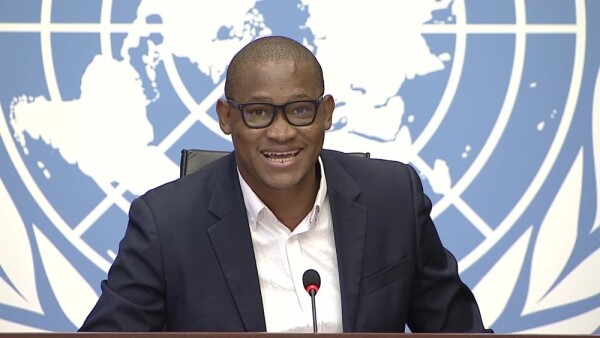
WFP's spokesperson in Geneva reacted to the announcement by the Norwegian Nobel Committee at the United Nations press briefing in Geneva, Switzerland: “I have just learned that the Nobel Peace Price has been awarded to the World Food Programme”, said Tomson Phiri, Spokesperson of the World Food Programme (WFP).
WFP is the largest humanitarian organization in the world. Last year, it assisted 97 million people in 88 countries. Its efforts focus on emergency assistance, relief and rehabilitation, development aid and special operations. Two-thirds of the work is in conflict-affected countries where people are three times more likely to be undernourished than those living in countries without conflict.
“Yes, I will just say this is a pride moment, the nomination itself was enough and then to go out to be named Nobel Peace Price winner is nothing short of a feat”, Tomson Phiri said. “This is an organization I have served for 9 years. I have seen the extent to which people are dedicated across the globe, go the extra mile just before I moved to Geneva I was based in South Sudan where people would walk on foot to serve humanity, and it’s really a proud moment. I really feel honored to be a member of this great team”.
With this recognition, WFP joins the Office of the UN High Commissioner for Refugees (UNHCR), the International Labour Organization (ILO), the UN Children’s Fund (UNICEF), UN Peacekeeping, the International Atomic Energy Agency (IAEA), the Intergovernmental Panel on Climate Change (IPCC), former Secretary-General Dag Hammarskjöld and former Under-Secretary-General Ralph Bunche, and the UN itself as Nobel Peace Prize laureates.
"I think the great list of organizations that have been nominated do fantastic work. And for WFP as well, I think for this year we have gone all and above the call of duty. We have been able to support, even when other -- I mean you saw everything went into shutdown following nationwide global restrictions following Covid-19 -- the World Food Programme stepped up to the plate. We were able to connect communities at one point, we were the biggest airline in the world when most - if not all - commercial airlines have grounded to a halt," Mr Phiri said.
"We were able to move assistance to keep people moving," he continued. "We were able to deliver assistance and this was through the global common services that we provided that some, most, of the aid workers, were able to stay in some places and deliver, even in communities where people were at risk of both the infection and hunger”.
Mr. Phiri explained that thanks to its global logistics network, the agency had made it possible for a number of other humanitarian actors to continue to do their work even as the COVID-19 pandemic brought global activity to a grinding halt. WFP not only provided short-term food aid, he explained, but also assisted people to become self-sustainable, growing enough food to feed themselves. Funded entirely by voluntary donations, WFP received record support in 2020, Mr. Phiri said.
“This is really a proud moment. This is a humbling nomination to say the least. Not only is it for the staff and the people who work for the World Food Programme, but also the many volunteers and the communities we are working in”, Tomson Phiri said.
Praising the work of the UN agency, Nobel Committee chair Berit Reiss-Andersen highlighted WFP’s role in boosting resilience and sustainability among communities by helping them to feed themselves.
WFP, Headquartered in Rome, was established in 1961 and had helped millions of people in extremely dangerous and hard-to-reach countries affected by conflict and natural disaster, including Yemen, Syria and North Korea.
- Exterior wide shot, Palais des Nations flag alley, nations’ flags flying, a cloudy day.
- SOUNDBITE (English) — Tomson Phiri, Spokesperson of the World Food Programme (WFP): “I have just learned that the Nobel Peace Price has been awarded to the World Food Programme”.
- Wide shot, podium Room XIV, Palais des Nations.
- SOUNDBITE (English) — Tomson Phiri, Spokesperson of the World Food Programme (WFP): “Yes, I will just say this is a pride moment, the nomination itself was enough and then to go out to be named Nobel Peace Price winner is nothing short of a feat. This is an organization I have served for 9 years, I have seen the extent to which people are dedicated across the globe, go the extra mile. Just before I moved to Geneva, I was based in South Sudan where people would walk on foot to serve humanity and it’s really a proud moment, I really feel honored to be a member of this great team”.
- Medium shot, podium
- SOUNDBITE (English) — Tomson Phiri, Spokesperson of the World Food Programme (WFP): “I think the great list of organizations that have been nominated do fantastic work. And for WFJP as well, I think for this year we have gone all and above the call of duty. We have been able to support, even when other – I mean you saw everything went into shutdown following nationwide global restrictions following Covid-19, the World Food Programme stepped up to the plate, we were able to connect communities at one point we were the biggest airline in the world when most if not all commercial airlines have grounded to a halt, we were able to move assistance to keep people moving. We were able to deliver assistance and this was through the global common services that we provided that some, most of the aid workers were able to stay in some places and deliver, even in communities where people were at risk of both the infection and hunger”.
- Medium shot, journalists sitting and listening, Room XIV, Palais des Nations.
- SOUNDBITE (English) — Tomson Phiri, Spokesperson of the World Food Programme (WFP): “This is really a proud moment, this is a humbling nomination to say the least. Not only is it for the staff and the people who work for the World Food Programme, but also the many volunteers and the communities we are working in”.
- Medium shot, cameraman
- Wide shot, press room
- Close up, cameras
- Various shots, Tomson Phiri speaking to journalists
Similar Stories

1
1
1
Edited News | UNICEF
A little over one year since a ceasefire agreement was announced between Hamas fighters and Israel, more than 340 children have been reported killed and hundreds more injured, the UN Children’s Fund, UNICEF, said on Friday.

1
1
1
Edited News | UNICEF , IFRC
Six weeks after Nepal’s deadly flooding disaster, communities are still struggling to rebuild their lives, but they will need sustained help as global warming increases the risk of another Himalayan catastrophe, the UN Children’s Fund (UNICEF) said on Friday.

1
1
1
Edited News | WHO
In suspected Russia plague death, testing and monitoring underway – WHO
The death of a lab worker in Russia’s Siberia region has sparked concerns about plague being the cause, the UN World Health Organization (WHO) said on Tuesday, adding that it was following the situation closely.

1
1
Edited News | OHCHR , UNOG
UN Human Rights Chief Volker Türk on Friday provided and oral update to the 63rd session of the Human rights Council on Ukraine.

1
1
1
Edited News | OHCHR , UNOG
UN Human Rights Chief Volker Türk on Friday provided and oral update to the 63rd session of the Human rights Council on the human rights situation in Haiti.

1
1
1
Edited News | WHO
Repeated delays in bringing lifesaving medicines, prosthetics and more from Israel into Gaza risk having devastating consequences on Palestinians who urgently need them in the wartorn enclave, the UN World Health Organization (WHO) said on Friday. “A truck full of non-priority supplies or the right supplies arriving too late, doesn't save lives. That's the question that actually matters," said Dr Reinhilde Van De Weerdt, WHO Representative in the OPT.

1
1
1
Edited News | WHO
DRC: Early access to care and oxygen decisive for Ebola patients’ survival – WHO
In the Democratic Republic of the Congo (DRC), health workers fighting the country’s largest-ever Ebola outbreak are struggling to overcome critical challenges to patient care, the UN World Health Organization (WHO) warned on Tuesday.

1
1
1
Edited News | OCHA , UN
Civilians in Iran are continuing to feel the consequences of months of conflict and military escalation, the UN’s top official in the country has said, as loss of life, damage to civilian infrastructure and mounting economic pressures leave many facing continued uncertainty.

1
1
1
Edited News | WHO , UNICEF
Aid agencies in Yemen highlighted the growing hunger emergency sparked by renewed fighting between Houthi opposition forces and Government troops, after mobile health clinics reported that hundreds of children displaced by the violence are suffering from the most deadly form of malnutrition.
1
1
1
Edited News | UNHCR
Displacement on the rise in Yemen as fighting continues - UNHCR
As hostilities worsen in Yemen, more people have been fleeing their homes, further intensifying the humanitarian crisis within the region, the UN Refugee Agency (UNHCR) warned on Tuesday.
1
1
1
Edited News | IOM , OHCHR , UNFPA , UNOG , UNHCR , WHO
Yemen’s humanitarian crisis growing by the hour amid spike in displacement
Yemenis displaced by renewed fighting have described fleeing for their lives amid shelling and gunfire, aid agencies reported on Friday, while highlighting the dramatic increase in humanitarian needs in the country and in Djibouti, where thousands have sought shelter.
1
1
1
Edited News | OHCHR , UNOG
The UN Human Rights Office issued on Friday a report documenting a shocking pattern of sexual violence amid Russia’s full-scale armed attack on Ukraine.