

The United Nations Office at Geneva
Multimedia Newsroom
Syrians gather in Geneva for fresh round of talks aimed at writing new constitution for war-torn country
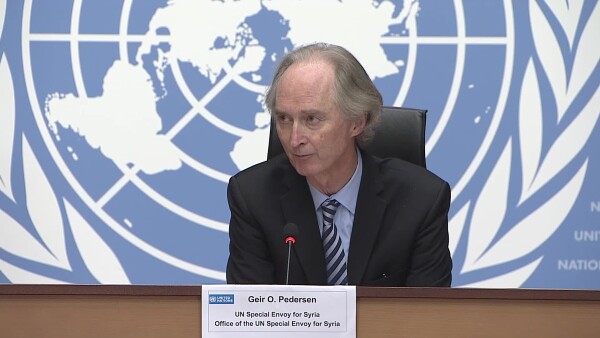
A fourth round of intra-Syrian talks hosted by the United Nations in Geneva could present an opportunity to “focus more heavily” on securing a peaceful political solution to almost a decade of fighting, UN Special Envoy Geir Pedersen said on Sunday.
“I’m pleased to say that you know, after intense discussions with Swiss authorities, the Swiss health authorities and with the UNOG, and of course with the cooperation of the three delegations, it will now be possible for us to start the meeting tomorrow, tomorrow morning, at 10 o’clock,” he said at a press conference at the Palais des Nations.
Ahead of the week-long meeting due to start on Monday morning, the UN negotiator explained that the two Syrian co-chairs had agreed to discuss national foundations and principles, while constitutional matters will be on the agenda at a fifth meeting in the new year.
“(The fourth meeting) would be followed up with a fifth session in January which will focus on constitutional principles, or basic principles of the constitution, so this is obviously a package,” he told journalists attending the press conference remotely, in line with COVID-19 prevention measures.
Taking part in the discussions in the Swiss city are an equal number of delegates from the Government, opposition and civil society, who total 45 in all and are known as the “Small Body”.
It works closely with a larger, 150-member Constitutional Committee which is a key part the United Nations’ effort for a Syrian-owned and Syrian-led end to the country’s devastating conflict, that has seen more than five million Syrians flee across borders, six million internally displaced and 13 million in need of humanitarian assistance.
Fielding questions about what Mr Pedersen’s expectations were for this new round of talks, he stressed that millions of suffering Syrians were counting on progress being made, as detailed in the 2015 Security Council resolution 2254, which calls for a ceasefire and political settlement to the Syrian conflict.
“We had hoped it should have been possible to make much more progress on the political side that what we have done so far,” he said. “We know that we have not lived up to the expectations of the Syrian people in making the progress that is necessary in ending the suffering for the Syrian people, so it is my hope that in the relative calm that we are seeing in Syria now, despite all the daily violations, that it should be possible to focus more heavily on the political process and all the elements of Security Council resolution 2254.”
While the last (third) round of talks in Geneva in August were curtailed when delegation members positive for the coronavirus, Mr. Pedersen also noted that earlier disagreements between the co-chairs had been responsible for challenges in getting them to sit down face to face.
“Let’s also be honest and say that we knew from the very beginning that moving forward also on discussions on the constitutional process would be difficult one,” he said. “And after 10 years of - nearly now 10 years - of conflict there is a deep lack of trust between the parties, we knew that we would have to overcome this deep mistrust, we knew that that would take time, it would be a - you know - a difficult process; I hope that what we have achieved is actually the beginning of starting to build trust between the parties and that this building of trust could then be a door-opener to a broader political process.”
SHOTLIST OF THE EDITED STORY
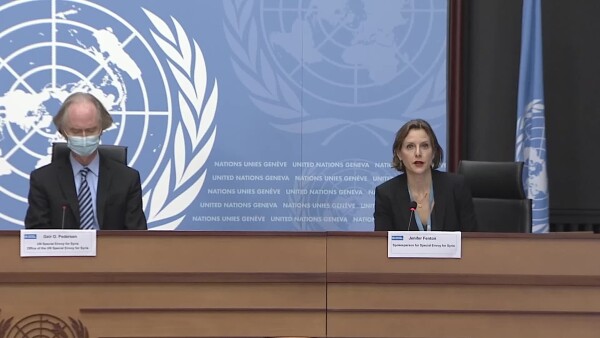
- Medium shot, Room XIV, Palais des Nations, UN Geneva, with Special Envoy Geir Pedersen shown sitting on podium, flanked by spokesperson Jenifer Fenton.
- Medium shot, TV broadcast in foreground and podium with speakers to rear, Room XIV, Palais des Nations.
- SOUNDBITE (English) — Geir Pedersen, UN Special Envoy for Syria: “And I’m pleased to say that you know, after intense discussions with Swiss authorities, the Swiss health authorities and with the UNOG, and of course with the cooperation of the three delegations, it will now be possible for us to start the meeting tomorrow, tomorrow morning, at 10 o’clock.”
- Close-up, UN Geneva technician monitoring the live video stream of the press conference on webtv.un.org
- Medium shot, Press photographer, Room XIV, Palais des Nations, UN Geneva.
- SOUNDBITE (English) — Geir Pedersen, UN Special Envoy for Syria: “And then it would be followed up with a fifth session in January which will focus on constitutional principles, or basic principles of the constitution, so this is obviously a package.”
- Medium shot, translators listening to Geir Pedersen, viewed from behind, podium to rear, Room XIV, Palais des Nations, UN Geneva.
- Close-up, photographer’s laptop showing image of Geir Pedersen being treated on-screen.
- SOUNDBITE (English) — Geir Pedersen, UN Special Envoy for Syria: “We had hoped it should have been possible to make much more progress on the political side that what we have done so far. We know that we have not lived up to the expectations of the Syrian people in making the progress that is necessary in ending the suffering for the Syrian people, so it is my hope that in the relative calm that we are seeing in Syria now, despite all the daily violations, that it should be possible to focus more heavily on the political process and all the elements of Security Council resolution 2254.”
- Medium shot, onlookers watching press conference, Room XIV, Palais des Nations, UN Geneva.
- SOUNDBITE (English) — Geir Pedersen, UN Special Envoy for Syria: “Let’s also be honest and say that we knew from the very beginning that moving forward also on discussions on the constitutional process would be difficult one, and after 10 years of - nearly now 10 years - of conflict there is a deep lack of trust between the parties, we knew that we would have to overcome this deep mistrust, we knew that that would take time, it would be a - you know - a difficult process; I hope that what we have achieved is actually the beginning of starting to build trust between the parties and that this building of trust could then be a door-opener to a broader political process.”
- Medium shot, podium speakers Geir Pedersen and spokesperson Jenifer Fenton donning or wearing masks, panning up to UN logo on wall behind them. Room XIV, Palais des Nations, UN Geneva.
Transcript of the continuity of the Media Briefing by Geir O. Pedersen,
United Nations Special Envoy for Syria, Before the Fourth Convening of the Small Body of the Constitutional Committee
Thank you, Jenifer, and good to see you all. I understand we also now connected with friends in New York, so heartily welcome to you as well.
I have just now concluded my meeting with the civil society group, the so-called Middle Third group, that is part of the drafting body to the Constitutional Committee and before that today I met with representatives from the government delegation, and from the opposition delegation and of course the two Co-Chairs. And I am pleased to say that after intense discussions with the Swiss authorities, Swiss health authorities, with UNOG and of course with the cooperation of the three delegations it will now be possible for us to start the meeting tomorrow morning at 10 o’clock.
We will start the meeting tomorrow, as you know we had the last meeting here in Geneva in late August, and we have had since then some negotiations with the two Co-Chairs about an agenda for the next meeting and also when we should start the meeting. And we have then been able to agree with the two Co-Chairs that we would have this meeting, that will start tomorrow, will continue with the same agenda as the previous meeting, that is discussing so-called National Foundations and Principles, and that this meeting, Covid-19 situation permitting, should take place before the end of the year, and then it will be followed-up with a fifth session in January, which will focus on Constitutional Principles, or basic Principles of the Constitution, so this is obviously a package.
I have been, as you may know, travelling extensively before this session, I have had meetings in Damascus, with late Foreign Minister Walid al-Moallem, I then have met with the SNC opposition, I met with Turkish authorities in Ankara, I met with the Arab League Secretary-General in Cairo, and of course with Foreign Minister of Egypt, Mr. Shoukry in Cairo. And then I went on and had extensive meeting with Foreign Minister Lavrov in Moscow, and of course also with other Russian officials, and then I went on to Tehran where I met with Foreign Minister Zarif and with other officials, and from Tehran via Dubai I went to Riyadh and met with the Foreign Minister in Riyadh. Then back here in Geneva.
Why is this important? Because we want to see progress in the Constitutional Committee which is, of course, decided by the Syrians themselves, but it is also important that we have clear international support for the work that we are doing, and I am pleased to say that this has been forthcoming. So I am looking forward to extensive, and hopefully good discussions next week that will be able to bring us a little bit further down the road towards then starting the discussions in January on Constitutional Principles.
Thank you.
Question: I really want to ask you sort of the big picture question, there are still many, in the Syrian opposition, diplomats who I speak to, who are skeptical of this whole project, they believe that the Syrian government is only engaging in it as part of a tactic of an endless delaying tactic, and just keeping the international community busy with this. You have been doing that for 15 months, what have you actually achieved?
Mr. Pedersen: Thank you, good to hear your voice again. Let’s be frank, there is no reason to not be frank about all the challenges we have had in moving this process forward. So tomorrow we will start with the fourth meeting in the process, we had obviously hoped that we would be able to move the process more quickly forward. Part of it has been disagreement, but it has also been part of course due to the outbreak of the Covid-19 in February-March this year. Let’s also be honest and say that we knew from the very beginning that moving forward also in discussions on constitutional process would be a difficult one. After nearly now 10 years of conflict there is a deep lack of trust between the parties, we knew that we had to overcome this deep mistrust, we knew that that would take time, it will be a difficult process, I hope that what we have achieved is actually the beginning of starting to build trust between the parties and that this building of trust could then be a door-opener to a broader political process, which will engage us on other issues that will extremely important to be able to move forward more substantially, and one of the obvious issues that we are hoping to make progress on is the file of abductees, detainees and missing persons. And my hope is that if we can continue to build trust within the Constitutional Committee that that could have a positive impact also on the other issues and that then that could play positively back on the work we are doing in the Constitutional Committee. This, of course, depends to a large extent on the Syrians themselves, but also to the international community and that’s why I think that it is also important now that we re-emphasise the support from the international community to the political process in Syria.
Question: My question is somehow similar to James’, because I have also been talking to some leaders within the Syrian opposition taking part in these talks and they do say that they are afraid or worried that the aim of these talks is to force them to withdraw from it delivering a victory to the Syrian government, they state that they are going nowhere fast, that is what I have been told. Can we have a timeline for these talks or is it really open-ended? And my second question is can you tell us anything about the agenda for the meeting in January, which I understand will be early in January.
Mr. Pedersen: As I said we have now a package agreement, we have an agreement on this round of discussions, and we have an agreement for a round in January. And for the round in January the agreement is that the agenda would be Constitutional Principles, or basic Principles of the Constitution, that is what we are going to discuss. I think every time I am meeting with the press I am receiving a question about whether there is sort of a deadline for the discussions, whether there is a timeline for this discussion. I think here the important thing to say is no, there is no deadline and there is no exact timeline for this discussion, and that is partially because we know from experiences from other processes that if you set a timeline, so far no one has been able to respect that timeline. The other, and more important issue, is that we had agreed that we should work in a manner that makes progress possible and we should continuously strive towards that, and that is what the two parties had agreed upon before we entered into these negotiations.
Question: What is the goal you want to achieve next year? Will constitutional drafting process be completed in 2021? And are you optimistic about issuing at least some parts of the constitution completed by next year?
Mr. Pedersen: Let me say that my hope is that we will start to make progress in the substantial discussions that is needed to be able to move forward, then to table different suggestions that could be taken forward and to be discussed with the large group. When this will happen? I think that is not up to me to say, as I said I hope that we will continue to make progress, will continue to build trust, but this will not happen in the next meeting, it will not happen in the meeting after that, but let’s see then and discuss again with the Syrian parties how it is possible for us to make steady progress on this file. When I have been making my rounds and been visiting the different capitals I have been saying that after 10 years of conflict and after five years of adopting Security Council resolution 2254 time has come to take stock of where we are, and the reason for that is obviously we had hoped it should have been possible to make much more progress on the political file than what we have done so far. We know that we have not lived up to the expectations of the Syrian people in making the progress that is necessary to end the suffering for the Syrian people. So it is my hope that with the relative calm that we are seeing in Syria now, despite all the daily violations, that it should be possible to focus more heavily on the political process and all the elements of Security Council resolution 2254. One element of Security Council resolution 2254 is indeed that, pursuant to the adoption of a new constitution there will be elections. So my mandate is then to help to organise elections pursuant to the adoption of a new constitution and that is very clear in Security Council resolution 2254. If elections are held as the parliamentary elections were or if new presidential elections are held under the current constitution, that is not part of my mandate.
Question: (Arabic) What guarantees do you have to bring back the negotiators to the fifth session if they did not achieve any progress during the fourth session? The second question, there are announcements by the opposition group saying that the current authority will not be allowed to take part in the next parliamentary or presidential elections according to the new constitution, what is your comment about that?
Pedersen: We have a very clear understanding with the two Co-Chairs when it comes to how we are going to move the process forward, as I said we have negotiated a package on this round and for the round that will take place hopefully in January. And there are absolutely no pre-conditions or anything linked to this understanding. So it is my expectations that we will be able then to smoothly move forward with the next round with the agreed agenda in January. I am afraid I did not quite get the last question, so we will have to get back to you on that.
Thank you.
Similar Stories
1
1
1
Edited News | OCHA , UNICEF , WFP
Aid agencies warned on Friday of the fast-developing humanitarian emergency inside Taiz City in Yemen, which has been encircled by de facto Houthi forces fighting government troops along the country’s west coast.
1
1
1
Press Conferences | UN WOMEN , WFP , WHO
UN WOMEN: Sudan Women and girls one year after the fall of El Fasher; increasing drone attacks across the country; WFP: DRC - Ebola spreads to eighth DRC province as WFP delivers food, builds treatment centres and keeps supplies moving; WHO - Update on Ebola (Bundibugyo Virus Disease)
1
12
1
1
Press Conferences , Images | UNOG
Closing Press Conference following the Sixth Consultative Meeting on Enhancing Coordination of Peace Initiatives and Efforts in Sudan

2
17
1
2
Edited News , Press Conferences , Images | OCHA , WMO
Two UN agencies teamed up on Wednesday to issue an appeal for immediate assistance to help communities already being impacted by the strongest El Niño on record.

3
16
2
2
Edited News , B-roll , Conferences , Images | UNITED NATIONS , UNOG
Sixth Consultative Meeting on Enhancing Coordination of Peace Initiatives and Efforts for Sudan
1
1
1
Press Conferences | CITES
Wildlife trade and conservation policy discussions at the 81st meeting of the CITES Standing Committee (SC81)

1
1
1
Edited News | UNICEF , WHO , UNHCR
Yemen war continues to force families from homes amid hunger and disease
More than 250,000 people have now fled renewed fighting in Yemen, the UN said on Tuesday, citing particular concern for those sheltering in the southwestern city of Taiz and the wider governorate, where access is “essentially blocked”.
1
1
1
Press Conferences | UNHCR , UNCTAD , WMO , OCHA , UNICEF , WHO
UNHCR Hungary’s 1956 Refugee Crisis: 70 Years On, UNCTAD World Investment Forum 2026, Doha, WMO Greenhouse Gas Bulletin and Climate Update for COP31, OCHA Afghanistan: Malnutrition, Girls’ Education and Recovery, UNICEF Yemen: Child Malnutrition and Unsafe Water in Taiz, WHO Inequalities in Noncommunicable Diseases and Risk Factors

1
1
1
Press Conferences | UNHCR
End of UNHCR's 77th Annual Executive Committee (ExCom) meeting week

1
1
1
Edited News | UNICEF
A little over one year since a ceasefire agreement was announced between Hamas fighters and Israel, more than 340 children have been reported killed and hundreds more injured, the UN Children’s Fund, UNICEF, said on Friday.

1
1
1
Press Conferences | UNICEF , IOM , UNHCR
UN Special Assistant to the Personal Envoy Office (SUDAN): Peace Initiatives and Efforts in Sudan; UNICEF: Dire situation of children in Gaza; IOM: Damaged Homes and Energy Attacks Risk Displacing Ukrainians for this winter; UNHCR: update on EXCOM week

1
1
1
Press Conferences | IOM , UNDRR
UN stresses importance of household preparedness for disaster risk reduction.