

The United Nations Office at Geneva
Multimedia Newsroom
Press Conferences | OHCHR , UNHCR , WHO , UNOG , UNITED NATIONS , WIPO
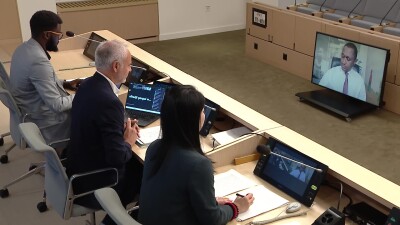
Bi-weekly Press Briefing 17 September 2021
Dire consequences for refugees from COVID-19 underfunding
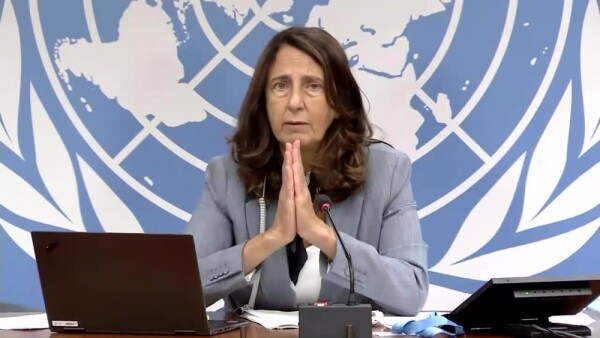
Ann Burton, Chief of the Public Health Section at the United Nations Refugee Agency (UNHCR), stated that the UNHCR was calling for more global support for COVID-19 measures to help displaced people around the world. Only one third of the budgeted requirements of USD 924 million had been received thus far, leaving a huge gap in UNHCR’s ability to protect the most vulnerable. Safe and effective vaccines could relieve pressures on health systems and save lives, but vaccine inequity continued to be a major challenge. A vast majority of vaccine doses had been given in high- and mid-income countries, said Ms. Burton. UNHCR was reiterating its call to States to share their extra doses with the COVAX vaccine-sharing mechanism. UNHCR was encouraged by the approach of some host States, but many barriers in access to vaccines remained, nonetheless. Creating information materials in refugee populations’ languages was one way to overcome some of the obstacles, for example.
UNHCR called upon States to include refugees in national social safety nets. UNHCR’s COVID-19 response covered every region of the world and a wide spectrum of needs. The largest areas of unmet needs included cash assistance, primary health care, primary education, and displaced people with special needs.
Answering to questions, Ms. Burton said that the most urgent shortfall was that of USD 74 million for cash assistance to displaced people. Needs of refugees varied greatly depending on where they were living and the country context. Cases among refugees were highest in Central and South America, she explained; an increase was now being observed in Sub-Saharan Africa. Leaving one segment of the population unprotected, such as refugees, would translate into more risks for the host community as well; nobody was safe unless we were all safe.
COVID-19
Responding to a series of questions on Covid-19, Margaret Harris, for the World Health Organization (WHO), said that teenagers with comorbidities were considered the same as adults with underlying conditions and should thus be considered as the same priority category. The Pfizer-Biontech vaccine could be used for people over the age of 12, but those without comorbidities were not a priority.
On another question, Alessandra Vellucci, for the UN Information Service (UNIS), said that the UN in New York was working intensely with Member States, the host country and the host city to ensure that the upcoming General Assembly would be as safe as possible, including by taking a number of mitigation steps. Ms. Vellucci explained that the Secretary-General had authority over UN Secretariat staff only. Member States had to ensure a safe participation for their representatives and the Secretariat was assisting and cooperating on pilot solutions.
Ms. Harris explained that all WHO staff in Geneva had been offered vaccines and were strongly recommended to get their jabs. Both Ms. Harris and Ms. Vellucci stressed that data on staff vaccination figures could not be shared as it contained confidential information.
Announcements
Alessandra Vellucci, for the UN Information Service (UNIS), informed that world leaders were going to gather for the high-level segment of the seventy-sixth General Assembly in New York the following week. The overall theme would relate to building resilience and hope in the context of the COVID-19 pandemic. There would be a number of key events in the coming week, including the SDG Moment on 20 September, a high-level meeting on the 20th anniversary of the Durban Declaration and Programme of Action against Racism on 22 September, the Food Systems Summit on 23 September, and the high-level event on energy on 24 September. The UNGA76 press kit was available here.
On 23 September, from 7:30 pm, on the occasion of the twentieth anniversary of the Durban Declaration and Programme of Action, an event would be held at the Ethnographic Museum of Geneva, celebrating reggae as an instrument of the collective memory of slavery. The event would be also webcast live at webtv.un.org and on UN Geneva Facebook page. Questions could be asked from the room, but not online. Interview requests should be shared with UNIS.
On 21 September, the ninth edition of Geneva Peace Talks would take place in Room XVIII of the Palais des Nations, under the theme “Recovering Better for an Equitable and Sustainable World.” More information was available here.
The Committee on Rights of the Child was concluding this morning its day of general discussion devoted to children’s rights and alternative care. During this session, the Committee was reviewing the reports Eswatini, Switzerland, the Czech Republic, and Poland.
The Committee on Enforced Disappearances would have this afternoon at 3 pm a dialogue with Spain to review additional information. On 20 September at 3 pm, the Committee would also have a dialogue with France.
Edward Harris, for the World Intellectual Property Organization (WIPO), spoke about a virtual press conference on 21 September at 11 am and a launch of the Global Innovation Index 2021 at 1:30 pm the same day, in the presence of several presidents and ministers. Aside from the economy rankings for which it was known, the report would include a new section looking at the immediate impacts of COVID containment measures on human innovation. Materials under embargo (20 September, 1 pm) would be shared soon.
Rolando Gomez, for the Human Rights Council, informed that the Council today was continuing an interactive discussion on the right to development. It would soon hear from the new special rapporteur on the contemporary forms of slavery, to be followed by the High Commissioner’s report on mainstreaming human rights of women and girls in conflict. Finally, climate action at the national level, in the context of the right to development, would be discussed at the end of the day. On 20 September, the Council would discuss deprivation of liberty of human rights defenders, and ageism.
Margaret Harris, for the World Health Organization (WHO), said that today, Dr. Tedros was in Lebanon and would address the media there at 12:30 Geneva time. At 2 pm today there would be a joint WHO-ILO conference on estimates on the burden of occupational hazards and work-related injuries. On 22 September, at 3 pm, the WHO would present a report on air-quality standards. It was still not known if there would be a regular press conference on COVID-19 in the coming week, as there were many commitments related to the UN General Assembly.
Similar Stories
1
1
1
Press Conferences | UNHCR
End of UNHCR's 77th Annual Executive Committee (ExCom) meeting week
1
1
1
Press Conferences | UNICEF , IOM , UNHCR
UN Special Assistant to the Personal Envoy Office (SUDAN): Peace Initiatives and Efforts in Sudan; UNICEF: Dire situation of children in Gaza; IOM: Damaged Homes and Energy Attacks Risk Displacing Ukrainians for this winter; UNHCR: update on EXCOM week
1
1
1
Press Conferences | IOM , UNDRR
UN stresses importance of household preparedness for disaster risk reduction.
1
1
1
Statements , Press Conferences | OHCHR
1
1
1
Press Conferences | UNHCR , UNICEF , IFRC , OHCHR , UN WOMEN , IOM , OCHA , WHO
UNHCR – ExCom Meeting, UNICEF – Nepal Recovery, IFRC – Flash Floods, WHO – Mental Health, IOM – South Sudan Floods, OCHA – DRC Humanitarian aid, UNHCR – Sahel Displacement, UNICEF – Yemen Update, IOM – Gaza Shelter, UN Women – Gaza Women, OHCHR – Arrests and detentions of Syrians by Israeli force
2
1
2
Press Conferences | UNCTAD
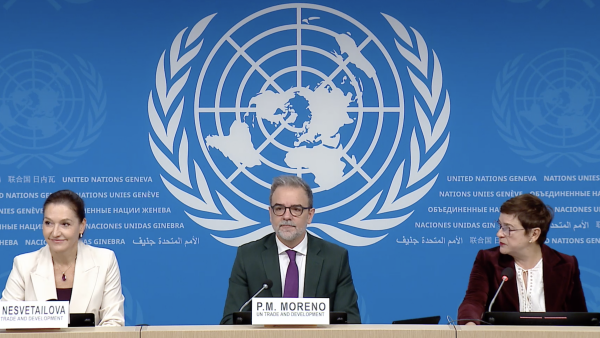
Presentation of the Trade and Developement Report 2026
Embargoed until 9 October 2026 at 11 a.m. (Geneva Time)
UNCTAD: UNCTAD’s flagship report finds that governments increasingly use industrial, trade, financial and technology policies to pursue economic and national security objectives. Market access and the ability to move into higher-value activities now depend more heavily on technology, finance and geopolitics.
1
1
1
Press Conferences | UPU
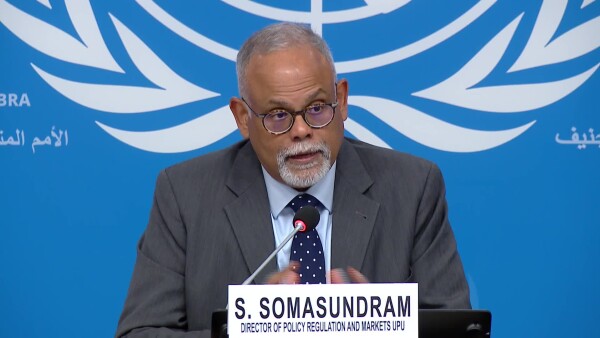
Release of the State of the Postal Sector Report 2026
1
1
1
Press Conferences | IOM , ITU , UNECE , UNICEF , WHO , WMO
UNICEF: Ebola, DRC - children orphans or separating them from parents and caregivers; IOM: Humanitarian needs in Djibouti amid arrivals from Yemen and increased migrant movements; WHO: Darfur, scale of health needs far exceeds available resources; WMO co-sponsored Global Heat Forum, Bangkok, monthly Global Seasonal Climate Update; UNECE: UN Forum of Mayors; ITU Plenipotentiary Conference 2026; WHO: child and adolescent obesity guidelines and new global roadmap to tackle pregnancy hypertension, a leading cause of maternal mortality
1
1
1
Press Conferences | OCHA , UN WOMEN , UNHCR , WFP , WHO , WTO , UNEP
OCHA – $160M CERF allocation to 12 underfunded crises; UNHCR – 5.8M refugee children remain out of school amid funding cuts; UN Women – Middle East escalation and food security among women/girls; WHO – Gaza supplies and overall situation; WFP – Yemen food insecurity and impact on global hunger ; UNEP - First International Conference of the Global Framework on Chemicals in Geneva | 16-20 November 2026
1
1
1
Press Conferences | UNHCR , WHO
Yemen's health system nears collapse amid conflict, causing rising casualties and medicine shortages.
1
1
1
Press Conferences | HRC
Update by the Expert Mechanism to Advance Racial Justice and Equality in Law Enforcement
1
1
1
Press Conferences | WIPO , WHO , UNICEF , UNHCR , IOM , WFP , FAO
WIPO Global Innovation Index 2026 launch and press conference, WHO Composition of influenza vaccines for the 2027 Southern Hemisphere flu season, UNICEF Yemen hunger and malnutrition; UNHCR Sudan displacement into Chad; IOM Ebola and population movements in DRC; WFP emergency food assistance in Nepal; and FAO food loss and waste.