

The United Nations Office at Geneva
Multimedia Newsroom
Edited News , Press Conferences | UNOG , WMO
WMO Presser: Report - Looming Water Crisis needs monitoring and early warnings
Growing water-related hazards require monitoring and early warnings, highlights report by World Meteorological Organization (WMO)
The number of people suffering from water-related hazards like floods and droughts is increasing because of climate change. However, forecasting and early warnings are inadequate and global climate finance efforts insufficient, according to a report published today by the World Meteorological Organization (WMO).
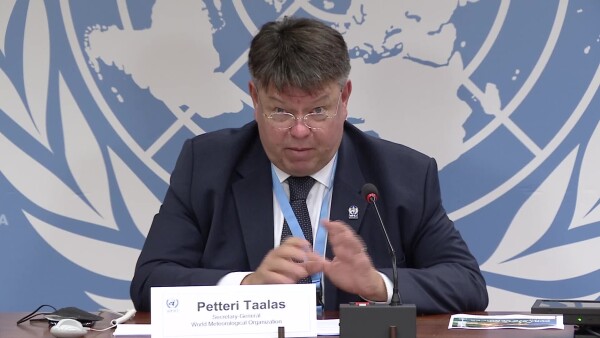
“There has been a dramatic increase in the flooding events during the past 20 years and that increase has been of 134% and we know that because of this current 1.5 degree warming of the planet, we have more humidity in the atmosphere; we have 7% more humidity in the atmosphere because of the current warming and that is also contributing to the flooding“, said Professor Petteri Taalas, WMO’s Secretary-General, today at a press briefing at the United Nations in Geneva.
Most of the flood-related deaths and economic losses were recorded in Asia, where end-to-end warning systems for riverine floods require strengthening.
The number of droughts also increased by 29% over this same period. Most drought-related deaths occurred in Africa.
“We have also seen an increase in the amount of and duration of drought events”, stated WMO’s Secretary-General. “We have about 30% increase at the same time during the past 20 years and this has been very much affecting Africa where both observing systems and early warning services are perhaps the poorest. And the population growth in Africa is boosting this challenge”.
The report called “The State of Climate Services 2021: Water”, a collaboration between the WMO, international organizations, development agencies and scientific institutions, highlights the need for urgent action to improve cooperative water management and scale up investment on climate change adaptation and disaster risk reduction.
It estimates that the number of people with inadequate access to water will reach more than 5 billion by 2050 versus 3.6 billion in 2018.
“According to our sister organization FAO, there has been already 2 billion inhabitants of our planet, one fourth of our planet, where people have been exposed to major water stress and there is a lack of drinking water and also a lack of water for agriculture,“ said WMO’s Secretary-General. He added that “also the water resources management is limited according to our sister organization UNEP (UN Environment Programme). We have 107 countries which are not managing their water resources in a sustainable way.”
This past year has seen extreme rainfall caused massive flooding in Japan, China, Indonesia, Nepal, Pakistan and Indian where millions of people were displaced, and hundred killed. In Europe catastrophic flooding led to hundreds of deaths and widespread damage.
According to Mr. Taalas, “sixty percent of WMO members don’t have a proper water sector services, and this is also one of the major challenges for us, and that is also one of the major challenges for climate adaptation. For climate adaptation, we need proper early warning services and the situation at the moment is not suitable.”
WMO’s Secretary-General has reason to believe that the negative trend in weather patterns will continue for coming decades. “Some of these features, like melting of glaciers and sea level rise, will continue for centuries because of the high concentration of carbon dioxide. We have to improve the observing systems and we have to improve the early warning services’ capability of especially least developed countries and that is the way to avoid both the casualties and economic losses related to climate change.”
-ends-
- Exterior wide shot, United Nations flag flying.
- Medium-wide shot, inside the press conference room, showing speakers, participants and photographers.
- SOUNDBITE (English): Petteri Taalas, Secretary-General, World Meteorological Organization (WMO): “There has been a dramatic increase in the flooding events during the past 20 years and that increase has been of 134% and we know that because of this current 1.5 degree warming of the planet, we have more humidity in the atmosphere; we have 7% more humidity in the atmosphere because of the current warming and that is also contributing to the flooding.”
- Close shot, a participant listening to the WMO Presser.
- SOUNDBITE (English): Petteri Taalas, Secretary-General, World Meteorological Organization (WMO): “And we have also seen an increase in the amount of and duration of drought events. We have about 30% increase at the same time during the past 20 years and this has been very much affecting Africa where both observing systems and early warning services are perhaps the poorest. And the population growth in Africa is boosting this challenge.”
- Medium shot of the speakers and of the press briefing broadcast on Zoom.
- SOUNDBITE (English): Petteri Taalas, Secretary-General, World Meteorological Organization (WMO): “According to our sister organization FAO, there has been already 2 billion inhabitants of our planet, one fourth of our planet where people have been exposed to major water stress and there is a lack of drinking water and also lack of water for agriculture.“
- Close shot, a participant listening to the WMO Presser.
- SOUNDBITE (English): Petteri Taalas, Secretary-General, World Meteorological Organization (WMO): “And also the water resources management is limited according to our sister organization UNEP, we have 107 countries which are not managing their water resources in a sustainable way.”
- Medium shot, photographers taking pictures of the press briefing broadcast on Zoom.
- SOUNDBITE (English): Petteri Taalas, Secretary-General, World Meteorological Organization (WMO): “Sixty percent of WMO members don’t have a proper water sector services, and this is also one of the major challenges for us, and that is also one of the major challenges for climate adaptation. For climate adaptation, we need proper early warning services and the situation at the moment is not suitable.”
- Close shot, a participant taking notes.
- SOUNDBITE (English): Petteri Taalas, Secretary-General, World Meteorological Organization (WMO): “Some of these features, like melting of glaciers and sea level rise, will continue for centuries because of the high concentration of carbon dioxide. We have to improve the observing systems and we have to improve the early warning services’ capability of especially least developed countries and that is the way to avoid both the casualties and economic losses related to climate change.”
- Close shot, a photographer taking pictures.
- Medium shot, cameramen filming the WMO presser.
- Close shot, the Press Conference filmed by a camera.
Similar Stories
1
1
1
Edited News | OCHA , UNICEF , WFP
Aid agencies warned on Friday of the fast-developing humanitarian emergency inside Taiz City in Yemen, which has been encircled by de facto Houthi forces fighting government troops along the country’s west coast.
1
1
1
Press Conferences | UN WOMEN , WFP , WHO
UN WOMEN: Sudan Women and girls one year after the fall of El Fasher; increasing drone attacks across the country; WFP: DRC - Ebola spreads to eighth DRC province as WFP delivers food, builds treatment centres and keeps supplies moving; WHO - Update on Ebola (Bundibugyo Virus Disease)
1
12
1
1
Press Conferences , Images | UNOG
Closing Press Conference following the Sixth Consultative Meeting on Enhancing Coordination of Peace Initiatives and Efforts in Sudan

2
17
1
2
Edited News , Press Conferences , Images | OCHA , WMO
Two UN agencies teamed up on Wednesday to issue an appeal for immediate assistance to help communities already being impacted by the strongest El Niño on record.
3
16
2
2
Edited News , B-roll , Conferences , Images | UNITED NATIONS , UNOG
Sixth Consultative Meeting on Enhancing Coordination of Peace Initiatives and Efforts for Sudan
1
1
1
Press Conferences | CITES
Wildlife trade and conservation policy discussions at the 81st meeting of the CITES Standing Committee (SC81)
1
1
1
Edited News | UNICEF , WHO , UNHCR
Yemen war continues to force families from homes amid hunger and disease
More than 250,000 people have now fled renewed fighting in Yemen, the UN said on Tuesday, citing particular concern for those sheltering in the southwestern city of Taiz and the wider governorate, where access is “essentially blocked”.
1
1
1
Press Conferences | UNHCR , UNCTAD , WMO , OCHA , UNICEF , WHO
UNHCR Hungary’s 1956 Refugee Crisis: 70 Years On, UNCTAD World Investment Forum 2026, Doha, WMO Greenhouse Gas Bulletin and Climate Update for COP31, OCHA Afghanistan: Malnutrition, Girls’ Education and Recovery, UNICEF Yemen: Child Malnutrition and Unsafe Water in Taiz, WHO Inequalities in Noncommunicable Diseases and Risk Factors
1
1
1
Press Conferences | UNHCR
End of UNHCR's 77th Annual Executive Committee (ExCom) meeting week

1
1
1
Edited News | UNICEF
A little over one year since a ceasefire agreement was announced between Hamas fighters and Israel, more than 340 children have been reported killed and hundreds more injured, the UN Children’s Fund, UNICEF, said on Friday.
1
1
1
Press Conferences | UNICEF , IOM , UNHCR
UN Special Assistant to the Personal Envoy Office (SUDAN): Peace Initiatives and Efforts in Sudan; UNICEF: Dire situation of children in Gaza; IOM: Damaged Homes and Energy Attacks Risk Displacing Ukrainians for this winter; UNHCR: update on EXCOM week
1
1
1
Press Conferences | IOM , UNDRR
UN stresses importance of household preparedness for disaster risk reduction.