

The United Nations Office at Geneva
Multimedia Newsroom
Shrinking humanitarian space and no ceasefire require a humanitarian corridor within Gaza – WHO
As the humanitarian situation in Gaza has been continuing to deteriorate during the last weeks, the UN health agency (WHO) on Tuesday warned of the ongoing health and humanitarian disaster in the Palestinian enclave and called for a humanitarian corridor to bring in urgent required supplies.
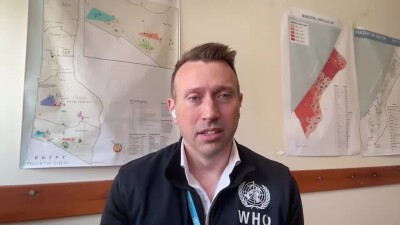
Speaking from Jerusalem, Dr. Rik Peeperkorn, WHO’s Representative for the occupied Palestinian territory, said that “the shrinking humanitarian space and the lack of access, and we're not just talking about humanitarian supplies into Gaza, but also the humanitarian aid and the work as within Gaza,” hampers that aid can be delivered to people in need wherever they are in the north, in the middle or in southern area.
“As long as there's no ceasefire, humanitarian corridors are required within Gaza to make sure that this can happen,” the WHO official said.
WHO reiterated its call for the active protection of civilians and health care and full adherence to international humanitarian law by all parties to the conflict.
“What we actually see that a constricted flow of supplies and access, but also very important, an evacuation of medical staff from the many hospitals due to fears of safety, they and their family leave,” said Dr. Peeperkorn. "It's a recipe of a disaster and makes the hospitals more nonfunctional. So they've gone from functional, partly functional, barely functional and we witness this in the north.”
Speaking from southern Gaza, Sean Casey, WHO Emergency Medical Teams coordinator said that “we're seeing a humanitarian catastrophe unfold before our eyes here across the Gaza Strip. It's not just that there's 85 per cent of the population that is been displaced. Many of them have been displaced multiple times here in Rafah, where I am. There's shelters, spontaneous shelters everywhere. People are sleeping under tarpaulins, under makeshift tents, in very crowded shelters.”
According to Gaza’s Ministry of Health, 23,084 people have been killed in the enclave of whom killed 70 per cent were women and children. Nearly 59,000 people have also been injured, which is approximately 2.7 per cent of Gaza’s population.
Mr. Casey reported that “patients and their families are risking their lives to just seek care. And so these numbers that represented the 22,000 plus who have been killed, the 58,000 who were injured, many of them are treatable if they have access to care, they have injuries that are treatable. They have limbs that unfortunately are being amputated because they don't have access to surgery.”
In response to a journalist question whether the hostilities have decreased during the last days, Mr. Casey said that “the emergency departments are still seeing a steady stream of trauma […] among children who are playing in the streets, among people who are in their homes. So from our side, we are still seeing and - I can say this with certainty - a huge number of casualties and a huge number of casualties related to hostilities.” He added that “shrapnel injuries, gunshot wounds, crush injuries from buildings of the collapse, that's still happening every single day.”
WHO is particularly concerned about three hospitals located near evacuation zones – European Gaza Hospital, Nasser Medical Complex and Al-Aqsa – all three present a “lifeline” in the south for about two million people.
Since 26 December a total of six planned WHO humanitarian missions have had to be canceled, according to the WHO official.
“We plan missions almost every day to go to the middle area and to the north and we continuously struggle to get those missions cleared. And that has a huge consequence”, said Mr. Casey. “It means that hospitals don't have fuel. It means that patients don't have food. It means that there aren't supplies to care for the patients.”
Since two weeks the WHO has not been able to move humanitarian supplies to some of the most desperate hospitals in the north. “We continue to supply the south. But as I said, the few hospitals that are remaining are really bursting. They're bursting with patients, they're bursting with IDPs.”
-ends-
STORY: Update health situation Gaza – WHO
TRT: 3:29”
SOURCE: UNTV CH
LANGUAGE: ENGLISH
ASPECT RATIO: 16:9
DATELINE: 9 January 2024 - GENEVA, SWITZERLAND
SHOTLIST
- Exterior wide shot: UN building with UN flag with snow, UN Geneva.
- Cutaway: Medium shot UN entrance at Place des Nations
- SOUNDBITE (ENGLISH) – Dr. Rik Peeperkorn, WHO representative in the Occupied Palestinian Territory: “First of all, the shrinking humanitarian space and the lack of access, and we're not just talking about humanitarian supplies into Gaza, but also the humanitarian aid and the work as within Gaza, so that that aid can be delivered to people in need wherever they are in the north, in the middle or in southern area. And if there is, as long as there's no cease fire, the humanitarian corridors are required within Gaza to make sure that this can happen.”
- Cutaway: Medium shot, UN Geneva flag alley with snow
- SOUNDBITE (ENGLISH) - Dr. Rik Peeperkorn, WHO representative in the Occupied Palestinian Territory: “So what we actually see that a constricted flow of supplies and access, but also very important, an evacuation of medical staff from the many hospitals due to fears of safety, they and their family leave. It's a recipe of further disaster and makes the hospital more nonfunctional. So they've gone from functional, partly functional, barely functional. And we witness this in the north and we want to appeal again also to the international community.”
- Cutaway: Wide shot, UN flag with snow
- SOUNDBITE (ENGLISH) – Sean Casey, WHO Emergency Medical Teams coordinator: “We're seeing a humanitarian catastrophe unfold before our eyes here across the Gaza Strip. It's not just that there's 85% of the population that is been displaced. Many of them have been displaced multiple times. Here in Rafah where I am there's shelters, spontaneous shelters everywhere. People are sleeping under tarpaulins, under makeshift tents, in very crowded shelters.”
- Cutaway: Wide shot, UN building with flags under snow
- SOUNDBITE (ENGLISH) – Sean Casey, WHO Emergency Medical Teams coordinator: “Patients and their families are risking their lives to just seek care. And so these numbers that represented the 22,000 plus who have been killed, the 58,000 who were injured, many of them are treatable if have access to care, they have injuries that are treatable. They have limbs that unfortunately are being amputated because they don't have access to surgery.”
- Cutaway: Wide shot, UN building with flag alley under snow
- SOUNDBITE (ENGLISH) – Sean Casey, WHO Emergency Medical Teams coordinator: “Over the last few weeks, the emergency departments are still seeing a steady stream of trauma, a steady stream of trauma among children who are playing in the streets, among people who are in their homes. So from our side, it's difficult to see that. We are still seeing and I can say this with certainty, is a huge number of casualties and a huge number of casualties related to hostilities. So shrapnel injuries, gunshot wounds, crush injuries from buildings that have collapsed, that's still happening every single day.”
- Cutaway: Wide shot, UN building with flag alley under snow
- SOUNDBITE (ENGLISH) – Sean Casey, WHO Emergency Medical Teams coordinator: “We plan missions almost every day to go to the middle area and to the north. And we continuously struggle to get those missions cleared. And that has a huge consequence. It means that hospitals don't have fuel. It means that patients don't have food. It means that there aren't supplies to care for the patients. And so that's two weeks of not being able to move to some of these most desperate situations, most desperate hospitals in the north. And we continue to supply the south. But as I said, the few hospitals that are remaining are really bursting. They're bursting with patients, they're bursting with IDPs.”
- Cutaway: Wide shot, UN building with flag alley under snow, pedestrian walking
- Cutaway: Close up, UN building with flag alley under snow
Similar Stories

1
1
1
Edited News | UNICEF
A little over one year since a ceasefire agreement was announced between Hamas fighters and Israel, more than 340 children have been reported killed and hundreds more injured, the UN Children’s Fund, UNICEF, said on Friday.

1
1
1
Edited News | UNICEF , IFRC
Six weeks after Nepal’s deadly flooding disaster, communities are still struggling to rebuild their lives, but they will need sustained help as global warming increases the risk of another Himalayan catastrophe, the UN Children’s Fund (UNICEF) said on Friday.

1
1
1
Edited News | WHO
In suspected Russia plague death, testing and monitoring underway – WHO
The death of a lab worker in Russia’s Siberia region has sparked concerns about plague being the cause, the UN World Health Organization (WHO) said on Tuesday, adding that it was following the situation closely.

1
1
Edited News | OHCHR , UNOG
UN Human Rights Chief Volker Türk on Friday provided and oral update to the 63rd session of the Human rights Council on Ukraine.

1
1
1
Edited News | OHCHR , UNOG
UN Human Rights Chief Volker Türk on Friday provided and oral update to the 63rd session of the Human rights Council on the human rights situation in Haiti.

1
1
1
Edited News | WHO
Repeated delays in bringing lifesaving medicines, prosthetics and more from Israel into Gaza risk having devastating consequences on Palestinians who urgently need them in the wartorn enclave, the UN World Health Organization (WHO) said on Friday. “A truck full of non-priority supplies or the right supplies arriving too late, doesn't save lives. That's the question that actually matters," said Dr Reinhilde Van De Weerdt, WHO Representative in the OPT.

1
1
1
Edited News | WHO
DRC: Early access to care and oxygen decisive for Ebola patients’ survival – WHO
In the Democratic Republic of the Congo (DRC), health workers fighting the country’s largest-ever Ebola outbreak are struggling to overcome critical challenges to patient care, the UN World Health Organization (WHO) warned on Tuesday.

1
1
1
Edited News | OCHA , UN
Civilians in Iran are continuing to feel the consequences of months of conflict and military escalation, the UN’s top official in the country has said, as loss of life, damage to civilian infrastructure and mounting economic pressures leave many facing continued uncertainty.
1
1
1
Edited News | WHO , UNICEF
Aid agencies in Yemen highlighted the growing hunger emergency sparked by renewed fighting between Houthi opposition forces and Government troops, after mobile health clinics reported that hundreds of children displaced by the violence are suffering from the most deadly form of malnutrition.
1
1
1
Edited News | UNHCR
Displacement on the rise in Yemen as fighting continues - UNHCR
As hostilities worsen in Yemen, more people have been fleeing their homes, further intensifying the humanitarian crisis within the region, the UN Refugee Agency (UNHCR) warned on Tuesday.
1
1
1
Edited News | IOM , OHCHR , UNFPA , UNOG , UNHCR , WHO
Yemen’s humanitarian crisis growing by the hour amid spike in displacement
Yemenis displaced by renewed fighting have described fleeing for their lives amid shelling and gunfire, aid agencies reported on Friday, while highlighting the dramatic increase in humanitarian needs in the country and in Djibouti, where thousands have sought shelter.
1
1
1
Edited News | OHCHR , UNOG
The UN Human Rights Office issued on Friday a report documenting a shocking pattern of sexual violence amid Russia’s full-scale armed attack on Ukraine.