

The United Nations Office at Geneva
Multimedia Newsroom
The UN health agency announced today (16 January) at the launch of the latest Global tobacco trends report that the total number of adult tobacco users worldwide has decreased.
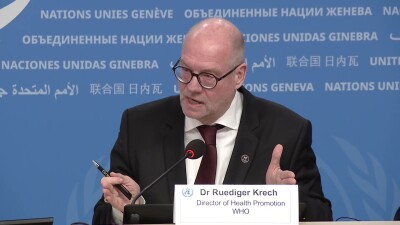
“The good news is that we have 1.25 billion people still smoking. That is the last figure we have from the Global trends report that we're releasing today,” said Dr. Rüdiger Krech, Director of Health Promotion at the World Health Organization (WHO) during the report launch at the UN in Geneva. “But that also means that we have 19 million less smokers than we had two years ago. That is the first time that we see such a decline.”
This trend shows a continued decline in tobacco use rates globally, with about one in five adults worldwide consuming tobacco in 2022, down from one in three in 2000.
Currently, the fastest decreases in tobacco use are happening in the lower middle-income group of countries whereas the highest prevalence of tobacco users is in the WHO South-East Asian region, however with fast falling rates.
The WHO region which currently has the lowest tobacco use prevalence is the African Region, which has already decreased from an average of 18 per cent in 2000 to under 10 per cent in 2022.
According to Dr. Krech, “the region that is a bit of a problem is the European region where especially women are […] on the increase in some parts, in some countries, or at very high levels still of tobacco users.”
WHO urges countries to continue putting in place tobacco control policies and continue to fight against tobacco industry interference.
The report estimates that there are at least 37 million children aged 13-15 currently using some form of tobacco, and many countries have found alarming levels of e-cigarette use among adolescents as well. There is a clear need for policies that restrict advertising to young people, restrict access and reduce exposure to tobacco and nicotine products.
“There's a few countries who have banned e-cigarettes, which we welcome,” said Dr. Krech. “If you have not banned it, you should take very strong regulatory measures, meaning that you need to ensure that children do not get access to e-cigarettes.”
He added that “children as young as eight years old […] actually use e-cigarettes or vape. This is, I believe, criminal, but they do. And in many countries these use of e-cigarettes and vaping are not yet regulated.”
Dr. Krech mentioned that “we have teachers calling us, especially in the UK, where you saw a 150 per cent increase in the last three years of uptake of e-cigarettes by children. So, they call us to say children cannot stay a whole 45-minute lesson anymore because they need to step out to get e-cigarettes.”
Since most of the e-cigarettes and vapes are purchased through internet, it would be important, according to the WHO, to ensure that these devices are no longer available to children.
All the different kind of flavors offered for vaping are more attractive to children and less to older adults. “You have thousands of flavors, each of these flavors contain different chemicals,” said WHO’s Dr. Krech. “So the toxicity of these liquids, if you inhale them, if you're not swallowing them, but you inhale them, is completely different. So, the tactics of the tobacco industry is to swamp the market.”
For those who use vaping to quit smoking, it should be regulated as medicine where you get it through a pharmacy with a prescription for it, said Dr. Krech.
-ends-
STORY: WHO Global tobacco trends report
TRT: 3:13”
SOURCE: UNTV CH
RESTRICTIONS: NONE
LANGUAGE: ENGLISH / NATS
ASPECT RATIO: 16:9
DATELINE: 16 January 2024 GENEVA, SWITZERLAND
- Exterior medium shot: UN flag alley
- Wide shot: speakers at the press conference
- SOUNDBITE (English) – Dr. Rüdiger Krech, Director of Health Promotion WHO: “The good news is that we have 1.25 billion people still smoking. That is the last figure we have from the Global trends report that we're releasing today. But that also means that we have 19 million less smokers than we had two years ago. That is the first time that we see such a decline.”
- Wide shot: press room with journalists and speakers at the podium
- SOUNDBITE (English) – Dr. Rüdiger Krech, Director of Health Promotion WHO: “There's a few countries who have banned e-cigarettes, which we welcome. If you have not banned it, you should take very strong regulatory measures, meaning that you need to ensure that children do not get access to e-cigarettes.”
- Medium shot: press room with journalists and speakers at the podium
- SOUNDBITE (English) – Dr. Rüdiger Krech, Director of Health Promotion WHO: “We have seen this for instance in what they call novel products on e-cigarettes and vaping, where they actually try to get our children as young as eight years old to actually use e-cigarettes or vapers. This is, I believe, criminal, but they do. And in many countries these use of e-cigarettes and vaping are not yet regulated.”
- Medium shot: press room with journalists
- SOUNDBITE (English) – Dr. Rüdiger Krech, Director of Health Promotion WHO: “The region that is a bit of a problem is the European region where especially women are, you know, on the increase in some parts, in some countries, or at very high levels still of tobacco users.”
- Wide shot: press room with journalists and speakers at the podium
- SOUNDBITE (English) – Dr. Rüdiger Krech, Director of Health Promotion WHO: “I find this and I'm not understandable how you could do this, as you know, that you're hooking children to nicotine, which is highly addictive. So, we have teachers calling us, especially in the U.K., where you saw a 150 per cent increase in the last three years of uptake of e-cigarettes by children. So they call us to say children cannot stay a whole 45 minute lesson anymore because they need to step out to get, you know, e-cigarettes.”
- Wide shot: Camera people with conferencing staff
- SOUNDBITE (English) – Dr. Rüdiger Krech, Director of Health Promotion WHO: “You have thousands of flavors. Each of these flavors contain different chemicals. So the toxicity of these liquids, if you inhale them, if you're not swallowing them, but you inhale them, is completely different. So the tactics of the tobacco industry is to swamp the market.”
- Wide shot: press briefing room with journalists
- Wide shot: press briefing room with journalists and speakers at the podium
Similar Stories
1
1
1
Edited News | OCHA , UNICEF
At least six million people in Somalia are going days without enough food, UN aid teams warned on Friday, highlighting that nearly two million of this number are young children “at high risk of illness or death”.
1
1
1
Edited News | UNICEF , WHO
Children shot, stabbed and pepper-sprayed in occupied West Bank; scores of Gaza amputees denied prosthetics, aid teams warn
Israeli military operations and surging settler attacks in the occupied West Bank are killing and maiming Palestinian children, while in Gaza tens of thousands with life-changing injuries lack access to treatment and rehabilitation, UN agencies warned on Tuesday.

1
1
1
Edited News | WHO
The risk of hantavirus spreading to the general population is “absolutely low”, the UN World Health Organization (WHO) stressed on Friday.

1
1
1
Edited News | UNHCR , IFRC
Death and destruction have continued unabated in Lebanon while communities are still unable to return to their homes despite a ceasefire that began on 17 April, humanitarians said on Tuesday.
1
1
Edited News | WHO
Deadly hantavirus on board cruise ship may be transmitted among humans - WHO
Hantavirus victims on a ship in the Atlantic Ocean may have been infected prior to joining the cruise and human-to-human transmission on board cannot be ruled out – although it is rare - the World Health Organization (WHO) said on Tuesday.
1
1
1
Edited News | OHCHR
UN rights chief concerned by upheld convictions of Cambodian activists.
1
1
1
Edited News | UNHCR , OHCHR
Middle East crisis puts aid, food, fuel further out of reach for millions already struggling – UN agencies
As the Middle East crisis continues the humanitarian fallout is worsening, with aid route disruptions and food and fuel price hikes wrecking the lives and rights of the most vulnerable, UN agencies warned on Friday.
1
1
2
Edited News | UNMAS
Demining experts from around the world have been sharing their collective shock at the widespread and growing threat from unexploded ordnance, the new head of the UN Mine Action Service (UNMAS) said on Wednesday.
1
1
1
Edited News | OHCHR , UNOG
The UN Human Rights Office in Syria conducted a 5-day visit to the northeast of the country where they received accounts of human rights violations and abuses.
1
1
1
Edited News | UNICEF
Sudan: ‘History repeating itself’ for Darfur’s children - UNICEF
Mass atrocities in Sudan’s Darfur 20 years ago reverberated as far as Hollywood, but today, a new generation of children faces attacks, hunger and displacement in an emergency largely ignored by the outside world, the UN Children’s Fund (UNICEF) warned on Tuesday.
1
1
Edited News | WHO , UNMAS
Desperate and dangerous conditions in Gaza continue to hamper recovery efforts for the wartorn enclave's people, the UN health agency said on Friday, while demining experts warned that they’ve “barely scratched the surface” in assessing the level of contamination of unexploded ordnance.
2
1
2
Press Conferences , Edited News
The continued support of UN Member States to Lebanon will be “indispensable” to boost the country’s national armed forces and provide humanitarian assistance with more than one million people still uprooted by the Middle East war, the UN's peacekeeping chief said on Wednesday.